
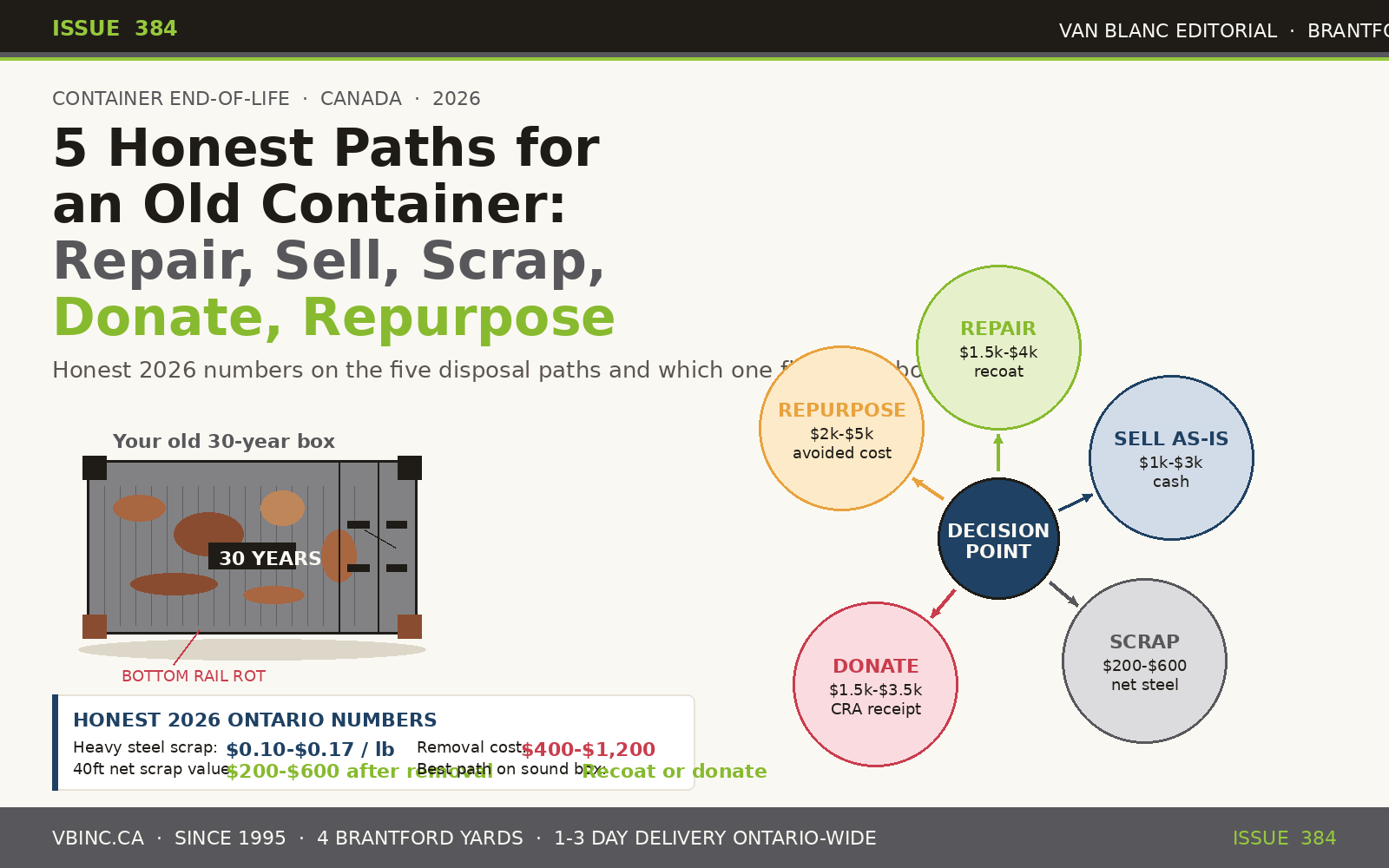
Quick Answer: A retired container that has carried freight under Transport Canada oversight ends its working life as recyclable steel. Container recycling in Canada feeds the Steel Recycling Institute circuit, where a retired box is valued on its net heavy-steel weight. A shipping container at end of life in Canada has five honest paths in 2026: (1) repair and recoat for another 5 years, (2) sell as-is to a buyer who will do the work themselves, (3) scrap the steel, with a 40ft worth more than a 20ft because it carries more metal, (4) donate to a registered charity for a CRA tax receipt at fair market value, or (5) repurpose the box as art, fencing, or building material. The right call depends on rust pattern, location, and removal cost. Family-run since 1995 with COD-honest pricing, call for a same-day quote tailored to your site. The LeBlanc family has run Van Blanc Ent. Inc. since 1995. 140+ verified Google reviews at 4.9 stars, 1-3 day delivery.
In This Guide
- When is a container truly end-of-life?
- Should you repair and recoat?
- Can you sell as-is to a repair buyer?
- What does a scrap yard pay in Ontario?
- Can you donate for a CRA receipt?
- Can you repurpose it as art or fencing?
- What does removal from your site cost?
- Which pays more, resale or scrap?
- How do you decide which path to take?
- FAQs
Reading Time: 13 minutes
When Is a Shipping Container Truly End-of-Life?
A shipping container reaches end of life when one structural failure appears: bottom rail rot through in several places, a cracked or torn ISO corner casting, or a collapsed underfloor. Surface rust, dents, and faded paint are cosmetic and fixable. Only a structural failure retires the box from working storage service.
Most boxes that buyers think are end-of-life are not. A container that looks ugly is not the same as a container that is finished. The honest threshold is structural, not cosmetic.
A 25 to 30 year old corten box with surface rust, fading paint, dented corner posts, and a sagging cargo door is not at end of life. It needs a recoat, hinge rebuild, and new floor section. The industry calls these “as-is” or “cargo-worthy minus” and they have a real Canadian market.
The honest threshold sits at three failure points. A single one is enough to retire the box:
- Bottom rail rot. When the bottom side rails have rusted through in multiple spots, the box has no structural floor frame. Patching is possible but rarely cost-effective.
- Corner casting damage. The eight ISO corner castings are how the box gets lifted, locked, and stacked. Cracked or torn castings cannot be re-welded reliably and the box cannot be moved by twistlock or certified.
- Floor joist collapse. The 19 gauge corrugated steel underfloor and cross-members beneath the marine plywood are the load-bearing skeleton. A full underfloor rebuild costs more than a replacement box.
A box with one of those failures has reached end of life as a shipping container. It can still serve as art, fencing, or scrap, but should not be sold as a working storage unit.
Paul LeBlanc, owner: “Buyers call thinking their box is done because of surface rust. Done is when you put a wrecking bar against the bottom rail and the metal moves like cardboard. Done is when a corner casting has a fatigue crack you can fit a quarter into. Cosmetic ugly and structurally done are two different decisions.”
Should You Repair and Recoat for 5 More Years?
A repair and recoat keeps a sound container in service for another five years. If the box is not at a structural failure point, a repair and spot rust treatment plus full recoat is almost always the highest-value path. A 5 year service extension is worth several thousand dollars of avoided replacement cost. What the job costs depends on scope: the amount of rust to strip, the size of the box, and whether you do the work yourself or contract a coatings crew.
The typical job covers four work items. Surface rust is wire-wheeled or sandblasted back to bright steel. A rust-converting primer neutralises iron oxide chemically. A marine or industrial topcoat is applied in two coats. Any pinhole leaks at panel laps get welded shut or sealed.
Cost ladder for the recoat job in 2026 Ontario:
- DIY recoat, 20ft: the cost is mostly materials (rust converter, primer, two coats of marine or industrial topcoat) plus a long weekend of your own labour.
- DIY recoat, 40ft: the same material list scaled up for the larger surface area, plus three to four days of labour.
- Contracted recoat, 20ft: a mobile coatings crew handling surface prep, primer, and two topcoats, with labour the largest line item.
- Contracted recoat, 40ft: the same scope on a 40ft box, where the extra wall area pushes both materials and crew time higher than the 20ft.
Pair the recoat with a small structural touch-up: a floor patch, fresh door seals, hinge greasing. That bundle keeps the box in honest storage service for another five to seven years, and it postpones the day you have to step up to a fresh factory-built unit.
Why a recoat usually wins on math
Replacing a box means paying for a sound used 40ft from our Brantford yard, plus delivery, plus removal cost on the old box. That is a full turnover of three separate costs. A recoat is roughly half the all-in figure, and the box stays on the existing pad. The recoat wins unless the underfloor is gone.
If the recoat math does not work, or the box has reached one of the three structural failure points, the next question is whether someone else will pay something for it. That is the as-is sale.
Can You Sell a Container As-Is to a Repair Buyer?
An as-is sale puts the box in front of a buyer willing to do the repair work themselves. The Ontario as-is market is real, and three buyer profiles show up consistently.
The first is the farm or rural property buyer who needs a static storage box for hay, equipment, or tools. They do not care about cosmetics and they have a welder. They will pay a fair as-is figure for a 40ft because they can do their own repairs.
The second is the contractor or trade buyer who wants a job-site lockup. They are happy with surface rust if the doors lock and the roof does not leak, so a sound 40ft as-is is worth real money to them.
The third is the artist, architect, or modification buyer who is going to cut the box apart. They pay the most for a 40ft with sound castings, since intact corners are what they need for clean cuts and lifts.
Where to find these buyers in Ontario:
- Facebook Marketplace, with honest photos. Show the rust and damage. Buyers expecting better than the photos walk away.
- Kijiji classifieds. Still the highest-traffic Ontario listing site for used containers in 2026.
- Local container dealers. Some Brantford-area yards, including ours, will buy a structurally sound as-is box.
- Auction houses. Ritchie Bros and IronPlanet handle container lots, though fees bite small lots.
The pricing rule on an as-is sale is to subtract the buyer’s likely repair cost from the working-grade resale price. If a clean used 40ft Wind & Watertight commands a certain figure and the box in front of you needs a recoat and a hinge job, the honest as-is price is that figure minus what those repairs will cost the buyer.
How Much Does a Scrap Yard Pay for a Container in Ontario?
When the box has hit a structural failure point, or the as-is market produced no buyer, the steel-scrap path is next. The honest 2026 Canadian numbers are smaller than most owners expect.
A 20ft container weighs approximately 2,200 kg empty, a 40ft high cube approximately 3,800 kg. Ontario scrap-steel pricing in May 2026 is quoted on a per-pound heavy-steel rate that moves with the global steel market, per ScrapMonster and Schmidt’s Auto Recycling rate cards. Yards pay that heavy-steel rate rather than a special container rate, so the value tracks weight, not the box’s history.
| Container size | Gross weight | Non-steel deducted | Net billable steel | What the yard pays on |
|---|---|---|---|---|
| 20ft standard | ~2,200 kg (4,850 lb) | plywood floor, ~150 kg | ~2,050 kg (4,520 lb) | net steel x heavy-steel rate per lb |
| 20ft after removal | same | same | same | net steel rate, less pickup and any sectioning |
| 40ft high cube | ~3,800 kg (8,380 lb) | plywood floor, 200-300 kg | ~3,550 kg (7,825 lb) | net steel x heavy-steel rate per lb |
| 40ft after removal | same | same | same | net steel rate, less pickup and any sectioning |
The realistic 2026 net to the owner, after the scrap yard takes its cut and the cost of cutting up and trucking the box, is modest in most Ontario markets, with a 40ft netting more than a 20ft simply because it carries more steel. A 40ft on a strong-steel-pricing month, handled by an owner who already has a roll-off truck, can pull noticeably more, but those are outlier conditions rather than the norm.
How the path works:
- Call two or three yards within driving distance. Ask for the heavy-steel rate per pound and whether they accept whole containers or require sectioning.
- If the yard accepts whole boxes, they send a roll-off truck or flatbed with a winch, and they typically charge a pickup fee that comes off your net in Ontario.
- If sectioning is required, cut the box into 8 to 10 panels with a plasma cutter or oxy-acetylene torch. A day’s work for a competent welder.
- Weigh at the yard, settle on net poundage, cheque issued same-day in most cases.
The scrap price is paid on net steel, not gross weight
The yard weighs the box, deducts the marine plywood floor (200-300 kg on a 40ft), and pays on net steel. Plywood, paint flakes, insulation, and contents are deducted from the weight or charged back as per-kg disposal fees. Strip the box before delivery so you are not paying the yard to haul away non-steel.
Scrap is honest income, but the lowest-value disposal option on the menu. Recoat, as-is sale, and donation all typically pay better on a structurally sound box.
Can You Donate a Container for a CRA Tax Receipt?
A registered Canadian charity can issue an official donation receipt for a donated shipping container. The receipt counts toward the charitable donations tax credit on line 34900 of the donor’s return. For an owner who would otherwise net very little at the scrap yard, a fair-market-value donation receipt is a far better tax outcome.
CRA rules on non-cash donations (gifts in kind) are specific. The receipt must show fair market value at the time of the gift, describe the property, and state who determined the fair market value, along with the charity’s registration number, the donor’s name and address, and the donation date.
Fair market value is usually established with a written quote from a container dealer for the same grade and condition, dated within 30 days of donation. For higher-value boxes, a formal written appraisal is used. A typical as-is 40ft donation can rely on a dated dealer quote to support its fair market value.
Canadian charities that have accepted used containers include:
- Habitat for Humanity ReStore. Some local ReStores accept boxes for resale or on-site storage during builds.
- Emergency response and disaster relief charities. Used for shelter and supply program storage.
- Animal rescues and wildlife sanctuaries. Used for feed storage and dog-house conversion.
- Community gardens and food bank operators. Locked weather-tight storage on community properties.
- Faith-based and community building organisations. Storage for fundraiser inventory and program materials.
Verify the recipient is a registered charity using the CRA’s Charities Listings search. Only registered charities and qualified donees can issue receipts CRA will honour.
The donation path in Brantford
Local Brantford-area charities that have accepted container donations include some Habitat for Humanity sites in the broader Hamilton-Niagara region, community garden operators, and horse rescues and dog sanctuaries in Brant County and Norfolk County. The owner picks up delivery cost, the charity issues a receipt for fair market value. We have driven a donated box to a charity site before, charging only fuel, so the charity gets full value without delivery eating their budget.
Can You Repurpose a Container as Art, Fencing, or Building Material?
The final value path is repurposing the steel without leaving the property. A box finished as a shipping container can still serve as an outbuilding, fence, tool wall, or art installation. The steel is a free starting point for a project that would otherwise buy plate steel at retail.
Common repurpose paths we have seen in Ontario:
- Stationary outbuilding on a slab. If the corner castings are gone but the walls, roof, and doors are sound, the box can sit on a concrete pad as a permanent shed, garden room, or workshop.
- Fence sections. A 40ft wall sectioned into four panels of 10ft each becomes 8ft tall steel fence sections for a commercial yard.
- Roof sections for sheds and animal shelters. The corrugated steel roof of a 40ft is roughly 320 square feet of weather-grade roofing.
- Art and signage. Several Brant County artists have sourced corten panels from finished containers for sculpture, planters, and outdoor signage, the same raw material behind the built-out container projects we see come through the yard.
- Garden raised beds. Cut down to 18-30 inch height, the wall panels become galvanised-look raised garden beds, paint-side out.
The repurpose path requires labour and a torch or plasma cutter, but the steel is free. Owners who repurpose also avoid the removal cost entirely, since the box stays on the property.
What Does It Cost to Remove a Container From Your Site?
Removal cost surprises owners and changes the math on every disposal path. What a 40ft costs to leave an Ontario site in 2026 typically depends on three factors: site access, distance, and whether sectioning is required.
Site access matters most. A box with clear truck access, a flat dry approach, and 60 feet of swing room for a tilt-deck trailer is the cheapest pickup. A box behind a building or down a long lane runs higher because the truck needs more time and sometimes a crane assist.
Distance is the second factor. Brantford-Hamilton-Cambridge pickups are cheapest. Long-haul from Eastern Ontario, Northern Ontario, or cottage country lands at the higher end for a 40ft because of the added truck time and fuel.
The third factor is sectioning. Yards that accept whole boxes do not require cutting. Yards that require sectioned panels add a full day with a torch and the labour that goes with it.
Removal cost flips the scrap math
The gross scrap value of a 40ft is set by its net steel weight times the heavy-steel rate. After the removal cost and any sectioning fees come off, the net to the owner shrinks sharply, often to a fraction of the gross. This is why the as-is sale, the donation receipt, and the repurpose path almost always beat scrap value on the structural-sound boxes. The owner only pays removal once on as-is and donation paths if the buyer or charity picks up, and never pays removal on a repurpose-in-place project.
Ready to price your container?
Tell us the size and your postal code and we’ll send back an honest, all-in number, container, delivery, and placement, usually within 1-3 days. No pressure, no mystery fees.
Family-run in Brantford since 1995 · 200+ containers in stock · 4.9★ across 140+ Google reviews · every box graded by a person, walk it before it lands.
Which Disposal Path Pays the Most: Resale or Scrap?
The five paths produce wildly different net returns. Here is the honest 2026 Ontario comparison for a typical 25-year-old 40ft high cube with surface rust and minor dents but sound corner castings and bottom rails:
| Path | Owner’s labour | Cash outlay | Relative net to owner |
|---|---|---|---|
| Repair and recoat, keep in service | Low (contract out) | Recoat materials and crew | Highest: avoids the full replacement cost |
| As-is sale to repair-it-themselves buyer | Listing time only | None | High: positive cash, no outlay |
| Charity donation with CRA receipt | Delivery coordination | Delivery only | High: fair-market-value tax credit |
| Repurpose on-site as outbuilding | Moderate to high | Materials only | High: avoids new-build cost and removal |
| Scrap yard for steel value | Low to moderate | Removal and sectioning | Lowest: net shrinks after costs come off |
Scrap is the lowest-value path for a box with structural soundness left in it. Owners who reach for scrap without trying recoat, as-is, or donation leave meaningful money on the table. Scrap is the right path only when the structural failure points have been hit, the as-is market has been tested with no buyer, and donation has been declined.
How Do You Decide Which Disposal Path to Take?
Walk the box and answer four questions in order:
One: Are the corner castings, bottom rails, and underfloor structurally sound? If yes, the box is not at end of life. Recoat or sell as-is.
Two: Will the box stay on this property for repurpose? If yes, repurpose-on-site is almost always the highest value because it avoids removal cost entirely.
Three: Is there a registered charity in the area that needs static storage? If yes, a CRA donation receipt typically beats scrap value on the same box.
Four: Has the as-is market been tested at a realistic price for two to four weeks? Most structurally sound boxes sell within a month at an honest price. If no buyer materialised, scrap is the final path.
This sequence is how we walk customers through the decision, and how we evaluate boxes we are considering for our own yard.
Paul LeBlanc, owner: “Every scrap-yard call I get, I ask if the owner has walked the box with someone who knows what to look for. Half the time the box has another five years in it. The other half it is genuinely done. Owners who scrap a sound box lose two or three thousand dollars they did not have to lose.”
Frequently Asked Questions
How much is an old shipping container worth as scrap in Canada in 2026?
Scrap value is set by the box’s net steel weight times the current Ontario heavy-steel rate per pound, which moves with the global steel market. A 20ft carries roughly 2,050 kg of net steel and a 40ft high cube roughly 3,550 kg, so the 40ft is always worth more as scrap. Removal and sectioning costs come off that gross, often leaving only a fraction as the net to the owner. Strong-steel-pricing months and an owner who already has trucking access push the net higher, but those are outlier conditions.
When is a container actually at end of life?
A container is at honest end of life when one of three structural failures has occurred: bottom rail rot through in multiple spots, cracked or torn ISO corner castings, or floor joist and underfloor collapse from rust. Surface rust, dents, and fading paint are cosmetic and respond to a recoat. Only the structural failures retire the box.
Can I get a tax receipt for donating my shipping container to charity?
Yes, if the recipient is a registered Canadian charity. The charity issues an official donation receipt at the fair market value of the box at the time of donation, and the receipt counts toward the federal and provincial charitable donations tax credit on line 34900 of the donor’s return. Fair market value is typically established with a written quote from a container dealer dated within 30 days of donation, or a formal appraisal for higher-value boxes.
What is the most valuable disposal option for an old shipping container?
For a structurally sound but cosmetically rough box, repair and recoat usually wins because it avoids the replacement cost. For a box that is genuinely finished as a shipping container, repurpose-on-site as an outbuilding or fence often wins because it avoids the removal cost. Scrap value is the lowest-net path on every box with usable structure left in it.
How much does it cost to remove a container from my property?
Removal cost for a 40ft in 2026 Ontario depends on three things: site access, distance, and whether sectioning is required. Brantford-Hamilton-Cambridge pickups are cheapest. Long-haul from Eastern Ontario, Northern Ontario, or cottage country lands at the higher end because of the added truck time and fuel. Sectioning adds a full day of labour if the scrap yard requires the box cut into panels.
Will a scrap yard pick up a whole container or do I have to cut it up?
Both arrangements exist in Ontario. Some yards send a roll-off truck or flatbed with a winch to pick up whole boxes for a pickup fee. Other yards require the box cut into 8 to 10 panels using a plasma cutter or oxy-acetylene torch, which adds a day of labour. Call two or three yards within driving distance and ask both questions: heavy-steel rate per pound and whole versus sectioned delivery.
Can I sell my old container on Kijiji or Facebook Marketplace?
Yes, and it is one of the highest-value disposal paths for an as-is box. Honest photos showing rust, dents, and door condition are essential, because the listing that looks far better than the box that shows up is the one buyers learn to distrust. Pricing rule: subtract the buyer’s likely repair cost from the working-grade replacement price. So an as-is 40ft that needs a recoat and a hinge job should be listed below a clean used 40ft by roughly what those repairs will cost the buyer.
Are shipping containers actually recyclable?
Yes. The corten steel that makes up roughly 95 percent of a shipping container’s mass is fully recyclable through any heavy-steel scrap yard. The marine plywood floor and any added insulation or finish materials are deducted from the gross steel weight at the yard. Most retired containers recirculate through repair, as-is sale, repurpose, or scrap rather than landfill.
What happens to a container if it is not disposed of properly?
An abandoned container becomes a municipal and environmental issue. Rust runoff carries iron oxide into the soil over years. Some municipalities issue property-standards orders requiring removal at the owner’s cost, which runs higher than planned disposal. Handling disposal proactively, even at scrap value, costs less than forced removal under municipal order.
Does Van Blanc buy back old containers in Brantford?
We will look at any structurally sound used container within a reasonable drive of Brantford. Pricing depends on grade, age, door condition, and current inventory needs. Send photos of all four exterior walls, both interior end walls, cargo doors open and closed, the underfloor, and the corner castings. We give an honest as-is quote and never pretend a finished box is worth more than scrap.
Sources
- ScrapMonster. (2026). Scrap Metal Prices in Ontario, Canada. scrapmonster.com
- Schmidt’s Auto Recycling. (2026). Current Scrap Steel Prices in Canada. schmidtsautorecycling.ca
- Canada Revenue Agency. (2025). Line 34900 – Donations and gifts. canada.ca/en/revenue-agency
- Canada Revenue Agency. (2025). What information must be on an official donation receipt from a registered charity?. canada.ca/charities-giving
- Sigma Container Corporation. (2025). The Life Cycle of a Shipping Container Explained. sigmacontainer.ca
- Universal Containers. (2025). How to Dispose of Your Old Shipping Container. universal-containers.com
- ST Containers. (2025). How Much Is a Shipping Container Worth as Scrap?. st-containers.com
Reach Van Blanc in Brantford
We have been buying, refurbishing, and supplying shipping containers across Ontario since 1995. If your box has reached a decision point, we will walk it with you honestly and tell you which of the five paths makes sense. We do not pretend a finished box is worth more than scrap, and we do not steer you toward replacement when a recoat will give you five more years.
Van Blanc Ent. Inc. · 90 Morton Ave E Unit 1B, Brantford, ON N3R 7J7 · 519-754-6844 or toll-free 1-888-509-6658
Worth the drive for unbeatable quality and family customer service with 30 years of experience. Send photos and we will tell you what we see, on the phone, same day.