
Quick Answer: Cargo Doors Or A Roll-Up Door?
Per CSA SPE-1000-13. Keep your factory cargo doors if security and weather seal are the priority. The double-swing cargo doors at the end of every ISO container were engineered to survive ocean crossings, lock with four vertical bars and eight cam-and-keeper points, and accept a hardened lock-box that resists bolt cutters. Add a roll-up door (cut into a sidewall or the opposite end) when you open the unit several times a day, when you load with a forklift or pallet jack, or when swing-out clearance is tight. The honest tradeoff is real: cargo doors give you the strongest seal and the strongest lock; a roll-up door gives you fast convenient access and slightly less weather protection. A common Ontario answer for sites that need both is the hybrid: keep one cargo-door end factory-original and cut a roll-up into the other end or the long sidewall. Van Blanc holds 200 plus units across our four Brantford yards, ships in 1 to 3 days, and you walk the row and pick the exact unit before any money moves. Call 519-754-6844 for a quote.
This guide is for an Ontario buyer who has narrowed the container decision down to one specific question. Do I run the unit as it left the factory, with its two big swing doors at one end and steel walls everywhere else? Or do I pay a fabricator to cut a roll-up door into a sidewall or the back wall and gain a second access point? (We do that cut at the Brantford yard; the finished roll-up door unit is on its own page.) Either answer can be right. Picking the wrong one costs you in two different ways. Keep cargo doors when you should have added a roll-up, and you fight the swing of two heavy double doors every morning for ten years. Cut a roll-up when you should have stayed factory, and you trade a sea-tested weather seal for a coil-spring door that needs maintenance and never reaches the same security level.
Van Blanc has been in the container trade in southern Ontario for roughly twenty years and the company has been running in Brantford since 1995. Christian LeBlanc is second-generation on the yard and walks the row with most buyers who are weighing this question.
Cargo Doors: What The Factory Actually Built
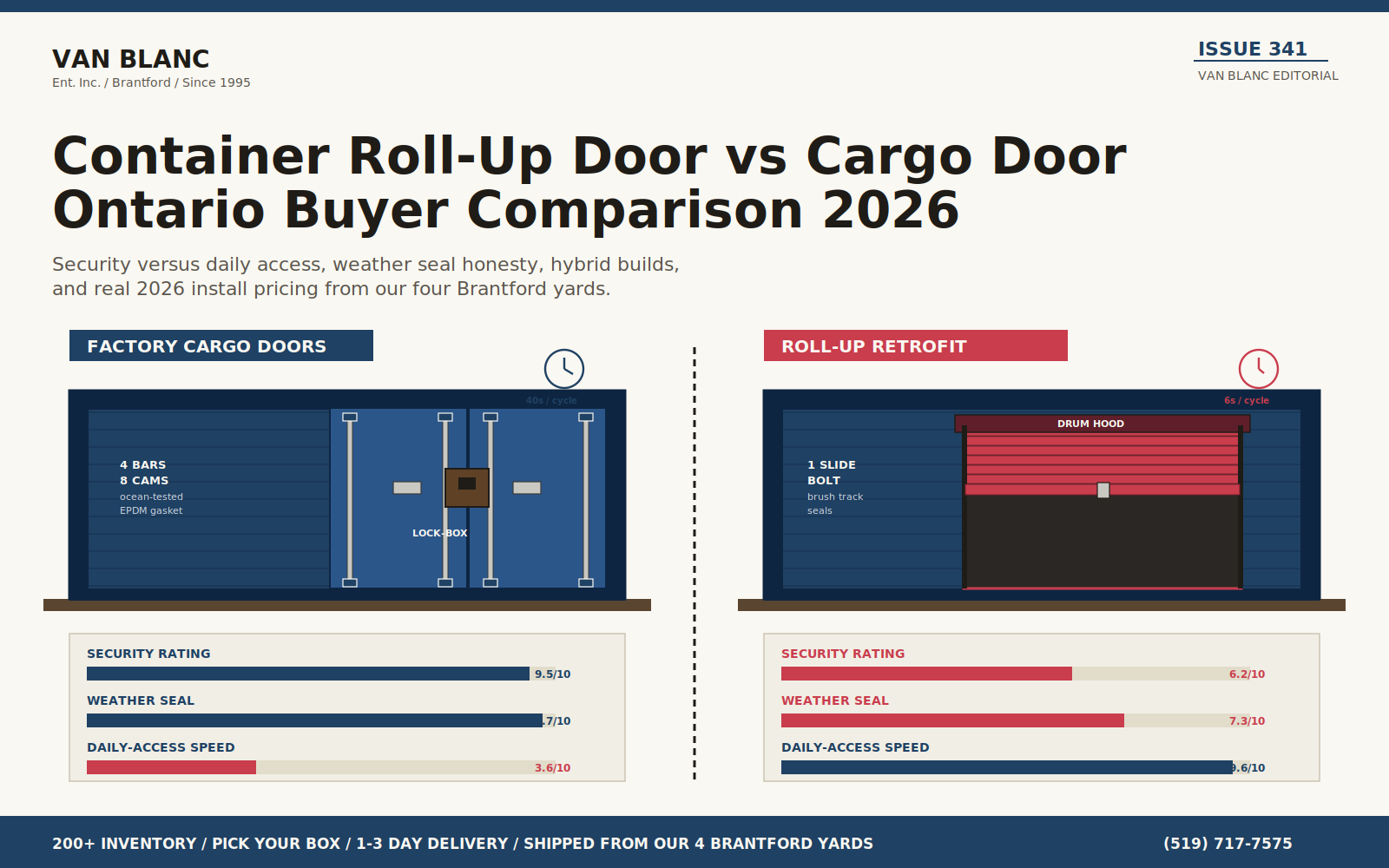
Every standard ISO shipping container leaves the factory with a set of cargo doors at one end (the door-end). The doors are a pair of double-swing steel panels, each roughly 1.13 metres wide, hinged at the corner posts, sealed with a continuous EPDM rubber gasket around the full perimeter, and locked with four vertical locking bars. Each bar carries two cams (one top, one bottom). Turning the handle rotates the bar, which rotates the cams into matching cam keepers welded to the container frame. The eight cam-keeper engagement points pull the door tight against the gasket and resist forced entry.

Cargo doors were engineered for the worst handling environment the cargo industry could throw at them: stacked nine high on a container ship, sprayed with North Atlantic salt water for fourteen days, dropped onto rail flats, hammered by intermodal vibration, then dropped again at a port. The factory doors survive that and arrive at a Brantford yard still water-tight. You inherit that engineering for the life of the container.
The other side is the swing. A cargo door at full open swings 270 degrees flat against the side of the container. Opening both doors gives you the entire end as an opening (about 2.34 metres wide by 2.29 metres tall). That is generous for a forklift, a pallet jack carrying a 1.2 metre skid, a UTV, or a pair of riding mowers side by side. The cost is swing clearance: you need clear ground in front of the door-end and you walk each door open and closed every access.
The Security Advantage Of Cargo Doors
The eight cam-and-keeper engagement points do something a residential garage door cannot. They pull the door tight against the gasket from inside the frame, behind the steel face, where a thief cannot reach them. Factory cargo doors also accept a welded-on lock-box that covers the padlock body. A properly installed lock-box leaves only the shackle exposed, shielded by hardened steel that resists bolt cutters and angle grinders long enough that an opportunistic thief moves on. Ontario insurance underwriters rate factory cargo doors plus lock-box as the strongest configuration short of a custom safe-room build.
Christian LeBlanc, second-generation operator: “The buyers who ask me about security on a container almost always end up keeping factory cargo doors. I have walked the row with police officers, with security firms, with insurance adjusters. The conversation always lands the same way. The factory bars, the cams, the keepers, the gasket, and a real lock-box are a stronger setup than any roll-up door we can retrofit. If the contents matter (tools, ATVs, dirt bikes, restaurant inventory, contractor stock), keep cargo doors and add a lock-box.”
A roll-up door, by contrast, is a coil of interlocking slats running in side tracks tensioned by a torsion spring above the opening. The lock is a slide-bolt or T-handle at the bottom slat. There is no equivalent to eight cam-and-keeper points pulling the door into a gasket. A determined thief with a grinder can attack a roll-up at the bottom track or centre lock and be inside in less time than the same thief can defeat a lock-box-protected cargo door. See our container security and lock guide for hardware specifics.
Roll-Up Doors: When They Make Sense
None of the security math above means you should never cut a roll-up door. There are buyers who open their unit twenty times a day, and for them the cargo-door swing is daily friction. A roll-up changes the math. The most common situations where a roll-up earns its keep:
- Daily-access tool storage on a busy contractor yard. A GC pulling tools four to ten times a day stops fighting the swing. Roll-up opens in three to five seconds with one hand.
- Self-storage rental units. Tenants want quick predictable access. A roll-up with a single-key handle outperforms cargo doors plus a padlock for repeat users.
- Forklift or pallet-jack staging. The operator does not want to climb down from the forklift to swing cargo doors every cycle.
- Tight swing clearance. A property line, a parked vehicle, or a wall built two metres from the door-end can make a 1.5 metre swing arc impractical.
- Drive-through setups. Two containers end-to-end with roll-up doors at the joined wall give a continuous workshop tunnel for a forklift.
- Side-access on a long sidewall. A sidewall roll-up turns a 40ft container into two access zones (tools at the door-end, parts at the sidewall).
For full coverage of roll-up options see our shipping container roll-up doors Ontario cluster guide. The question at the yard is whether you are an everyday-access buyer or a once-a-week buyer.
Roll-Up Door Install: What The Fabricator Actually Does
A roll-up door retrofit is a real metal-work job, not a bolt-on add. The work involves four steps and a competent steel fabricator who has done it before should turn the job in one to two days at our yard or at the buyer property. The process:
- Layout and cut. The fabricator marks the door rough-opening on the sidewall or the back wall. Standard roll-up dimensions are 6 by 6 feet, 7 by 7 feet, or 8 by 8 feet, with 8 by 7 also common for forklift use. The corrugated steel is plasma-cut or torch-cut to the marked opening.
- Frame the opening. Container sidewalls and end walls carry structural load through the corrugations. Cutting a door-sized hole removes load path. The fabricator welds a structural steel frame (typically 4 inch by 4 inch tube or angle) around the opening to restore stiffness. Without proper framing the container racks under its own weight or under lift loads.
- Mount the door unit. The roll-up door assembly (drum, slat curtain, side tracks, hood, hardware) bolts to the framed opening. The drum sits above the opening inside the container, which loses some interior headroom (typically 30 centimetres at the door zone).
- Seal and paint. The cut edges are primed, the new frame is painted to match, and a fresh perimeter gasket is bedded under the door assembly. A good fabricator leaves the install looking factory-clean.
Not every roll-up retrofit you see is competently done. We have refused units traded in to our yard with poor installs: unframed openings, unsealed cut edges, drums mounted out of square that bind the slats. When buyers want to source a used roll-up retrofit from a private seller, we tell them to bring the unit to our yard for inspection before paying. For broader customization context see our customizing containers guide.
Weather Seal: An Honest Side-By-Side
This is the comparison most marketing pages soften. Factory cargo doors with intact EPDM gasket and properly cammed bars produce a seal validated by twenty days of North Atlantic ocean crossings. The seal resists wind-driven rain, snow infiltration, and Ontario winter freeze-thaw for the gasket lifespan (typically eight to fifteen years before the rubber hardens). A well-maintained cargo seal keeps the interior dry through ice storms, lake-effect snow events, and summer thunderstorms equally well.
A roll-up door sealed with side-track brush seals and a bottom-slat foam seal is good. It is not as good. The honest descriptions we use at the yard:
- Wind-driven rain at the side tracks. Roll-up brush seals leak in horizontal rain (wind over 40 km/h hitting the door face). The leak is small and intermittent but it is real.
- Snow infiltration at the bottom slat. Drifted snow that piles against the bottom of the door works its way past the foam seal during freeze-thaw cycles. A few centimetres of snow inside the door zone is common after a heavy lake-effect event.
- Air infiltration at the hood. The hood that houses the coiled drum is not airtight. In high wind the unit moves more air than a sealed cargo-door end does.
- Long-term gasket life. Roll-up door seals are exposed to weather every cycle and replaced more often than cargo door gaskets, typically every five to seven years.
None of this rules out a roll-up door for outdoor storage. It does mean that if you are storing moisture-sensitive equipment (electronics, paper records, fabric inventory, leather goods, dry food), keep cargo doors or pair a roll-up door with closed-cell spray foam interior insulation that breaks the dew point at the wall surface rather than at the door surface.
Daily-Access Convenience: Where Roll-Up Wins Clean
For the buyer who opens the container many times a day, the roll-up case is not really debatable. A cargo door cycle (lift handle locks, swing the right door 90 to 270 degrees, swing the left door, walk in, walk back out, close both doors in sequence, set the locks) runs thirty to forty-five seconds even for a quick operator. Across ten daily access events that is five to seven minutes a day, twenty to twenty-five hours a year, just on doors.
A roll-up cycle (release handle, pull the slat up, walk in, walk back out, pull the slat down, set the lock) runs five to eight seconds. Across the same ten access events that is one to two minutes a day, three to five hours a year. The difference is two to three working weeks of operator labour saved annually.
Christian LeBlanc, second-generation operator: “I tell daily-access buyers to count their cycles. If you open the container ten or more times a day, the roll-up earns its install cost back inside the first season just in time saved. The number nobody can argue with is the cycle count.”
The Hybrid: One Wall Cargo, One Wall Roll-Up
For buyers who genuinely need both (secure long-term storage and daily-access workshop), the answer is not picking one door type for the whole container. Run both. The hybrid we install most often on 40ft units at our Brantford yards:
- Keep factory cargo doors at one end. Add a hardened lock-box and high-security padlock. This end is secure long-term storage (tools that live in the box, spare inventory, seasonal gear).
- Cut a roll-up door into the opposite end wall. The roll-up handles daily workshop traffic. Tool walls, workbenches, and parts walls live in the half closest to the roll-up.
- Or cut the roll-up into one long sidewall. This works better when the container sits with one long wall facing the active yard.
- Add a personnel man-door near the roll-up. A small steel man-door with a deadbolt lets one worker pop in for a hand tool without rolling the roll-up.
The hybrid costs more than either single-door configuration. For personnel access options see our container man-door guide.
What Drives The Cost Of A Roll-Up Install
Roll-up retrofit pricing is not a flat sticker. It moves with a handful of factors, and a phone quote against your exact spec is always the real number. The table below shows which choices push an install quote up or down and why, so you can read your own job before you call:

| Cost driver | How it moves the quote and why |
|---|---|
| Door opening size (6×6, 7×7, 8×7, 8×8) | Up with size: a larger opening means more corrugated steel cut out, a longer structural frame to weld, and a wider, heavier door curtain. An 8 by 8 carries the most material and labour of the common sizes. |
| Forklift-friendly width (8×7) | Up modestly versus a square 7×7: the wider clear opening sized for a forklift mast adds curtain width and framing length. |
| Manual versus motorized | Up with motorization: a chain hoist or electric operator adds the drive hardware, wiring, and setup labour on top of the base manual install. |
| Structural framing quality | Holds the floor on price: a proper 4 by 4 inch tube or angle frame welded around the full opening is non-negotiable for strength, so a quote that looks cheap because it skips framing is the wrong quote. |
| Lock-box on factory cargo doors | Small add: a hardened welded lock-box is a modest line item next to a full roll-up cut, and it is the cheapest security upgrade per dollar. |
| Personnel man-door (3 by 6.5 foot) | Mid add: a framed steel man-door with a deadbolt is less work than a roll-up but still a cut-and-frame job. |
| Hybrid build (cargo end plus opposite-end roll-up plus man-door) | Highest: it stacks a full roll-up cut, a man-door cut, and two framed openings into one container, so it sits above any single-door configuration. |
| Current steel market and season | Up or down with the market: framing steel and curtain stock track the steel price, and shop scheduling in peak season can firm the quote. |
The five-year math we walk through at the yard compares two paths for the same 20ft One-Trip into the Brantford to Hamilton corridor: factory cargo doors with a lock-box, versus that same unit with an 8 by 7 roll-up retrofit framed into the back wall. The roll-up path carries an install premium over the cargo-door-only path. For a contractor opening the box ten times a day that premium pays itself back in saved operator hours inside one season. For a seasonal-storage buyer, the factory cargo doors with a lock-box already carry the job. Match the door choice to the access pattern. See our container pricing in Canada guide for broader context.
Frequently Asked Questions: Cargo Doors vs Roll-Up Doors
Are factory cargo doors more secure than a retrofit roll-up door?
Yes. Factory cargo doors carry four vertical locking bars with eight cam-and-keeper engagement points, accept a hardened welded lock-box that shields the padlock from bolt cutters, and seal against a continuous EPDM gasket validated by ocean crossings. A roll-up door locks at a single slide-bolt or T-handle at the bottom slat and has no equivalent multi-point cam engagement. For high-value contents (tools, ATVs, restaurant stock, dirt bikes) the factory cargo door configuration is the stronger security choice.
How much does it cost to install a roll-up door on a shipping container in Ontario?
The install quote depends on the opening size and the door specification. A larger opening (stepping up from 6 by 6 to 7 by 7, 8 by 7 forklift-friendly, or 8 by 8) cuts out more corrugated steel, needs a longer welded structural frame, and carries a wider, heavier curtain, so each step up firms the number. Motorization with a chain hoist or electric operator is an add-on over the base manual install, and the current steel market moves framing and curtain stock. The honest answer is that a phone quote against your exact spec at our Brantford yards is the real number.
How long does a roll-up door retrofit take to install?
A competent steel fabricator turns the job in one to two working days. The job covers four steps: layout and torch or plasma cut, structural frame welded around the opening to restore wall stiffness, roll-up door assembly bolted and squared to the frame, and edges primed and painted with a fresh perimeter gasket. Done correctly the install looks factory-clean.
Does cutting a roll-up door weaken the container structure?
Yes if it is done badly. Container sidewalls and end walls carry structural load through their corrugations. Cutting a door-sized hole without restoring that load path lets the container rack under its own weight or under lift loads. A proper retrofit welds a 4 by 4 inch tube or angle frame around the full opening, which restores the lost stiffness and returns the unit to near-original strength.
Is a roll-up door weather-tight enough for outdoor Ontario storage?
It is good but not as good as factory cargo doors. Roll-up brush seals leak slightly in wind-driven horizontal rain over 40 km/h, drifted snow at the bottom slat works through during freeze-thaw cycles, and the hood is not fully airtight. For moisture-sensitive contents pair the roll-up with closed-cell spray foam interior insulation, or keep factory cargo doors instead.
Can I keep factory cargo doors and add a roll-up door on the same container?
Yes and this is the hybrid configuration we install most often on 40ft units. Keep factory cargo doors at one end with a lock-box for secure long-term storage. Cut a roll-up door into the opposite end wall or one long sidewall for daily-access workshop use. Add a personnel man-door near the roll-up for quick hand-tool runs. The hybrid stacks a roll-up cut, a man-door cut, and two framed openings into one container, so it carries the highest fabrication cost of any door configuration on top of the container price.
How much faster is a roll-up door than factory cargo doors for daily access?
About five to seven times faster per cycle. A cargo door cycle (unlock both handles, swing both doors, walk in, walk out, close both doors, reset handles) runs thirty to forty-five seconds. A roll-up cycle (release handle, pull slat up, walk in, walk out, pull slat down, set lock) runs five to eight seconds. For a contractor opening the box ten times daily that is three to five working weeks of operator time per year.
What size roll-up door fits a standard shipping container sidewall?
Common retrofit sizes are 6 by 6, 7 by 7, 8 by 7, and 8 by 8 foot openings. The container sidewall interior height is about 2.39 metres (about 7 feet 10 inches), so an 8 foot tall roll-up runs floor to near-ceiling. The drum housing eats roughly 30 centimetres of interior headroom in the immediate door zone, which is the practical reason most retrofits land at 7 by 7 rather than 8 by 8.
Will my insurance accept a roll-up door retrofit on a shipping container?
Most commercial property and contents underwriters accept a well-installed roll-up door, but expect underwriting to ask about the lock specification and the installer. We recommend keeping the install documentation (fabricator invoice with structural framing detail) for the underwriter file. For maximum insurability on high-value contents many underwriters still prefer the factory cargo door configuration with a hardened lock-box.
Why does Van Blanc let buyers walk the row and pick the exact container?
It is the rule we built the company for thirty plus years. We hold 200 plus units across our four Brantford yards. When a buyer drives in they walk the row, read CSC plates, inspect floors and gaskets, look at the cargo door cam-keeper engagement, and identify the exact unit they are paying for. National competitors ship from a generic pool and the buyer sees the unit at delivery. The pick-your-box rule is the strongest single trust signal in the Ontario market, and it is doubly important when door choice (factory cargo vs roll-up retrofit) is the buying decision.
Sources
- Container Technology Inc. Roll Up Doors vs Cargo Doors: Tradeoffs For Shipping Container Buyers.
- Falcon Structures. Six Types Of Shipping Container Doors And When To Use Each.
- Conexwest. How To Choose Between Cargo Doors And Roll-Up Doors.
- Container Surveyor. Locking Bar Cam And Locking Bar Security Cam In ISO Containers.
- International Organization for Standardization. ISO 668: Series 1 Freight Containers, Classification, Dimensions And Ratings.
- HZ Containers. Door Cam And Door Cam Keeper Technical Reference.
- Container Technology Inc. Shipping Container Locks And Security Hardware Field Guide.
Related Reading
Plan your container door configuration with Van Blanc
Standard 20ft and 40ft units with factory cargo doors, lock-box installs, and roll-up door retrofits all ship from our four Brantford yards in 1 to 3 days. Walk the row, read the CSC plate, inspect the gasket and cam-keeper engagement, and pick the exact unit before any money moves. That is the pick-your-box rule, and it is the strongest scam-protection in the Ontario market.
Van Blanc Ent. Inc. | Brantford, Ontario | Call 519-754-6844 | Request a door configuration quote
Ready to price your container?
Tell us the size and your postal code and we’ll send back an honest, all-in number, container, delivery, and placement, usually within 1-3 days. No pressure, no mystery fees.
Family-run in Brantford since 1995 · 200+ containers in stock · 4.9★ across 140+ Google reviews · every box graded by a person, walk it before it lands.