
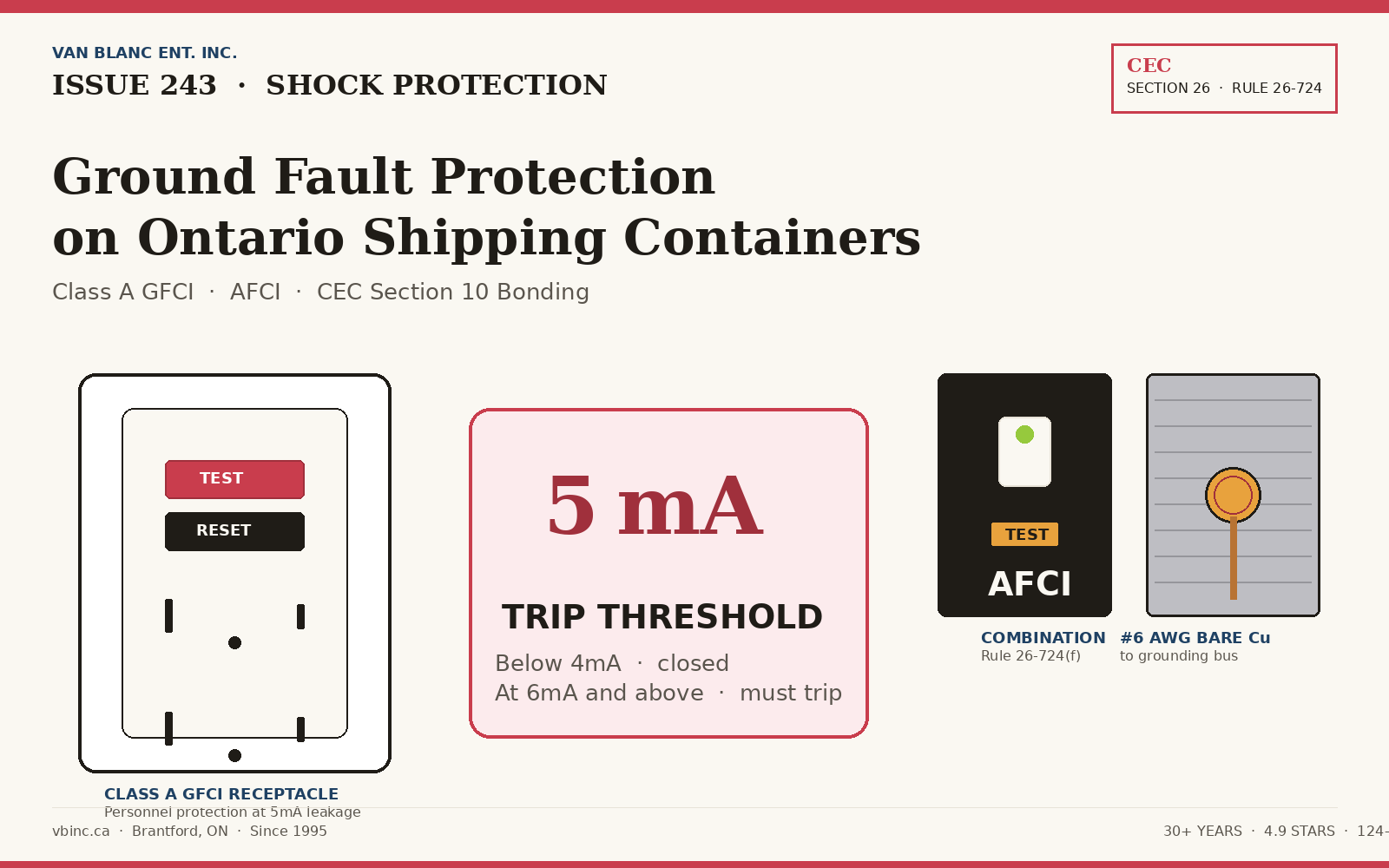
Quick Answer: Shipping container ground fault protection in Ontario requires Class A GFCI receptacles that trip at 5mA leakage, combination-type AFCI breakers on bedroom and living-area circuits per CEC Rule 26-724, and a Section 10 bonding lug welded to the steel shell with #6 AWG copper to a driven ground rod. Every electrified Van Blanc container ships with this wiring approach baked in. Real Brantford yards, real reviews (4.9 / 140+), real 1-3 day delivery. Family-operated since 1995.
In this guide
- Why is a steel container the worst place to skip GFCI?
- What is a Class A GFCI and why does it trip at 5mA?
- Do you need AFCI breakers when the container has a bed in it?
- How do you bond the steel shell under CEC Section 10?
- Where do the GFCI receptacles actually go in a container?
- What does the ESA inspector test on shock protection?
- Why does a Northern Ontario container trip its GFCIs in February?
- What are the five wiring mistakes on used container conversions?
- Paul on the call we hate getting
- What does Van Blanc handle in-yard, and what do we refer out?
- Frequently asked questions
Reading time: about 14 minutes.
Why Is a Steel Container the Worst Place to Skip GFCI?
A steel shipping container is one continuous welded conductor, so a single hot wire touching the shell can energize the whole box. Ground fault protection matters more here than in a wood shed because a Class A GFCI senses the few milliamps escaping through a person to wet ground and cuts power before a shock can lock the muscles or stop the heart.
A shipping container is a 4,500-pound steel box on the ground. Roof, walls, floor frame, and door pillars are one continuous welded conductor. If a hot wire ever touches the inside of that shell, the whole box becomes a 120V or 240V surface waiting for someone to lean against it in wet boots.
That single fact is why ground fault protection on a container is not a nice-to-have. In a wood-framed shed a hot-wire fault might char a stud and trip the breaker. In a steel container the breaker may never see enough current to trip on overload alone, because the path through a person to wet gravel can be a few milliamps. A Class A GFCI sees those milliamps. A standard breaker does not.
This article walks through how we wire shock protection into every electrified bin that leaves our yard, and the companion piece on service sizing and the SPE-1000 inspection path covers the rest: what the Ontario Electrical Safety Code requires for receptacles, what the Canadian Electrical Code says about bonding the shell, and the judgement calls experienced electricians make that the printed code does not spell out.
Paul LeBlanc, owner: “People treat a container like a tin shed. It is not. The shell is a conductor wired to whatever you plug in. The day a hot wire kisses that steel, the bin is live from the roof to the door pins. That is why we ground every electrified box we sell and put a Class A GFCI on every general receptacle before it leaves the yard.”
What “ground fault” actually means on a container
A ground fault is current escaping the intended return path (the white neutral) and finding a different route back to source. On a container, that route is almost always the steel shell, and what is touching the shell is usually you. Class A GFCI protection senses the imbalance between hot and neutral and opens the circuit before the imbalance becomes a heart-stopping shock. Below 4 mA it stays closed. At 6 mA and above it must trip within milliseconds, a threshold we cover alongside CSC plates and the rest of the paperwork and code checks a container has to clear (ESA Bulletin 26-18).
What Is a Class A GFCI and Why Does It Trip at 5mA?
The Ontario Electrical Safety Code (currently 29th edition, with the 27th edition having brought modern receptacle protection into general use in 2019) refers to a Class A device because that is the personnel-protection grade. Personnel protection means “designed to keep the human on the other end of the cord alive.” There are also higher-threshold ground fault devices used for equipment protection on industrial circuits, but those will not save a person. On a container that anyone might enter, every general-purpose 125V 15A and 20A receptacle must be Class A.
The 5mA threshold is not arbitrary. Below 5mA most people feel a sharp tingle. Between 5 and 30 mA muscles lock and you cannot let go of the energized surface. Above 30 mA the heart can fibrillate. A Class A GFCI interrupts the circuit while you are still in the “tingle” zone, before the muscles lock and before the heart is at risk.
Why GFCI receptacles, not just GFCI breakers
Both work. A GFCI breaker in the panel protects the whole circuit downstream. A GFCI receptacle protects itself plus any standard receptacle wired off its load side. For a small container with one circuit, the breaker is cleaner. For a longer container with multiple receptacles on one branch, the GFCI receptacle at the first device on the line protects every standard receptacle downstream and gives the user a local test/reset button right at the box. We default to GFCI receptacles at the first outlet plus a non-GFCI breaker. Easier to reset, easier to test monthly, and one tripped receptacle does not kill an entire dehumidifier or office circuit.
Do You Need AFCI Breakers When the Container Has a Bed in It?
The moment a container has a bed in it, the wiring rules change. CEC Rule 26-724(f) requires combination-type arc-fault circuit interrupter (AFCI) protection on all 125V branch circuits supplying receptacles rated 20A or less in dwelling unit sleeping rooms and certain adjacent spaces. The intent is fire prevention rather than shock prevention. AFCIs detect the high-frequency electrical signature of an arc inside the wire (a damaged staple cut into the insulation, a loose backstab on a receptacle, a chewed romex behind drywall) and open the circuit before the arc ignites the surrounding combustibles.
“Combination-type” means the breaker handles both parallel arc faults (line-to-neutral arcing) and series arc faults (a single conductor arcing across a broken strand). The combination word is what the inspector looks for. A plain AFCI without the combination rating no longer satisfies the code on new branch circuits.
For a hunting-camp container with a sleeping platform along one wall, the bedroom-style AFCI rule applies even with no door dividing the sleeping area from the rest of the box. Treat any container with a bed inside as a dwelling unit sleeping room for wiring purposes.
The two-protection stack: AFCI and GFCI on the same circuit
Sometimes a circuit needs both. A container office with a kitchenette and a small sleeping nook would need AFCI on the sleeping-area outlets and GFCI on the kitchen counter receptacles within 1.5 m of a sink. The cleanest answer in that case is a dual-function breaker (combination AFCI plus Class A GFCI in one device), not two separate breakers wired in series. Stacking two protection devices on one circuit causes nuisance trips because each device sees the other as a fault signature. Dual-function breakers exist for exactly this scenario and are now standard inventory at any Ontario electrical wholesaler.
GFCI vs AFCI vs bonding: three different jobs on the same container
| Protection | What it guards against | How it senses trouble | Where it is required on a container |
|---|---|---|---|
| Class A GFCI | Electric shock to a person | Imbalance between hot and neutral above 5mA | Effectively every 125V 15A/20A general receptacle in the bin |
| Combination AFCI | Fire from an arcing wire | High-frequency arc signature inside the conductor | Branch circuits feeding any sleeping-area receptacle (a bed in the box) |
| Section 10 bonding | The steel shell going live | It does not sense; it gives fault current a low-impedance return so the breaker trips | The entire welded shell, tied to the grounding electrode |
| Dual-function breaker | Shock and fire on one circuit | Combines Class A GFCI and combination-AFCI sensing in one device | A circuit serving both a sink area and a sleeping nook |
Read the table top to bottom and the logic is plain: GFCI keeps the person alive, AFCI keeps the box from burning, bonding makes sure a fault has somewhere to go that is not you.
How Do You Bond the Steel Shell Under CEC Section 10?
Bonding is what turns the steel container from a hazard into part of the safety system. Section 10 of the Canadian Electrical Code covers grounding and bonding in detail. The short version for a container: the entire metal shell must be electrically connected to the grounding electrode system so that any fault current finds a low-impedance path back to source, trips the breaker, and never has to use a human as a conductor.
The mechanical answer: a bonding lug welded or bolted to a clean, paint-free spot on the frame, then connected with a #6 AWG bare copper conductor (larger for bigger services) to the panel grounding bus. From the panel, a grounding electrode conductor runs to a driven 8-foot copper-clad rod. Two rods six feet apart is better in dry or rocky soil. The whole shell becomes a single bonded body, so a fault anywhere finds a fast return.
Where the bonding lug actually goes
Not on a corner casting. The corner castings are structural and often painted, galvanized, or rusty enough that a bolted connection is unreliable over time. The lug belongs on a vertical post or frame member where we can grind the paint clean, drill or weld a #10 stud, install the lug with a serrated lock washer, and apply NoAlox. One internal lug near the panel and one external lug at the closest accessible frame point gives the inspector clean visual confirmation that the shell is in the bonding system.
Where Do the GFCI Receptacles Actually Go in a Container?
The OESC requires Class A GFCI on outdoor receptacles, garage receptacles, receptacles within 1.5 m of a sink, receptacles in unfinished basements, and several others. On a container the easiest answer is to treat every general-purpose receptacle as if one of those rules applies. The cost difference is small enough that the universal approach pays for itself the first time a damp boot grounds against the door pillar.
Placement-wise, we put receptacles on roughly a two-metre rectangle pattern around the inside walls so no extension cord travels more than a couple of metres. For a 20ft bin that means about six receptacles. For a 40ft High Cube with a kitchenette and a small office, ten to twelve receptacles is normal. Each circuit is sized for its expected load, with kitchen and heated-tool areas on dedicated breakers.
Test monthly, replace every ten years
- Test: Press TEST on each Class A GFCI once a month. RESET should pop and the receptacle should go dead.
- Failure mode: If TEST does not pop RESET, the GFCI is dead. Replace it before next use.
- Lifespan: About ten years of normal use. After that, internal sensing drifts and false trips, missed trips, or dead-but-still-passing-current modes become more likely.
- Self-testing models: Newer Class A GFCI devices audibly or visually flag failure between manual tests. Use on containers that sit unattended for months.
What Does the ESA Inspector Test on Shock Protection?
The ESA inspection is not a paperwork formality. The inspector arrives with a calibrated tester and physically verifies each GFCI trips within the time and threshold window. They also verify continuity from the receptacle ground pin through the box, conduit jacket, panel grounding bus, grounding electrode conductor, all the way to the driven rod. Any high-resistance joint is a fail.
The inspector will tug the bonding lug. They will ask to see the panel cover off so they can confirm the grounding bus connections are torqued. They will pull a sample GFCI receptacle from its box to confirm load-side wiring matches labels. None of this is hostile. Cooperating, and laying out the wiring so each test point is accessible, turns a one-hour inspection into a twenty-minute pass. A fail means a defect notice with code references, correction, re-inspection, and an extra ESA fee.
Why Does a Northern Ontario Container Trip Its GFCIs in February?
Class A GFCI devices are sensitive by design. At -25°C in a container without active heat, two things go wrong. Moisture inside the receptacle box condenses on the GFCI’s printed circuit board, creating microamp leakage paths that nudge the trip threshold. And the panel itself can cold-soak below the operating temperature spec of components inside. The result is a phantom trip on a Sunday morning when nobody is on the property.
Three things help. Seal receptacle boxes with weatherproof gaskets and use in-use covers on exterior or near-door interior receptacles. Install a small thermostatic freeze-prevention heater inside the panel cabinet so the panel sees +5°C even when the container is at -25°C. On unattended hunting and cottage bins, accept occasional resets when you arrive. A trip is the device doing its job, not a defect.
Spray foam, vapour control, and condensation
The single most common GFCI-nuisance-trip root cause we see is moisture inside the panel from poor vapour control during insulation. Closed-cell spray foam applied directly to the inside of the steel shell to R-25 is the cleanest answer because the foam IS the vapour barrier. Avoid fibreglass batt against bare steel: the steel reaches dew point, water condenses behind the batt, the moisture migrates everywhere including the panel cabinet, and the GFCIs trip. If a container is already insulated with batts, retrofit with a continuous polyethylene vapour barrier on the warm side and verify the panel cabinet is sealed.
What Are the Five Wiring Mistakes on Used Container Conversions?
Containers come and go through our yard. Some arrive with electrical work done by previous owners and we get to see what they did. Five mistakes show up over and over. If you bought a used container with existing wiring or you are evaluating one to buy, walk through these before you energize anything.
One, no bonding lug on the shell. The wiring was done as if the container were a wood building. A hot-to-shell fault might never trip a breaker because the path through the steel has no defined return. Fix: retrofit a bonding lug and continuity-test every panel and receptacle.
Two, standard receptacles where Class A GFCI was required. Either the OESC was looser at the time, or the installer did not know. Fix: swap to Class A GFCI receptacles. The price premium over a standard receptacle at the wholesaler is small, and well worth it on a steel box.
Three, AFCI bypassed or replaced with a standard breaker. People do this because cheap AFCIs sometimes nuisance-trip on certain LED drivers or older vacuum motors. Fix: use a current-generation combination AFCI from a reputable brand. Bypassing is a code violation in any space where AFCI is required.
Four, two-wire wiring with no equipment grounding conductor. Old SOOW cable through a hole in the wall. Fix: full rewire with 14/2 or 12/2 NMD90, or armoured cable in exposed runs, including the bare or green ground.
Five, reverse polarity. Hot and neutral swapped at the receptacle. A plug-in tester catches it in two seconds. Fix: swap the wires. We test every receptacle on every container we sell.
Ready to price your container?
Tell us the size and your postal code and we’ll send back an honest, all-in number, container, delivery, and placement, usually within 1-3 days. No pressure, no mystery fees.
Family-run in Brantford since 1995 · 200+ containers in stock · 4.9★ across 140+ Google reviews · every box graded by a person, walk it before it lands.
Paul LeBlanc, owner: “The call we hate getting starts ‘my brother-in-law wired up my hunting bin and now it shocks me when I open the door in the spring.’ Nine times out of ten it is a missing bonding lug and no GFCIs anywhere. Bin sat all winter, picked up moisture, next person to touch it completed the circuit. Usually a tingle on a dry day. The tenth time it would not be a tingle. We ground every bin we sell, Class A GFCI on every general receptacle, and we will not sell a bin with electrical work that skips it.”
What Does Van Blanc Handle In-Yard, and What Do We Refer Out?
Van Blanc has been delivering shipping containers across Ontario since 1995. We are a container supplier with electrical partners, not a licensed electrical contracting firm. The work splits cleanly in two.
In our yard, our partner electricians install the panel, run the circuits, mount the GFCI receptacles, install any AFCI breakers required, fit the bonding lugs, and weld the exterior grounding stud. The electrical work sits inside the wider build-out work we do before a bin ships, from venting and insulation to office and kitchenette conversions, so the wiring is sized for whatever the box is becoming. The bin leaves with a load calculation sheet for the buyer’s electrician.
On site, a local licensed Ontario electrical contractor connects the bin to the service feed, drives the ground rod, runs the grounding electrode conductor, energizes the panel, and arranges the ESA inspection. We supply the wiring drawings and material list to make that connection straightforward, and we keep a short list of electricians across Ontario who have done container connections for us before.
If you want to see a finished electrified bin before you order, and talk through how it ties into your feed or a backup generator hookup, walk through our yard. Paul or Christian can open the panel covers and show you the bonding lug, the AFCI breakers, the GFCI receptacles, and the labelling that makes the ESA inspection painless.
Why Brantford-built electrical leaves the yard cleaner
Container electrical done at a yard with a flat concrete floor, full lighting, weather cover, and proper test equipment is different work from container electrical done on a customer’s gravel pad in the rain. We do not bend conduit in February. We do not pull cable while the bin is on a tilt deck. The work comes out cleaner because the conditions are controlled, and the inspector sees that on every job. The trade-off is one extra delivery step (the bin is heavier with the panel and wiring installed) which our tilt-deck trucks handle without issue. Most buyers prefer this trade-off once they understand it.
Frequently asked questions
Does a shipping container need GFCI in Ontario?
Yes, for any 125V receptacle rated 15A or 20A that falls into the categories the OESC lists for Class A GFCI protection. On a container that covers nearly every receptacle, because the bin is treated as a damp or outdoor location. The cost difference is small enough we install Class A everywhere.
What is the trip threshold for a Class A GFCI?
Five milliamps. The device must not trip at 4 mA or below, may or may not trip between 4 and 6 mA, and must trip at 6 mA and above within milliseconds. The threshold is chosen to protect a healthy adult from the muscle-lock and heart-fibrillation zones of electric shock physiology.
Do I need AFCI breakers in a container?
If any part of the container has a bed in it (hunting camp, cottage sleeping nook, jobsite bunkhouse), CEC Rule 26-724(f) requires combination-type AFCI on the branch circuits feeding receptacles in the sleeping area. For pure storage or office bins, GFCI alone is sufficient.
How do you bond the steel shell to ground?
An approved lug is welded or bolted to a clean, paint-free spot on the frame. A #6 AWG bare copper conductor connects it to the panel grounding bus. From the panel, a grounding electrode conductor runs to a driven 8-foot copper-clad rod (two rods six feet apart in dry or rocky soil). CEC Section 10 governs the full requirement.
Can I use one GFCI breaker for the whole container?
Yes, a single GFCI breaker at the panel protects the whole branch downstream. Trade-off: one trip shuts off everything on the circuit, and reset is in the panel. For small bins we do this. For larger bins we prefer Class A GFCI receptacles at the first device on each circuit.
Why do container GFCIs keep tripping in cold weather?
Moisture and cold sensitivity. Condensation inside the receptacle or panel creates microamp leakage that nudges the trip threshold. Fixes: weatherproof gaskets, in-use covers, a small thermostatic heater in the panel cabinet, and closed-cell spray foam on the interior shell to remove the dew point.
What is a combination-type AFCI breaker?
A breaker that detects both parallel arc faults (line-to-neutral) and series arc faults (a single broken or chafed conductor arcing across the break). The combination rating is required on new branch circuits under CEC Rule 26-724. Older parallel-only AFCIs are no longer code-compliant.
How often should I test container GFCIs?
Monthly. Press TEST on each Class A GFCI, confirm RESET pops, then reset to restore. Replace any GFCI that fails to trip. Manufacturers rate Class A GFCIs at about ten years of normal use, so plan a wholesale swap at the ten-year mark.
Does Van Blanc do the ESA inspection?
No, you do, through a local Ontario licensed electrical contractor who handles the on-site service connection. We provide wiring drawings, load calculation, and the bin with a clean panel ready for service. The contractor connects the feed, drives the ground rod, and arranges the inspection. ESA charges the fee directly.
What drives the cost of full GFCI and AFCI protection on a 20ft container?
The materials cost for a typical 20ft fitout is driven by the circuit count and by whether the panel needs dual-function (AFCI plus GFCI) breakers anywhere, since those devices cost more than plain breakers. Labour at our yard is bundled with the panel install in the electrified-container quote.
Sources
- Electrical Safety Authority. (2024). Bulletin 26-18: Arc-fault circuit interrupter (AFCI) and ground-fault circuit interrupter (GFCI) protection. esasafe.com
- CSA Group. (2024). Ontario Electrical Safety Code, 29th Edition (C22.1 ON-24). Includes the 25th edition Canadian Electrical Code Part I plus Ontario amendments. csagroup.org
- Electrical Safety Authority. (2019). 2018 Ontario Amendments to the Canadian Electrical Code Part I. esasafe.com
- Eaton. (2017). Understanding the 2015 CE Code Requirements for AFCI Protection. eaton.com
- Electrical Industry News Week. (2024). Guide to the Canadian Electrical Code, Part 1 (26th Edition) Road Map: Section 10, Grounding and Bonding. electricalindustry.ca
Reach Van Blanc in Brantford
We have been supplying shipping containers across Ontario since 1995. Our warehouse is at 90 Morton Avenue E in Brantford, and we deliver right across the province on a cash-on-delivery basis. Every electrified container that leaves our yard ships with the full panel build documented in our guide to electrical service and inspection costs: bonded steel shell, Class A GFCI receptacles, and AFCI breakers where required. The on-site connection is handled by your local Ontario electrical contractor; we make that connection painless.
Van Blanc Ent. Inc. 90 Morton Ave E Unit 1B, Brantford, ON N3R 7J7 +1 888-509-6658
If you are sourcing an electrified container, come walk through our yard. We will open the panel covers and show you the bonding lug, the GFCI receptacles, and the AFCI breakers, so you know exactly what is in the bin before it leaves.