
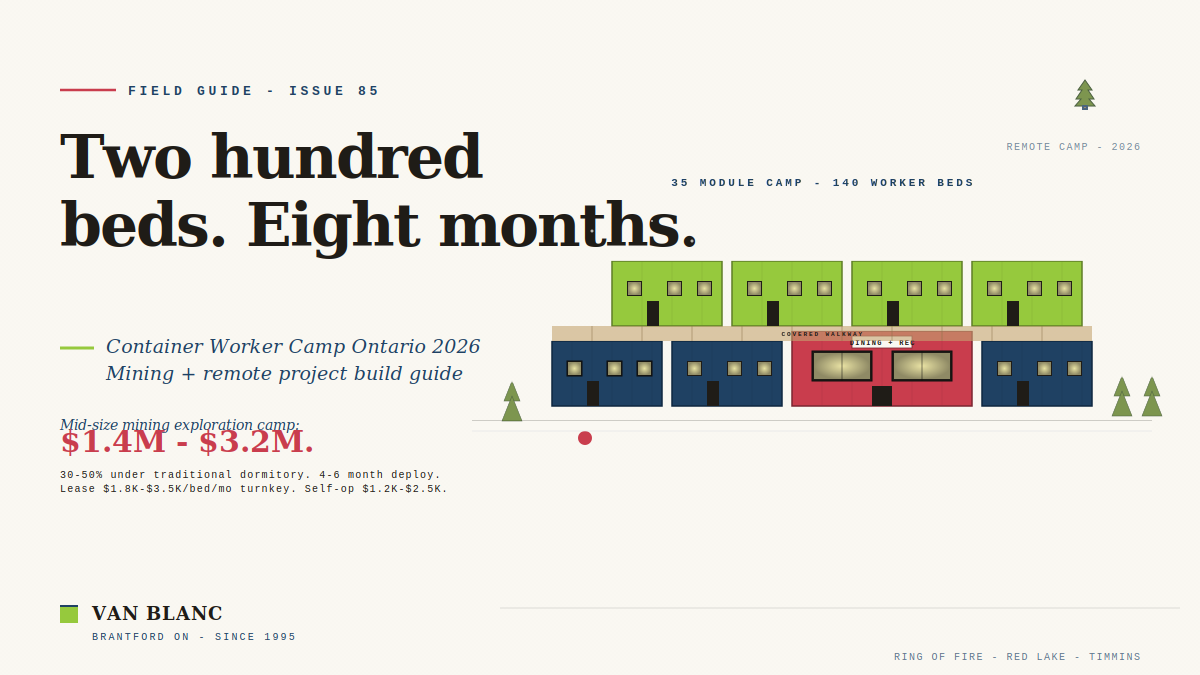
Quick answer. Standard reference: ESA (Electrical Safety Authority Ontario). A container worker accommodation camp in Ontario is built from steel boxes fitted out into livable modules: sleeper modules (single or multi-room), plus a dining hall and kitchen module and a recreation or common area module. A complete small camp typically houses 20 to 30 workers, while a mid-size camp scales to 80 to 150 workers, with cost driven by module count, sleeper tier, and Northern Ontario transport distance.
Ontario container worker camps deploy across mining sites in Red Lake, Timmins, Sudbury, and the Ring of Fire region; infrastructure megaprojects through Northern Ontario; forestry operations; wind farm construction; and emergency response deployments. Modular camp builds save 30 to 50 percent on total project cost compared to traditional dormitory construction and complete in months rather than years. Full cost breakdown, camp module specifications, and the comparison of purchase against the turnkey lease model sit below.
For module-level security configurations including welded lockboxes, puck locks, and remote camp monitoring, see how we harden remote camp modules against theft. Every quote is real-address specific. Reach Paul or Christian for honest delivered pricing. Three decades family-run, 140+ verified Google reviews. 1-3 day delivery from our 4 Brantford yards across Ontario.
What does this container worker accommodation Ontario guide cover?
This container worker accommodation Ontario guide covers per-module cost drivers, complete camp scenarios from 20 to 500+ workers, Northern Ontario logistics, and the operational realities of running a camp through the Canadian climate. If you searched for “container worker accommodation,” “shipping container worker housing,” “container mining camp,” “modular worker camp Ontario,” “container dormitory,” or any variation, the question underneath is the same: can container-based worker accommodation serve our Ontario remote project, what does the modular camp math look like, and how does our project compare to operations like the Renard diamond mine or Red Lake GoldCorp camps? The breakdown below covers per-module cost tiers, complete camp scenarios from 20 to 500+ workers, Northern Ontario logistics, and the operational realities of running container worker accommodation in the Canadian climate and regulatory environment.
“A worker camp order is the biggest single sale we handle. The operator tells us the bed count and the site, and we set aside the right grade of 40 ft High Cube boxes for the sleeper rows and the dining module. Picking the camp grade is the first real decision, and most people get it wrong before they call us.”
Paul LeBlanc, owner, Van Blanc Ent. Inc., Brantford (19 years in the container industry, 40 in Asian trade)
What does a container worker camp actually cost in Ontario in 2026?
A container worker camp in Ontario is priced by the module, not by a single sticker number. The total quote is driven by how many modules you need, the sleeper tier you choose, the share of high-cost modules like the dining hall, and the transport distance to a Northern Ontario site. Cost per bed falls as the camp grows.
| Camp module type | What drives its cost |
|---|---|
| Basic sleeper module (4 single rooms, shared washroom) | Lowest fit-out per bed: shared washroom, basic insulation and finishes, highest occupancy per container |
| Premium sleeper module (single rooms with ensuite) | Per-room plumbing for each ensuite raises cost; fewer beds per container reduces occupancy efficiency |
| Executive sleeper module (private suite with full ensuite) | Largest rooms, upgraded finishes, sitting area, and full ensuite; lowest occupancy per container |
| Dining hall and kitchen module | Commercial kitchen, walk-in refrigeration, ventilation, and seating capacity drive cost well above sleeper modules |
| Recreation and common area module | Fit-out level depends on fitness equipment, internet workstations, and AV; modest structural change |
| Administrative office module | Office partitions, meeting space, and data cabling; lighter mechanical load than residential modules |
| Laundry facility module | Commercial washer and dryer hookups, water supply, and drainage; 20 ft or 40 ft basis |
| First aid and medical station module | WSIB-compliant equipment, refrigerated medication storage, and treatment area finishing |
| Storage and equipment module | Minimal fit-out: shelving and weatherproofing; lowest cost per module in the camp |
Complete camp costs scale with worker capacity. Small remote project camps for 20 to 30 workers typically deploy 6 to 10 modules. Mid-size exploration camps for 80 to 150 workers deploy 20 to 35 modules. Large mining operation camps for 250 to 500+ workers deploy 50 to 150+ modules. The total quote moves with the number of modules, the sleeper tier you choose, the share of high-cost modules like the dining hall and kitchen, and the transport distance to the project site.
Why do container worker camps work for Ontario remote operations?
Container worker camps work for Ontario remote operations because they deploy faster and cost less than stick-built dormitories. The container worker accommodation category has dominated Ontario remote project deployment since the early 2000s. The reasons are operational, logistical, and economic:
- Faster deployment. Modular container camp construction completes in 2 to 8 months compared to 12 to 24 months for traditional stick-built dormitory construction. Resource industry projects with 18 to 36 month operational windows cannot wait for traditional construction.
- Lower total cost. Modular camp builds run 30 to 50 percent less than traditional dormitory construction across total project cost including land, labour, materials, and timeline.
- Northern Ontario logistics adaptation. Container modules transport via ice roads, winter roads, barge, and rail to remote Northern Ontario sites that conventional construction crews cannot reach efficiently. Pre-fabricated modules complete the bulk of construction at southern Ontario facilities, then ship to the project site for final assembly.
- Site portability. Container worker camps relocate between projects across a contractor or mining company portfolio. A camp serving a 24 month mine exploration can move to the next exploration site afterward without losing the modular investment.
- Compliance flexibility. Container modules can be configured to meet WSIB, Indigenous Services Canada workforce housing standards, Ontario Ministry of Labour regulations, and project-specific operator requirements.
- Resale and lease market. Used container worker camp modules have an active Canadian resale and lease market through the national camp operators.
Pro tip from our delivery yard. Ontario resource industry operators planning camp deployments should pre-engage with Canadian camp specialists like Dexterra Group (headquartered in Mississauga, Ontario) and Black Diamond Lodging well before container procurement. These operators handle catering, housekeeping, security, IT, and operational management as turnkey services. Many Ontario remote projects find that lease-and-operate contracts deliver lower total cost than purchase-and-self-manage models when factoring in operations and decommissioning.
How do Ontario worker camp sizes and costs scale?
Ontario worker camp size and cost scale together: more workers means more modules, and more modules spread the fixed infrastructure across more beds, so cost per bed drops as the camp grows. The four common size tiers are below.
| Camp size | Worker capacity | Module count | Cost-per-bed efficiency |
|---|---|---|---|
| Small remote project camp | 20 to 30 workers | 6 to 10 modules | Highest cost per bed: shared infrastructure spreads across few sleepers |
| Mid-size exploration camp | 80 to 150 workers | 20 to 35 modules | Lower cost per bed as dining, recreation, and admin amortize across more beds |
| Large mining operation camp | 250 to 500 workers | 50 to 100 modules | Strong economies of scale through standardized module procurement |
| Megaproject infrastructure camp | 500 to 1,000+ workers | 100 to 250+ modules | Lowest cost per bed at scale via procurement efficiency and standardization |
The cost per worker bed declines significantly at larger camp scales as fixed infrastructure (dining hall, recreation, administrative, water and sewer treatment) amortizes across more sleeper capacity. Small camps carry the highest cost per bed because that shared infrastructure spreads across only a handful of sleepers. Large mining operation and megaproject camps reach the lowest cost per bed at scale through procurement efficiency and module standardization.
What are some real Ontario container worker camp examples?
Real container worker camp examples relevant to Ontario operators range from Red Lake mining deployments to Northern Ontario highway corridors. Several landmark Canadian camps demonstrate the model at scale:
- Red Lake GoldCorp (Ontario). RCM Group built 90 modules in 2 months housing 184 mining workers. Located 2,200 km north of Montreal in Red Lake Ontario. Demonstrated rapid Ontario deployment capability for mining exploration camps.
- Renard Diamond Mine (Quebec, similar northern context). 2014 project for Canadian mining company Stornoway. 245 modules housing 534 mining workers. Major example of large-scale Canadian container worker camp deployment.
- Northern Ontario infrastructure projects. Multiple Highway 11, Highway 17, and Highway 144 corridor camps for road construction, bridge replacement, and infrastructure renewal projects across Northern Ontario.
- Wind farm construction camps. Container accommodation across Ontario wind farm developments in Bruce County, Huron County, and Eastern Ontario corridor.
- Forestry operations camps. Container worker housing supporting forest harvest operations across Northeastern and Northwestern Ontario.
What do two real Ontario worker camp builds look like?
Two real Ontario worker camp builds we scoped show how module count and lease length change with the project. Both came in well below traditional dormitory construction for equivalent capacity.
The Northwest Ontario mining exploration camp
Discussed with a mining exploration company in fall last year planning a 24 month gold exploration operation 180 km from Thunder Bay. Required 45 worker beds with dining hall, recreation area, administrative office, first aid, and laundry. Spec: 11 sleeper modules (4 rooms each, 44 worker capacity), 1 dining hall and kitchen, 1 recreation module, 1 office module, 1 first aid module, 1 laundry module = 16 modules total. The full camp estimate covered ice road transport, site preparation, sewage treatment, water well, generator power, and an 18 month commissioning lease, and still came in well below traditional dormitory construction for equivalent capacity. The operation pays back the camp through gold sample assay value within 14 months of full operation.
The Eastern Ontario highway construction camp
Worked with a regional general contractor in spring last year planning a 14 month bridge replacement project along Highway 17 east of Pembroke. Required 28 worker beds with smaller dining facility, office, and washroom infrastructure. Spec: 7 sleeper modules (4 rooms each, 28 worker capacity), 1 combined dining/recreation module, 1 office module, 1 storage module = 10 modules total. The camp scope included site delivery and a 14 month commissioning period. The operation deploys across two consecutive bridge projects in Eastern Ontario, amortizing the camp investment across 28 months of revenue-generating construction work. Modules return to inventory for next bridge project after the second campaign completes.
What are the container worker camp module specifications?
Container worker camp module specifications start from the 40 ft High Cube as the standard sleeper shell, with 20 ft units used for laundry and first aid. Each module type and its container basis is laid out below.
| Module type | Container basis | Specifications |
|---|---|---|
| Basic sleeper (4 rooms) | 40 ft High Cube | 4 single rooms with bed, desk, closet. Shared central washroom. Hallway access. |
| Premium sleeper (3 ensuite rooms) | 40 ft High Cube | 3 single rooms with bed, desk, closet, private ensuite washroom. Hallway access. |
| Executive suite (2 private) | 40 ft High Cube | 2 large rooms with bed, desk, closet, sitting area, full ensuite. For senior project staff. |
| Dining hall + kitchen | Two 40 ft combined | 40-80 seat dining hall, full commercial kitchen, walk-in refrigeration, dry storage. |
| Recreation module | 40 ft High Cube | Common area, TV, seating, fitness equipment, internet workstations. |
| Administrative office | 40 ft High Cube | Project office for managers, engineers, planning, meeting space. |
| Laundry facility | 20 ft or 40 ft | Commercial washers and dryers, folding area, soap/supply storage. |
| First aid station | 20 ft High Cube | Treatment area, WSIB-compliant equipment, refrigerated medication storage. |
Camp modules typically connect via covered walkways to allow workers to move between sleeper, dining, recreation, and administrative spaces without outdoor weather exposure. Covered walkway infrastructure adds 8 to 15 percent to camp module cost but is essential for Ontario winter operation. The sleeper module is where most of the per-worker decisions get made, and we break down the layout choices in our look at how a single mining-camp sleeper is laid out.
Should you purchase or lease a container worker camp in Ontario?
Whether you purchase or lease a container worker camp in Ontario comes down to project length and how many projects the camp will serve. Short single projects favour a turnkey lease; long or multi-project work favours purchasing. The decision math by operator profile is below.
| Operator profile | Best option | Reasoning |
|---|---|---|
| Single project, 12 to 24 months | Lease turnkey from operator | All-inclusive per-bed-per-month rate. Operator handles catering, housekeeping, decommissioning. |
| Single project, 36+ months | Purchase camp + contract operations | Capital cost amortizes faster across longer operating window than ongoing lease. |
| Multi-project portfolio, 5+ projects over 10 years | Purchase modular camp fleet | Camp redeploys across portfolio. Total fleet capital pays back across multiple projects. |
| Emergency response, 1 to 12 months | Lease turnkey on short notice | Camp operators (Black Diamond, Summit Camps, Dexterra) deploy in 2 to 6 weeks. |
| Indigenous community work camp | Partnership arrangement | Community ownership models with operator support services. |
Turnkey lease models from established Canadian operators are typically all-inclusive of meals, housekeeping, security, IT, and decommissioning. Self-purchase and self-operate models can achieve a lower per-bed-per-month operating cost on long-term deployments but require dedicated camp operations management investment.
What are the common Ontario worker camp deployment mistakes?
The common Ontario worker camp deployment mistakes cluster around under-speccing shared infrastructure: dining capacity, recreation, internet, walkways, sewage, and backup power. After 30 years supplying containers to Ontario commercial buyers including resource industry and infrastructure operators, the predictable mistakes are clear. Avoiding these protects the project budget and the worker retention rate.
- Underspeccing the dining hall capacity. Dining hall capacity should equal 100 percent of camp worker count for meal periods, plus 25 to 40 percent buffer for shift changes and visitor capacity. Undersized dining halls create line-ups, longer meal times, and worker dissatisfaction.
- Skipping the recreation module. Worker retention on multi-month remote deployments depends significantly on recreation, fitness, and communication facilities. Skipping the recreation module to trim the upfront budget creates retention problems whose turnover and rehiring costs typically dwarf what the module would have added to the camp.
- Underspeccing the internet bandwidth. Modern remote workforce expects video calling, streaming, and online connectivity. Satellite internet carries a recurring monthly operating cost for adequate camp bandwidth. Skipping this saves money but creates retention and recruiting problems.
- No covered walkway between modules. Ontario winters require covered walkway connection between sleeper, dining, recreation, and administrative modules. Skipping covered walkways to save 8 to 15 percent on camp cost creates outdoor exposure problems that affect worker retention and safety.
- Wrong sewage treatment specification. Camp sewage volume scales with worker count. Undersized treatment systems fail under capacity, creating environmental compliance issues and operational shutdowns. Plan sewage at 250 to 400 litres per worker per day.
- No backup power plan. Remote Ontario camps face power outages from weather, grid failures, and generator maintenance. Camps without backup power systems lose heating and water service during outages, creating worker safety risks.
- Underestimating decommissioning costs. End-of-project camp decommissioning includes module removal, site restoration, environmental cleanup, and equipment disposition. Budget 8 to 15 percent of original camp cost for proper decommissioning.
What does Van Blanc provide for Ontario container worker camp builds?
Van Blanc provides the base containers for Ontario container worker camp module conversions, sourced and delivered at camp scale from our Brantford yards. For camp builds we recommend:
- Cargo Worthy 40 ft High Cube for budget-conscious sleeper and recreational module builds. Provides full structural integrity at a lower delivered cost than One-Trip. Best fit for camps that will deploy across multiple projects over 8 to 15 years.
- One-Trip 40 ft High Cube for premium camp builds, executive suites, dining hall facilities, and first aid stations where premium finishes and the longest service life justify the higher delivered cost. These are our freshly manufactured boxes that have made a single loaded voyage, and if you want to weigh them against used grades for the sleeper rows, read which grade earns its keep in a camp.
- Bulk delivery coordination from our four Brantford yards to Northern Ontario project sites via tilt-deck transport, rail shipping, or barge depending on remote access. We have supplied multi-container orders to projects across the Ring of Fire region, Red Lake, Timmins, Sudbury, Thunder Bay, and Kenora.
- Vetted Canadian camp manufacturer referrals for module fabrication, electrical and plumbing systems, sewage treatment, and turnkey camp operations.
The container shell is roughly 6 to 12 percent of total camp module cost. The fit-out work (insulation, electrical, plumbing, interior finishing, washrooms, kitchen facilities) dominates the budget. Our overview of everything a steel box can be turned into and our notes on keeping a module warm through a -35 winter cover the full conversion specifications.
Camp operators planning a permanent jobsite office alongside the camp can see how we turn a 20 ft box into a heated site office. Operators adding a satellite food-service point can look at running a small kitchen out of a container. Operators speccing recreational amenities for an executive camp tier can read about dropping a pool into a container shell.
“Worker camp customers are the highest-volume single transactions we handle. A 35 module mining camp order means 35 containers selected, inspected, and delivered to a Northern Ontario rail head or tilt-deck transport corridor. The honest math wins. Container worker camps complete in two to eight months while traditional dormitory construction takes a year or two. We deliver the boxes, the camp manufacturer fits them out, and the operator gets people on site faster. That is what makes remote Ontario projects viable.”
Christian LeBlanc, second-generation operator, Van Blanc Ent. Inc., Brantford
Go Deeper: Detailed Topic Guides
For more depth on specific aspects of this topic, see our spoke articles:
More from this cluster
Deeper reads we’ve added since the original guide:
Sold outright. Delivered in 1 to 3 days.
Van Blanc sells new and used shipping containers outright from our 4 Brantford yards, with delivery in 1 to 3 days and payment on delivery. We do not rent, lease or offer rent-to-own. Request a sale quote or call the yard at 519-754-6844.
Frequently asked questions
How much does a container worker camp cost in Ontario?
Cost scales with worker capacity and module count. Small camps for 20-30 workers run 6-10 modules, mid-size camps for 80-150 workers run 20-35 modules, large mining camps for 250-500 workers run 50-100 modules, and megaproject camps for 500-1,000+ workers run 100-250+ modules. The quote moves with module count, sleeper tier, the share of high-cost modules like the dining hall, and transport distance, so the cost per bed falls as the camp gets larger.
What does a worker camp sleeper module cost?
Sleeper cost rises with the tier. A basic 4-room module with a shared washroom is the most economical per bed, a premium 3-room ensuite module adds per-room plumbing, and an executive 2-room private suite has the highest fit-out and the fewest beds per container. The per-bed figure depends on the tier and the ensuite features you specify.
Should I buy or lease a container worker camp in Ontario?
Single project 12-24 months: turnkey camp operators lease modules for that window. Single project 36+ months: purchase plus contract operations. Multi-project 5+ projects over 10 years: purchase modular camp fleet that redeploys across portfolio.
How long does it take to build a container worker camp in Ontario?
Small camps deploy in 2 to 4 months from order to operations. Mid-size camps 4 to 6 months. Large mining operation camps 6 to 8 months. Compare to 12 to 24 months for traditional dormitory construction at the same scale.
What grade of container is best for a worker camp?
Cargo Worthy for sleeper and recreational modules that prioritize cost efficiency. One-Trip for premium sleeper builds, executive suites, dining hall, and first aid stations where premium finishes and longest service life justify the investment.
Who are the major Ontario container camp providers?
Several Canadian camp operators, some with Ontario head offices, handle camp fabrication, deployment, and turnkey operations including catering and housekeeping.
How much does a turnkey camp lease cost per bed per month?
A turnkey camp lease is quoted as an all-inclusive per-bed-per-month rate covering meals, housekeeping, security, IT, and decommissioning. Self-operate models can reach a lower per-bed-per-month operating cost on long-term deployments but require dedicated camp operations management. The rate moves with camp size, location, service level, and contract length.
What is the typical Ontario worker camp module configuration?
Sleeper modules (4 single rooms each with shared washroom), dining hall and kitchen module (40-80 seat capacity), recreation module (TV, fitness, internet), administrative office, first aid station, laundry facility, and storage. Connected via covered walkways for Ontario winter operation.
Can container camps operate year-round in Northern Ontario?
Yes with proper closed-cell spray foam insulation, dedicated heating systems, covered walkway connections, and backup power. Container camps operate successfully across Ring of Fire region, Red Lake, Timmins, Sudbury, Thunder Bay, and Kenora through Northern Ontario winters at -35°C and below.
How does container worker camp cost compare to traditional dormitory construction?
Modular container camps cost 30 to 50 percent less than traditional dormitory construction across total project cost (land, labour, materials, timeline). One-Trip modules deliver 20 to 30 years. Mechanical systems (HVAC, plumbing, electrical) refresh on 8 to 15 year cycles. Container envelopes outlive equipment by 1 to 3 service rotations.
Come pick your container worker camp modules
If you are planning a container worker camp in Ontario, the starting point is selecting the right base containers at scale. We hold 200+ containers in stock at our Brantford yard with capacity to source additional units for camp-scale orders of 10 to 100+ units. For camp builds we offer both Cargo Worthy (cost-optimized) and One-Trip (premium) options. You walk the row, read CSC plates, and pick your units before you pay. Delivery to Northern Ontario project sites coordinated through our four Brantford yard logistics partners.
Call Van Blanc, Brantford, Ontario, 519-754-6844
Van Blanc Ent. Inc. has supplied containers for Ontario worker camp builds since 1995. 4.9-star rating across 140+ Google reviews. Brantford yards with 200+ containers in stock, and you pick your unit before you pay.
Ready to price your container?
Tell us the size and your postal code and we’ll send back an honest, all-in number, container, delivery, and placement, usually within 1-3 days. No pressure, no mystery fees.
Family-run in Brantford since 1995 · 200+ containers in stock · 4.9★ across 140+ Google reviews · every box graded by a person, walk it before it lands.
Sources & References
Authoritative external sources cited or referenced in this guide: