
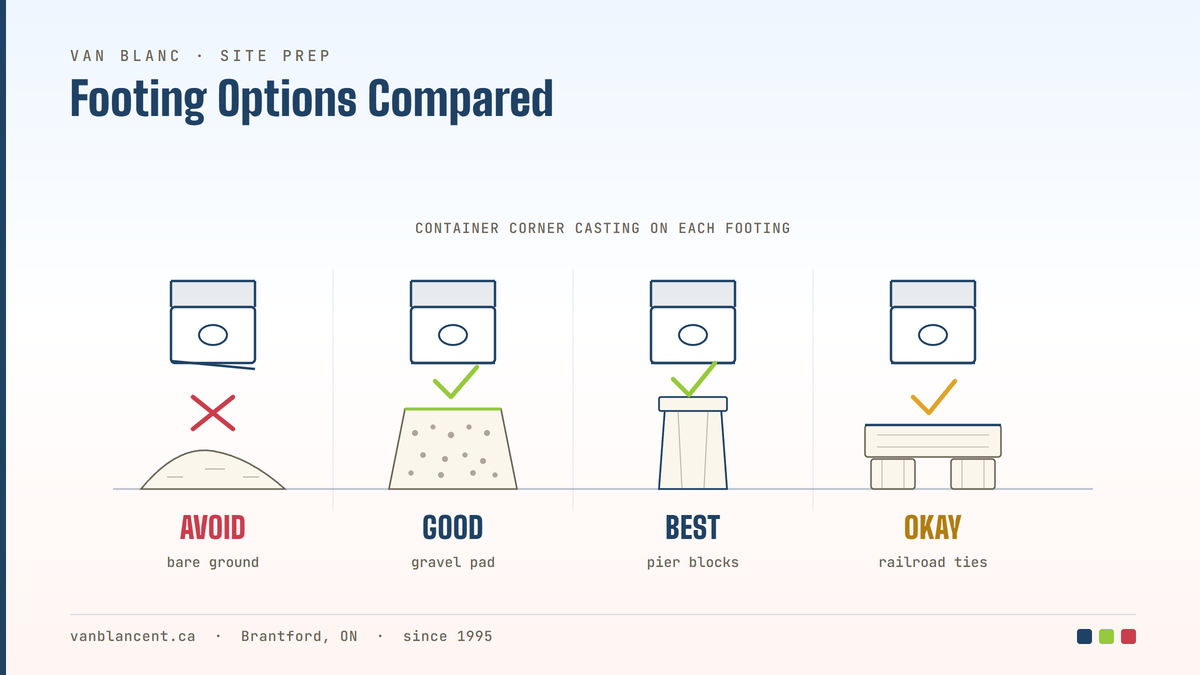
Quick Answer: A shipping container does not always need railroad ties or blocks, but on bare soil it should sit on something. A gravel pad is the best all-round footing in Ontario: it drains water away, spreads the load, and keeps the steel off wet ground. Railroad ties and blocks work too, placed under the four corner castings.
In This Guide
- Do you need railroad ties or blocks under a shipping container?
- A container carries its whole weight on four corners
- The footing options compared: ground, gravel, blocks, ties, pad
- What each option costs you in level, drainage and longevity
- When you can skip footing altogether
- Delivery day: how the bin actually lands on your footing
- FAQs
Reading Time: 11 minutes
Do you need railroad ties or blocks under a shipping container?
The honest answer is: it depends on the ground and how long the bin is staying. A shipping container is a self-supporting steel box. It does not need a poured footing the way a house does. What it needs is a firm, reasonably level base that keeps the steel off wet soil and lets water run away from underneath. On a packed gravel driveway or an existing concrete slab, you often need nothing at all. On grass, dirt, or soft fill, you want something under it.
That something can be railroad ties, concrete blocks, or a gravel pad. All three raise the container off the dirt and give it solid contact points. Which one is right comes down to your soil, your timeline, and how level your spot already is. We have delivered containers across Ontario since 1995, and our drivers see the same footing questions on most residential and farm sites.
One rule of thumb the industry uses: if the container is going to sit in one place for more than three or four months, put it on a footing of some kind. If it is staying for years, a gravel pad or concrete piers under the corners is worth the effort. A bin dropped straight onto damp grass for a season is usually fine. The same bin left on that grass for five years will start rusting from the bottom up.
Why footing matters at all: it is about water, not weight
A shipping container is built to be stacked nine high on a cargo ship, so the steel can easily hold its own weight on the ground. The problem with bare soil is moisture. Steel sitting flat on damp earth wicks water upward and traps it against the underside, where it cannot dry. Trapped moisture is what accelerates corrosion on the bottom rails and the floor crossmembers. Raising the container even a few inches lets air circulate underneath, and that airflow is the single biggest thing that keeps the underside dry. The footing’s real job is drainage and airflow, not load support.
A container carries its whole weight on four corners
Before you compare footing materials, understand how a container actually transfers its load. A shipping container is designed to be lifted and supported entirely on its four corner castings: the heavy steel blocks at each top and bottom corner. Per ISO 1161, each corner casting is rated to carry up to about 30,000 kg. The frame is engineered so the corners do the work, not the long bottom rails and not the floor.

This single fact decides everything about footing. You do not need to support the whole length of the container. You need four solid contact points, one under each bottom corner casting, all at the same height. Supporting the middle of a container while leaving the corners hanging is the one thing you should never do, because it loads the frame in a way it was never built for and can rack the doors out of square.
The level test that prevents door problems
If a container is not level across its four corners, the doors are the first thing to tell you. A bin that sits twisted will have doors that swing open on their own, will not latch cleanly, or bind at the top corner. Get the four corners level to within roughly a centimetre of each other and the doors behave. This is why footing material that holds its height matters: blocks that sink or crumble let one corner drop, and the doors go out of square.
So whatever footing you choose, the goal is the same: four firm, level contact points under the corner castings. Gravel does this by spreading a stable surface the corners rest on. Blocks and ties do it by placing a solid object directly under each corner. A full pad does it by giving the whole footprint a level base. The corner-casting rule is why a few well-placed supports work as well as a continuous foundation.

The footing options compared: ground, gravel, blocks, ties, and a full pad
Here is the honest run-down of the five common ways Ontario buyers set a container, from doing nothing to pouring concrete. Each is a real option for the right situation. We have placed bins on all of them.
| Footing option | How it works | Best for | Watch-outs |
|---|---|---|---|
| Bare ground | Container sits directly on existing soil or grass. | Short stays (a season), already-firm gravel or compacted ground. | Wicks moisture, traps water, settles unevenly over time. Not for long-term placement. |
| Gravel pad | A compacted bed of crushed stone under the footprint, extending past the edges. | Most Ontario sites. The best all-round choice for long-term placement. | Needs the area leveled and the stone compacted; soft soil may need geotextile fabric first. |
| Concrete blocks / piers | Solid blocks or poured piers stacked under each of the four corner castings. | Sites with a slight slope where you need to build up a low corner. | Hollow cinder block can crack under load. Use solid block or fill the cores. |
| Railroad ties / treated timber | Heavy treated wood beams laid under the corners (or full length) to spread load. | Farm and rural sites, quick setups, soft or uneven ground. | Wood eventually rots in contact with soil. Creosote ties are not for gardens, food areas, or near water. |
| Full concrete pad | A poured, reinforced slab sized to the container footprint. | Permanent installs, occupied conversions, anything you will never move. | The most work and expense. Overkill for plain storage that may relocate later. |
Bare ground: fine for a season, not for years
Setting a container straight on the ground is the no-prep option, and for a short stay on firm, well-drained ground it is genuinely fine. The risk is time. On bare soil the steel wicks moisture, water pools under the bin with nowhere to drain, and the unit can settle unevenly as the ground softens and freezes through an Ontario winter. If the bin is staying past a few months, get it up off the dirt.
Gravel pad: the best all-round footing in Ontario
A gravel pad is what we point most buyers toward for long-term placement. A bed of compacted crushed stone, usually around 6 inches deep over leveled ground, does three jobs at once. It drains water down and away so nothing pools under the steel. It spreads the load so the corners do not punch into soft ground. And it gives a stable, level surface the four corners rest on. For a 20ft bin, extend the pad about a foot past the footprint on all sides so runoff sheds clear of the container. On soft clay, lay geotextile fabric under the stone first so the gravel does not slowly migrate into the mud. For a shed rather than a box, the same three-way choice, with the slab and piers added, is worked through in the shed base comparison.
Concrete blocks and piers: good for building up a low corner
Blocks shine when your spot has a slight slope and you need to raise one or two corners to get the bin level. A solid concrete block or a poured pier placed under each corner casting gives a hard, height-stable contact point. The classic mistake is using hollow cinder block laid the wrong way: the thin webs can crack and crumble under the concentrated corner load. Use solid block, or block with the cores filled, and seat it on firm ground or a small gravel base so it cannot sink.
Railroad ties and treated timber: the quick rural answer
Railroad ties, or any heavy treated timber, are a long-standing favourite on farms and rural lots because they are fast, forgiving on uneven ground, and spread the corner load over a longer beam. Laid under the four corners, they get the steel up off the dirt and give you something to shim level. The trade-off is lifespan. Wood in ground contact eventually rots, even creosote-treated ties, so over many years they will need checking and replacing. Creosote is also a reason to keep ties away from vegetable gardens, play areas, and water, since the preservative can leach into soil. For a plain farm storage bin out in the field, they are a sensible, proven choice.
Full concrete pad: for permanent, never-moving installs
A poured slab is the gold standard for permanence. If the container is becoming an occupied space, a workshop you are wiring and insulating, or a fixture you will never relocate, a reinforced pad gives a perfectly level, rot-proof, settle-proof base. For most storage buyers it is more than the job needs, especially since one of the best things about a container is that it can be picked up and moved later. Pour concrete only when you are certain the bin is staying put.
The same 20ft bin, three different footings
On a Brant County farm, a Wind and Watertight 20ft sea can lands on a pair of railroad ties out by the equipment shed, level in twenty minutes, holding feed and tools for the next decade. On a Hamilton contractor’s gravel yard, the same size bin sits straight on the existing compacted stone with no extra prep at all. In a homeowner’s backyard, that bin goes on a fresh gravel pad so the lawn beside it stays dry and the doors swing true. Same steel, three honest answers, all driven by what the ground was already doing.
What each option costs you in level, drainage, and longevity
Footing is a trade among three things: how level you can get the bin, how well water drains away, and how long the setup lasts before it needs attention. Money is not the only cost. The cost that bites people later is a bin that rusted early or doors that stopped closing. Here is how the options stack up on the three that matter.
| Option | Levelling | Drainage | Longevity |
|---|---|---|---|
| Bare ground | Poor on anything but already-flat firm ground | Poor: water pools and is trapped | Low: settling and underside rust over time |
| Gravel pad | Good: stone is leveled during prep | Excellent: water drains straight through | High: stone does not rot or corrode |
| Concrete blocks / piers | Excellent: easy to shim and build up corners | Good: bin is raised, but ground between is untreated | High if solid block on firm base; risk if hollow block |
| Railroad ties / timber | Good: shim under the beams | Good: raises the steel and lets air move | Medium: wood rots in ground contact over years |
| Full concrete pad | Excellent: a true flat plane | Good with a slight slope built in | Highest: effectively permanent |
Read the table as a decision, not a ranking. If your spot is already a firm gravel surface, bare-ground placement scores fine for you because the ground is doing the gravel pad’s job already. If you are on soft clay that holds water, the gap between gravel and bare ground is the difference between a bin that lasts decades and one that pits underneath in a few winters. The footing question is really a soil and drainage question wearing a different hat.
Ontario ground is the deciding factor
Across Southern Ontario you meet a bit of everything: heavy clay around Brant and Haldimand that holds water and heaves in frost, sandy stretches through Norfolk that drain well, and rocky shield ground up north. Clay is the one to respect. It swells when wet, lifts in a freeze, and stays soft underfoot in spring, which is exactly when bare-ground placement settles unevenly and traps moisture. On clay sites, a compacted gravel pad earns its keep. On free-draining sand or an existing hardpack yard, you can often place straight down. When you describe your site to us, the ground type is the first thing we ask about.

Not sure what your ground needs? Tell us the container size, your postal code, and what the ground is doing right now (grass, gravel, clay, slope) and we will tell you whether you need a pad, ties, blocks, or nothing at all. The fastest answer is a call: describe the spot over the phone and we will tell you on the spot.
Get a Quote or call the Brantford yard: 519-754-6844
When you can skip footing altogether
You can skip prepared footing entirely when the ground is already doing the work. There are real situations where the right answer is to set the bin down and walk away, and we will tell you so rather than upsell a pad you do not need. Skipping footing is genuinely fine in these cases:
- You already have firm gravel, asphalt, or concrete. A compacted gravel driveway, a paved yard, or an existing slab already drains and spreads load. Setting the container straight onto it is correct, no extra prep required.
- It is a short-term placement. A bin staying a season for a renovation or a harvest does not need a foundation. Firm, reasonably level ground for a few months is fine; you are removing it before moisture has time to do damage.
- The ground is high, dry, and well-drained. On a free-draining sandy rise that water sheds off naturally, a storage bin can sit on the ground without pooling underneath.
The flip side: do not skip footing on low, wet, or clay ground for a long-term bin, do not skip it if the spot is noticeably out of level, and do not skip it if you are converting the container into anything occupied or insulated. When in doubt, a few inches of compacted gravel is cheap insurance against the one thing footing prevents, which is moisture trapped against the steel.
One question settles it: how long, and how wet?
Strip the decision down to two questions. How long is the bin staying, and how wet does that ground get? Short stay on dry, firm ground: set it down, no footing. Long stay or wet, soft, clay ground: get it up on gravel, ties, or blocks under the corners. Permanent occupied conversion: pour a pad. Almost every footing decision an Ontario buyer faces falls cleanly into one of those three answers.
Delivery day: how the bin actually lands on your footing
Whatever footing you prepare, the container has to get there, and how it lands depends on access. Van Blanc delivers across Ontario from our Brantford yards on tilt-deck trucks, and for most jobs that is all it takes. A tilt-deck trailer raises its bed, slides the container off the back, and sets it down at ground level as the truck pulls forward. The bin lands gently onto your gravel, ties, or blocks. No crane needed when the access works.

The catch is room. A tilt-deck has to pull straight forward to slide the container off, so it needs a clear, straight run. As a rough guide, plan on roughly 75 to 100 feet of straight pull-out space for a 20ft container and around 120 to 130 feet for a 40ft. The truck needs about 12 feet of width to work, and the deck lifts to roughly 14 to 16 feet of overhead clearance as it tilts (more for high-cube units), so keep that lane free of low branches and wires. The ground along that run has to be firm and dry, because a loaded delivery truck weighs tens of thousands of pounds and will sink into soft spring ground or a soaked lawn.
Tilt-deck clearance, at a glance
- Straight pull-out (20ft): roughly 75 to 100 feet of clear, straight space.
- Straight pull-out (40ft): roughly 120 to 130 feet.
- Width: about 12 feet for the truck to work.
- Overhead: roughly 14 to 16 feet of clearance during the tilt-off, more for high-cube.
- Ground: firm and dry along the whole run; a heavy truck sinks into soft ground.
These are planning numbers, not promises. Every site is different, so tell us what the approach looks like and we will tell you honestly whether a tilt-deck can reach the spot.
When the access is tight, when a fence, a building, or a slope blocks the straight run, we can place with a crane (HIAB) instead, lifting the container over the obstacle and setting it down on your footing. Crane placement opens up sites a tilt-deck cannot reach. The thing to sort out before the truck rolls is exactly where the bin lands, because moving a placed container is a second job. Mark your four corners, have the footing ready, and the driver sets it down right the first time. If you want to think through how the bin should be positioned and prepped before it arrives, our guide to shipping container site prep walks through the full delivery-day picture, and there is a companion piece on whether a container can be delivered onto grass or soft ground.
Paul LeBlanc, Owner: “People overthink the foundation and underthink the drainage. Nine times out of ten, six inches of compacted gravel under the four corners is all anyone needs. We have set bins on ties on farms that are still dead level twenty years later. The ones that give trouble are always the ones dropped on wet clay with nowhere for the water to go.”
Frequently Asked Questions
Do you need a concrete slab for a shipping container?
No, not for ordinary storage. A shipping container is self-supporting on its four corner castings, so a compacted gravel pad or solid blocks under the corners is enough for most placements. A full concrete slab is only worth it for permanent, occupied conversions you will never move. For plain storage, a slab is usually more than the job needs.
Are railroad ties or concrete blocks better under a container?
Both work when placed under the four corner castings. Railroad ties are faster and more forgiving on soft, uneven rural ground, but the wood eventually rots in ground contact. Solid concrete blocks or piers hold their height better and are ideal for building up a low corner, as long as you avoid hollow cinder block, which can crack under the concentrated corner load.
Why does a container need air underneath it?
Steel sitting flat on damp soil traps moisture against the underside, where it cannot dry, and that trapped moisture accelerates rust on the bottom rails and floor crossmembers. Raising the container even a few inches on gravel, ties, or blocks lets air circulate underneath. That airflow keeps the underside dry and is the single biggest thing that protects a container long term.
How level does a shipping container need to be?
Level across the four corners to within roughly a centimetre. The doors are your early warning: a container that sits twisted will have doors that swing on their own, bind, or refuse to latch. Footing that holds its height, like compacted gravel or solid block, keeps the corners even so the doors stay square for the life of the bin.
Can a shipping container sit directly on the ground?
For a short stay on firm, dry, well-drained ground, yes. The problem is time and water. On bare soil the steel wicks moisture, water pools underneath, and the unit settles unevenly through freeze and thaw. If the container is staying more than three or four months, raise it on gravel, ties, or blocks so water drains away and air moves underneath.
How much room does the delivery truck need?
Our tilt-deck trucks need a clear, straight pull-out: roughly 75 to 100 feet for a 20ft container and 120 to 130 feet for a 40ft, with about 12 feet of width and 14 to 16 feet of overhead clearance during the tilt-off. The ground has to be firm and dry. When access is tight, we can place with a crane instead. Describe the approach and we will tell you what will reach.
Sources
- International Organization for Standardization. (1984, current). ISO 1161: Series 1 freight containers, corner and intermediate fittings, specifications. iso.org
- International Organization for Standardization. (2022). ISO 6346:2022: Freight containers, coding, identification and marking. iso.org
- Falcon Structures. (2024). Do Shipping Containers Need Foundations? It Depends. falconstructures.com
- NH Department of Environmental Services. (2023). Railroad Ties and Creosote-Treated Wood. des.nh.gov
- Coast Containers. (2025). How to Prepare a Site for Shipping Container Delivery. coastcontainers.ca
Reach Van Blanc in Brantford
We have been supplying shipping containers across Ontario since 1995. Our warehouse is at 90 Morton Avenue E in Brantford, and we deliver right across the province on a cash-on-delivery basis. No surprise fees, no chase-the-paperwork.
Van Blanc Ent. Inc., 90 Morton Ave E Unit 1B, Brantford, ON N3R 7J7, 519-754-6844
Tell us about your spot and we will tell you, straight, whether it needs a gravel pad, a couple of ties, or nothing at all before the bin arrives.
Related Reading
- Shipping Container Foundation and Site Prep: Frost Heave, Anchoring, and Ontario Ground Conditions
- Building a Gravel Pad for a Shipping Container
- Can a Shipping Container Be Delivered on Grass or Soft Ground?
- how much bigger than the box your gravel base should be
- setting a container down on grass or a soft yard