
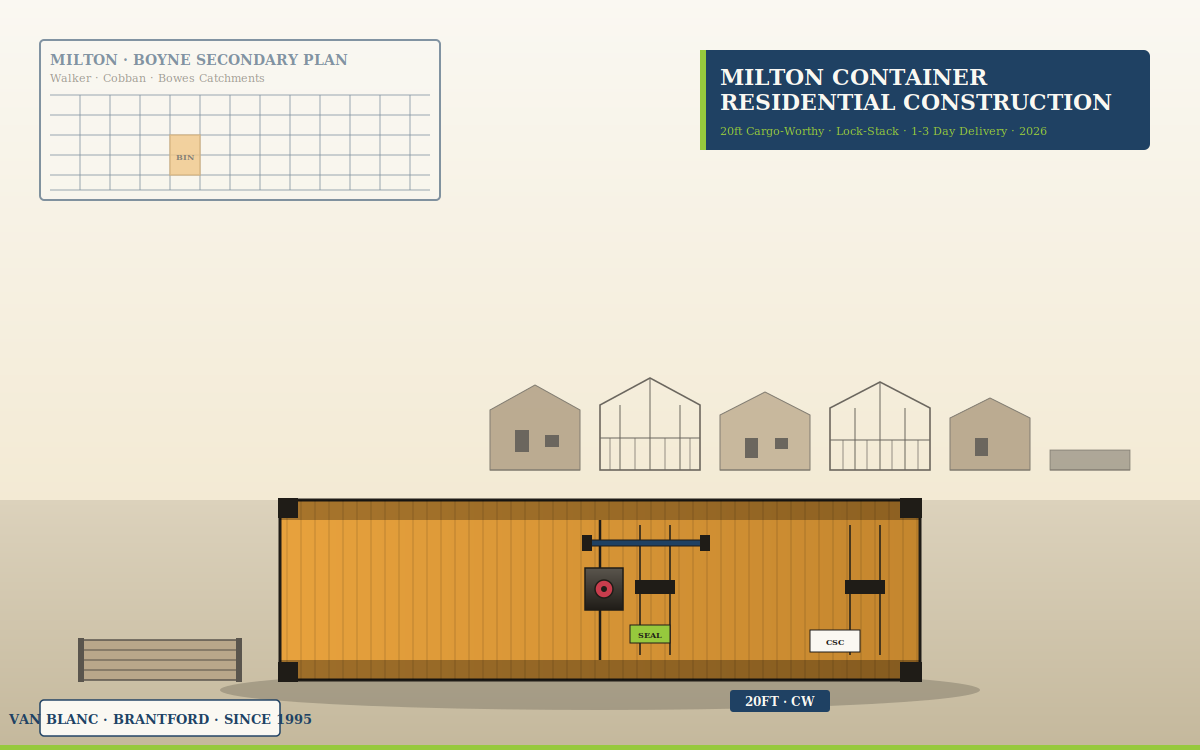
Quick Answer: Most standard dry containers follow the dimensions tracked by the World Shipping Council. Milton GCs building in Boyne, Sherwood Heights, Coates, and Bowes need a 20ft lock-stack secure storage bin on the pad for the 8 to 14 months a custom or small-builder home takes to close. Van Blanc delivers cargo-worthy bins right onto the subdivision lot in 1 to 3 days from our 4 Brantford yards, and most builders resell or redeploy the bin at occupancy. Real lead times. No deposits chased across Facebook. The LeBlanc family has run Van Blanc Ent. Inc. since 1995. 140+ verified Google reviews at 4.9 stars, 1-3 day delivery.
In This Guide
- Why is Milton such a busy build market in 2026?
- What size container does a Milton lot need?
- How do you lock a container on an open Milton pad?
- Cargo-worthy or wind-and-watertight for an 8 to 14 month build?
- What drives the cost of a Milton GC container?
- Can a tilt-deck truck place a container on a Milton lot?
- What happens to the container when the build closes?
- Why are cheap Facebook Marketplace containers a scam?
- FAQs
- Reach Van Blanc
Reading Time: 12 minutes
Why is Milton such a busy build market in 2026?
A container on a Milton residential lot is a 20ft cargo-worthy steel box that locks framing lumber, cabinets, and finish trim on the pad for the full 8 to 14 month build. Van Blanc delivers it onto the subdivision lot in 1 to 3 days from four Brantford yards, and most builders resell or redeploy the same bin at occupancy.
Milton is one of Halton Region’s most active residential markets in 2026. The Boyne Survey Secondary Plan, approved to ultimately house roughly 50,000 residents south of the older Sherwood Survey area, has phases still rolling out across the Walker, Cobban, and Bowes school catchments. Sherwood Heights continues to build out the medium-density north corridor. Coates is filling in the established southwest pocket with infill and small-builder custom homes. Bowes anchors the newest east-side phases under the Milton #11 Catholic catchment. The Town of Milton Ward 4 development applications page lists dozens of active subdivisions and site-plan amendments as of Q1 and Q2 2026.
What this means for a Milton GC running custom homes or small spec projects: every lot sits open from foundation through final occupancy for 8 to 14 months. During that window, the rough-in materials need somewhere dry, the finish trim and cabinet packages have to land before occupancy without sitting in the rain, and the bin needs to be on site the day the framers arrive and gone the week the closing lawyer signs the deal. Sizes, grades and the drive time to Boyne are on our Milton sea cans page.

Why Milton GCs call Van Blanc first
Milton sits roughly 75 km east of our Brantford yards, a straight shot up the 401. A flatbed leaving Morton Avenue at 7 a.m. is on a Boyne pad by mid-morning, on a Sherwood Heights lot before lunch, into Coates by early afternoon. Our 1 to 3 day delivery window covers the cadence Milton custom builders actually move at. Framing schedule clears on Friday, materials show up Tuesday, bin lands Monday. That is the window we built our four-Brantford-yard model for, and it is why we have been quoting Halton GCs since the late 1990s. Christian LeBlanc, who runs the yard side day to day, puts the Milton cadence plainly: “A builder calls us Thursday, we are on the Boyne pad Monday. The framers never wait on the steel, the steel waits on the framers.”
What size container does a Milton lot need?
A 20ft cargo-worthy container is the default size for a Milton residential lot. For a single custom home or small-builder spec lot in Boyne, Sherwood Heights, Coates, or Bowes, a 20ft cargo-worthy container is the default size. The 20ft fits on a standard residential subdivision lot without eating the driveway, swings tilt-deck off the road allowance without clipping the neighbour’s hedge, and holds enough volume for framing lumber, sheathing, cladding bundles, rough-in kits, and the finish carpenter’s tool stack. A 40ft high cube works for a builder running three or four adjacent lots, but for the one-lot custom or two-lot infill that defines most Milton GC work, the 20ft is the right call.
The interior layout Milton builders settle into after a couple of jobs: rear third for long bundles and bulk material against the back wall, middle third for trade-specific tool stations on shelving brackets bolted to the side wall, front third clear for daily-access framing hardware, fasteners, and the framer’s nail-gun station. A pallet of OSB or plywood goes in first, propped vertical against the rear corner. The cargo doors stay clear and bin contents are accessible from the front in under two minutes. If you are weighing a 20ft against a 40ft for a tighter lot, the full set of interior and exterior measurements by box type shows exactly what fits a standard Milton pad.
Why 20ft beats a job-box or jobsite trailer
The two alternatives a first-time Milton GC considers are a wheeled jobsite trailer or a steel job-box. The wheeled trailer has hitch-theft exposure and gets towed off half-finished pads in Halton twice a year by the call-back numbers we field. The steel job-box holds 30 cubic feet of tools but no lumber, no cabinets, no rough-in materials. A 20ft cargo-worthy is 1,165 cubic feet of locked steel sitting on the pad at ground level. Hitch-theft impossible. Forklift-theft impossible without the neighbours noticing. Paul has been making this pitch to Milton builders since the Boyne plan first started rolling out. A builder who wants the longest service life and the cleanest resell at occupancy often orders a freshly imported box that has only made one loaded voyage rather than an older used unit.
How do you lock a container on an open Milton pad?
Locking a container on an open Milton pad takes a layered lock-stack, not the factory hardware alone. The single biggest mistake a Milton GC makes on their first container job: relying on the factory cam-bar handles and the lockbox alone. Half-occupied subdivisions in Boyne, Sherwood Heights, and Bowes are walked by curious neighbours, kids on bikes, and occasionally an opportunist with bolt cutters. Anything short of a layered lock-stack telegraphs an easy bin to anyone reading the row.
The lock-stack we recommend on every Milton residential pad is three layers deep. A high-security puck lock inside the factory lockbox housing, hardened steel body, rated against bolt cutters and pry bars. A crossbar lock spanning the right-hand door over the cam-bar mechanism, anchored at both ends. And a visible third element: a heavy-duty hasp-and-padlock relocated above the cam bar, or a tamper-evident sticker seal that tells you at a glance whether the door has been touched overnight. The puck lock is the real defence; the visible elements are deterrents that move the opportunist three pads down. Full breakdown is in our container accessories field guide.

Position the bin so the doors face the framers, not the road
One small layout call that pays back across the whole 8 to 14 month build: position the container with the cargo doors facing the interior of the lot, never the road. The road-facing back wall is a flat steel target a thief can study from a parked truck without anyone in the half-occupied subdivision noticing. Doors facing the lot interior means anyone working the locks is visible to the framers, the supervisor, and the neighbours across the street. Paul on this point: thirty years in industrial trade taught him that ninety percent of the deterrent value of a container is its placement, and ten percent is the lock you put on it.
Cargo-worthy or wind-and-watertight for an 8 to 14 month build?
Cargo-worthy is the right grade for a long Milton residential build. The grade question on a Milton custom home comes down to how long the bin sits and what it holds. For an 8 to 14 month residential build with framing lumber, finish carpentry, cabinets, and tools rotating through, cargo-worthy is the right call. CW gives you a fully structural unit, doors that operate cleanly without the warp issues that bite WWT bins, and a CSC plate confirming structural inspection. WWT works for a 3 to 5 month bin holding tolerant material like exterior cladding bundles where door-warp during a wet Halton winter is not a critical-path risk.
There is a modest grade premium on a cargo-worthy 20ft over a wind-and-watertight one, driven by the structural inspection and the CSC plate that come with CW. For a 12-month build holding cabinet packages, finish trim, and rough-in fixtures, that delta pays for itself the first time a CW door opens cleanly at minus-fifteen in February while the neighbour’s WWT bin is frozen shut on the cam-bar gasket. Most experienced Milton builders land on CW after their first job. Price grade logic is laid out in our step-by-step inspection checklist for used bins and the plain-language walk through the grade ladder.
| Build factor | Cargo-worthy (CW) | Wind-and-watertight (WWT) |
|---|---|---|
| Best fit on a Milton lot | 8 to 14 month custom or spec build | 3 to 5 month bin for tolerant material |
| Door operation at minus-fifteen | Opens clean, inspected gasket | Warp and frozen-gasket risk |
| CSC plate | Structural inspection on the plate | May be expired, fine for storage |
| Holds cabinets and finish trim | Yes, dry through a full Halton winter | Risk if the build runs long |
| Relative grade premium | Modest premium for the inspection | Lower, reflects cosmetic wear |
How a Milton Boyne custom home actually uses the bin
Permit issued in March. Pad cleared and foundation poured in April. Van Blanc 20ft cargo-worthy delivered tilt-deck onto the south corner of the lot the first week of May, doors facing the interior, three-layer lock-stack set up day one. Framers stage lumber and sheathing inside through May and June. Mechanical rough-in kits land in the bin in July; cabinets in August; finish trim across September and October. Bin clears out by early December, holding only the last tool stack as the builder finishes punch-list work. Final occupancy in early January, bin gets picked up and either resold to the next GC up the street or redeployed to the next lot the builder is starting. Eight months of secure on-site storage, one bin, no jobsite trailer thefts.
What drives the cost of a Milton GC container?
The cost of a Milton GC container is driven by three things, not a single posted number. For a single-lot Milton custom home in 2026, the realistic landed cost breaks into three lines: the cargo-worthy 20ft itself, which moves with yard inventory the week of order; delivery from Brantford, which moves with pad access and the 75 km haul up the 401; and the lock-stack hardware for the puck lock, crossbar, and secondary hasp. Add those three together and you have the bin secured on the pad and ready to load.

Spread across an 8 to 14 month build, the landed cost works out to a low monthly figure for dedicated secure on-site storage. End-of-build resell typically recovers most of what you paid for the same bin with the lock-stack hardware transferred. The net cost across the build often lands below the deductible on a Halton GC tools-and-materials insurance claim, which is what a jobsite trailer stolen out of Boyne overnight would trigger.
Paul on what Milton GCs actually pay
Paul LeBlanc has been quoting Halton builders since the late 1990s. “The number that surprises a first-time Milton GC is not the bin price, it is the resell number at the end of the build,” he says. “A cargo-worthy 20ft you buy resells to the next builder up the street for most of what you paid ten months later, easy. The steel does not depreciate the way a wheeled trailer does. You are renting the difference. Forty years in international trade taught me one thing: a steel asset on the pad is not an expense, it is a rotating capital line.” Paul has 19 years specifically in containers and 40 in Asian trade.
Can a tilt-deck truck place a container on a Milton lot?
A tilt-deck truck can place a container directly on most Milton residential lots. Tilt-deck delivery on a Milton pad has specifics worth knowing before the truck shows up. Lots in Boyne and Bowes tend to be graded flat with a clean access ramp from the road allowance, which is the ideal scenario; the truck tilts the deck and rolls the container down onto compacted gravel without complication. Coates lots vary, from new infill on full subdivision pads to older streets where a tilt-deck reverses onto the front yard with the neighbour’s driveway as the only turn-around.
The placement specifics that matter across all four neighbourhoods: at least 14 feet of vertical clearance for the tilt-deck mast, at least 75 feet of straight-line backing distance from the road, and a clean drop zone graded to within 2 inches of level. If any of those constraints are tight, we send a crane-truck and crane-place the bin precisely where the GC wants it. The crane option carries a modest surcharge over a standard tilt-deck drop. Full delivery logic is in our yard pickup versus delivery guide.
What to clear off the pad before the tilt-deck arrives
- Overhead lines: Bell, Rogers, hydro service drop. If the line crosses the drop zone, the truck cannot tilt. Coordinate with the utility for a temporary lift if needed.
- Neighbour fence corners: A 20ft container needs a 25-foot swing arc on the tilt. Anything inside that arc gets clipped. Walk it before the truck arrives.
- Stockpiles and aggregate: The drop zone has to be clear and graded. A pile of sub-base or excavation spoils in the drop zone delays delivery by a half-day or pushes it to the next available slot.
- Mud: Halton clay in March or April makes a tilt-deck pad unworkable. If the pad is soft, we send the crane-truck instead.
What happens to the container when the build closes?
When a Milton build closes, the container is resold or redeployed, which is where the economics of the purchase actually finish, not at occupancy. For a custom builder running one or two homes per year, the typical pattern is to hold the bin between projects at our Brantford yard for a low monthly storage fee, then redeploy when the next foundation pours. Three jobs into the rotation, the bin has cost the builder less per month of in-use storage than a single quarter’s worth of wheeled-trailer rental.
For a spec project where the next job is six months out or longer, the resell-to-the-next-GC pattern is faster and cleaner. The Milton custom-build community is small enough that builders know each other; a bin that finished a Boyne home in November often lands on a Sherwood Heights pad in January with one phone call. Van Blanc tracks resell listings informally for customers as a courtesy. For the full asset-versus-expense framing, see container as asset versus expense for a Canadian business.

Repurposing a Milton bin to the next Halton job
Most Milton GCs we have supplied across the past two decades eventually move their bins between Milton, Burlington, Oakville, and Mississauga jobs. The 401 corridor keeps it simple when a builder redeploys a bin between jobs: a hauler the builder hires moves it from the wrapping Milton lot to the next Halton or Peel lot, and a new job can also take a fresh box straight from our Brantford yards in 1 to 3 days. For background on scaling up to three or four lots in parallel, see how we stage a phased multi-bin drop across the GTA.
Why are cheap Facebook Marketplace containers a scam?
A cheap Facebook Marketplace container is almost always a scam built to take an e-transfer deposit and vanish. Every Milton GC we eventually quote has seen the Facebook Marketplace listing priced suspiciously below the market to undercut a real yard. The pattern has not changed since the first iPhone showed up on a construction site. Clean listing photo, Halton area code, vague Mississauga or Brampton address, an e-transfer deposit request to lock in the bin. The container never arrives. The seller’s phone goes dead within 48 hours.
We have taken the call-back from too many Milton GCs to count. The pattern Paul sees, repeatedly: a builder on their first or second custom home decides the gap is worth the gamble, sends the e-transfer, and is on the phone to us four days later asking if we can deliver a bin tomorrow because the framers start Monday. We can usually deliver inside the 1 to 3 day window, but the lost deposit is gone. We break down how to spot, avoid, and recover from container fraud in our field guide on Ontario container fraud.
How to vet a Milton bin supplier before any deposit
Drive to the yard. Walk the row. Read the CSC plates on the bins you are looking at. Confirm the gate sign matches the invoice business name. Confirm the phone numbers on the invoice match the website. Any legitimate Ontario container supplier with a real yard will welcome a pre-purchase visit; this is the strongest single filter against scam exposure. Worth the drive from Milton for unbeatable quality and family customer service with 30 years of experience. Our protocol is in the container pre-purchase yard visit protocol.
Frequently Asked Questions
What size container does a Milton custom home GC need?
A 20ft cargo-worthy is the right call for a single-lot custom home or small spec project in Boyne, Sherwood Heights, Coates, or Bowes. The 20ft holds 1,165 cubic feet, fits on a standard residential subdivision pad without eating the driveway, and swings tilt-deck onto the lot without clipping the neighbour’s fence. 40ft high cubes work when a builder is running three or four adjacent lots, but the 20ft covers the typical Milton residential build.
How long does Van Blanc take to deliver a container to a Milton subdivision pad?
1 to 3 days from order confirmation to delivery into Milton from our 4 Brantford yards. A flatbed leaving Morton Avenue at 7 a.m. is on a Boyne pad by mid-morning, on a Sherwood Heights lot before lunch. Real lead times, not hopeful ones. Every quote we issue carries the delivery date in writing.
What does a 20ft container cost for a Milton GC in 2026?
The landed cost comes down to three lines: the cargo-worthy 20ft itself, which moves with yard inventory the week of order, plus delivery into Milton from Brantford, which moves with pad access, plus a three-layer lock-stack of puck lock, crossbar, and secondary hasp. Spread across an 8 to 14 month build, that works out to a low monthly figure for dedicated secure storage, and end-of-build resell typically recovers most of what you paid.
Cargo-worthy or wind-and-watertight for an 8 to 14 month Milton custom home build?
Cargo-worthy. CW gives you a fully structural unit with clean-operating doors at minus-fifteen in February, a CSC plate confirming structural inspection, and consistent gasket integrity across a full Halton winter. WWT costs a little less, but the door-warp risk on a 12-month build holding cabinets and finish trim is not worth that small saving. Most experienced Milton builders settle on CW after their first job.
How do I lock a container on an open Milton subdivision pad?
Three layers: a high-security puck lock inside the factory lockbox housing, a crossbar lock spanning the right-hand door over the cam-bar mechanism, and a visible deterrent above the cam bar like a heavy-duty hasp-and-padlock or a tamper-evident sticker seal. Position the bin with cargo doors facing the lot interior, never the road. Placement is ninety percent of the deterrent value; the lock is ten percent.
Can a tilt-deck truck place a container directly on a Boyne or Bowes subdivision lot?
Yes for most pads. The tilt-deck needs at least 14 feet of vertical clearance, 75 feet of straight-line backing distance from the road, and a clean drop zone graded to within 2 inches of level. Boyne and Bowes lots are typically new and graded flat which makes tilt-deck delivery straightforward. Sherwood Heights infill and older Coates lots sometimes need a crane-truck instead, which carries a modest surcharge over a standard tilt-deck drop.
What happens to the container at the end of a Milton custom home build?
Two options. Resell the bin to the next Milton GC up the street, typically ten months after purchase, the Milton custom-build community is small enough that one phone call usually closes that deal. Or redeploy the bin to your next Halton or Peel lot, holding at Van Blanc’s Brantford yard between jobs for a low monthly storage fee if the next foundation is more than two weeks out.
Does Van Blanc deliver to Boyne, Sherwood Heights, Coates, and Bowes specifically?
Yes, all four Milton neighbourhoods. We have delivered into Boyne phases under the Walker and Cobban school catchments, Sherwood Heights medium-density infill, Coates established southwest lots, and the newer Bowes east-side phases under the Milton #11 Catholic catchment. Tilt-deck on new graded pads, crane-truck on tighter infill or older streets.
What if a Milton GC sees a cheaper container on Facebook Marketplace?
It is almost always a scam. The pattern: Halton area code, vaguely Mississauga or Brampton address, an e-transfer deposit to lock in the bin, container never arrives, phone goes dead within 48 hours. Drive to a real yard before any deposit clears. Worth the drive from Milton for honest steel and a family business with 30 years of experience.
Can Van Blanc supply a small Milton developer running multiple adjacent lots?
Yes. For a small developer running three to six adjacent lots in Boyne or Bowes, we typically supply a fleet of three to five bins: one larger 40ft high cube for shared framing lumber and sheathing, two or three 20ft bins for lot-specific tools and finish materials, and one bin dedicated to fixtures and cabinets across the cluster. Full multi-bin fleet logic is in our GTA multi-bin container order guide. Delivery still lands inside the 1 to 3 day window from our 4 Brantford yards.
Ready to price your container?
Tell us the size and your postal code and we’ll send back an honest, all-in number, container, delivery, and placement, usually within 1-3 days. No pressure, no mystery fees.
Family-run in Brantford since 1995 · 200+ containers in stock · 4.9★ across 140+ Google reviews · every box graded by a person, walk it before it lands.
Sources
- Town of Milton. (2026). Boyne Survey Secondary Plan. Retrieved from milton.ca
- Town of Milton. (2026). Ward 4 Development Applications. milton.ca
- Town of Milton. (2026). Milton Heights Area Development Applications. milton.ca
- Falcon Structures. (2026). How to Secure Asset Storage for Construction Site Theft Prevention. falconstructures.com
- Sigma Container Corporation. (2026). A Guide to Secure On-Site Storage Solutions for Construction Sites. sigmacontainer.ca
- International Organization for Standardization. (2022). ISO 6346:2022 Freight Containers, Coding, Identification and Marking. iso.org
- Transport Canada. (2025). Cargo Securement Standard 10, Containerized Cargo. tc.canada.ca
Reach Van Blanc in Brantford
We have been supplying shipping containers across Ontario since 1995. Our warehouse is at 90 Morton Avenue E in Brantford, and we deliver right across the province on a cash-on-delivery basis. No surprise fees, no chase-the-paperwork.
Van Blanc Ent. Inc. 90 Morton Ave E Unit 1B, Brantford, ON N3R 7J7 519-754-6844 or 1-888-509-6658
Running a Milton custom home in Boyne, Sherwood Heights, Coates, or Bowes? Call Paul or Christian, walk the Brantford yard before the deposit clears, and have your 20ft cargo-worthy bin on the pad before the framers show up Monday morning.
Related Reading
- storing seasonal overflow when a Milton warehouse runs out of room
- turning a bin into a heated jobsite office
- picking the bin up yourself versus a tilt-deck drop
- why builders treat a bin as a rotating capital line
- browse the grades and sizes we keep in stock
- what to check on the steel before you pay