
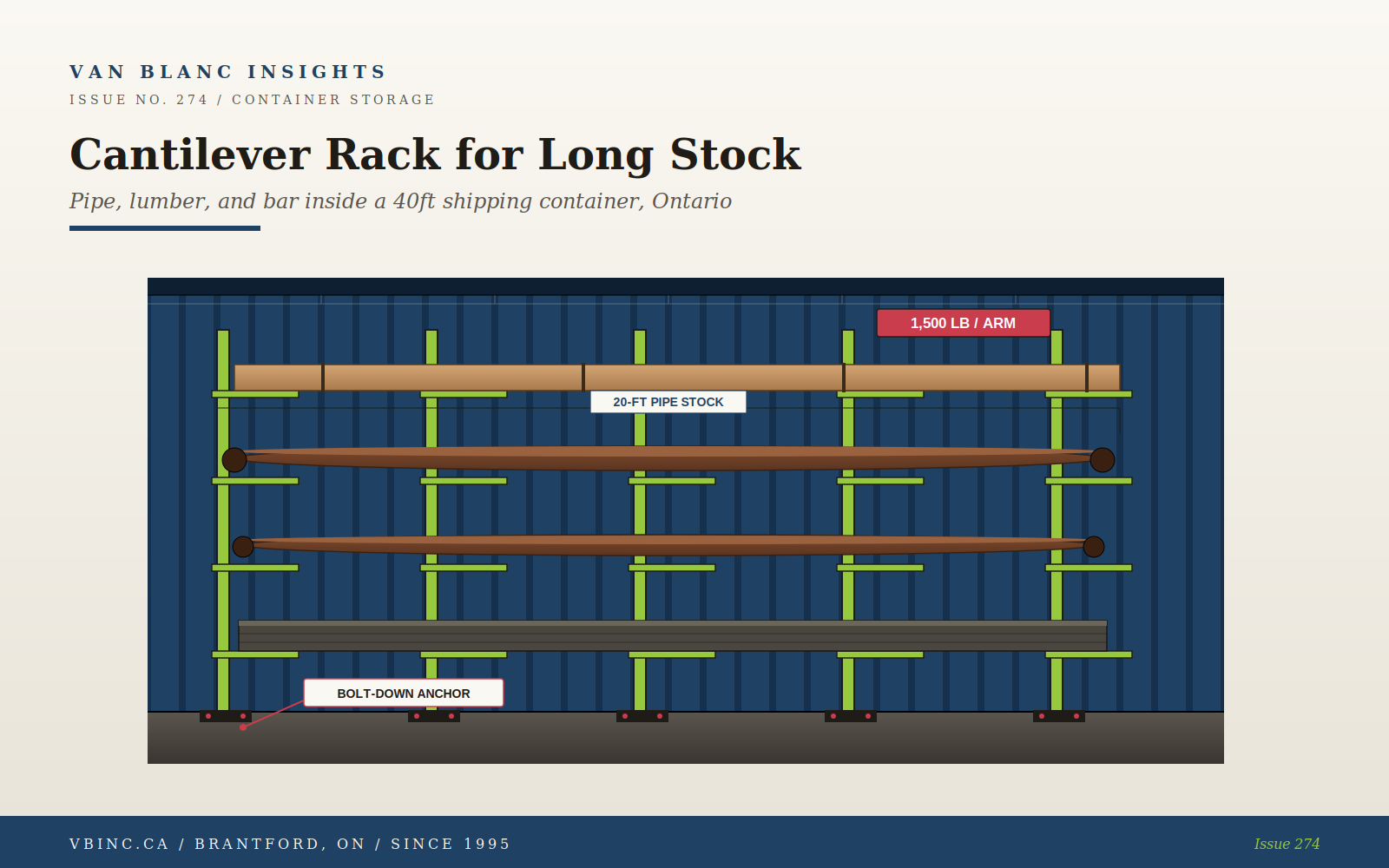
Quick Answer: A cantilever rack for long stock in a shipping container uses single-sided uprights bolted to a steel sub-frame, with arms rated 1,000-1,500 lb each under ANSI MH16.3-2025. A 40ft holds about 39 ft of pipe, lumber, or steel bar along one wall. Van Blanc specs and installs the rack at our Brantford yard and ships it standing, with fast 1-3 day delivery Ontario-wide. Family-operated since 1995, 4.9-star verified across 140+ Google reviews.
In This Guide
- Why Use Cantilever for Long Stock Inside a Container?
- What Are the Parts of a Cantilever Rack?
- How Much Weight Does a Cantilever Arm Hold?
- What Does a 40ft Cantilever Layout Look Like?
- How Do You Anchor Cantilever Inside a Bin?
- Do Pipe, Lumber, and Bar Stock Load the Same Way?
- Single-Sided or Double-Sided Cantilever in a Container?
- What Does Each Ontario Region Stack?
- Should You Buy the Rack Installed or Bare?
- How Do You Spot a Used Cantilever Scam?
- FAQs
Reading time: about 14 minutes.
Why Use Cantilever for Long Stock Inside a Container?
A cantilever rack holds long stock on arms that swing out from a back column, with no front upright in the way. Inside a shipping container, that open front lets a 20-foot pipe or a 16-foot lumber bundle lay flat along one wall, where pallet racking forces it to overhang. The arms carry the load; the steel box handles the weather.
A 20-foot length of 2-inch schedule 40 black iron pipe weighs about 47 lb. A bundle of 16-foot SPF studs weighs about 240 lb. None fit on a standard pallet without overhanging, and overhanging stock on selective pallet racking is how shoulders get dislocated. The 8-foot-wide steel box gives you a long enclosed wall (39 ft 6 in inside a 40ft, 19 ft 4 in inside a 20ft), exactly the shape long stock wants, which is why arm-and-column storage earns its place in the bin instead of the beam-and-frame approach we cover separately. Cantilever is one option in our full rundown of ways to fit out a container interior.
The geometry is simple. Pallet racking runs front beams between two upright frames, so every load fits between those uprights. A 16-foot stud bundle does not. Cantilever drops the front upright and holds the load on arms swinging out from a single back column. Front opens floor to ceiling. A 20-foot pipe lays flat across three or four arms without bumping the front of the bin.
Christian LeBlanc walks new buyers through this at the Brantford yard. “Most people come in picturing shelves,” he says. “Then they lay a 20-foot length across a single arm and the whole thing clicks. The front of the box is wide open, so the pipe goes in straight and comes out straight.” The 40ft high cube gives 39 ft 6 in of usable length, 7 ft 8 in of width, and 8 ft 10 in of height. Cantilever uses the length and the height. A back-wall row of uprights leaves the opposite wall clear for an aisle and turns the bin into a covered, lockable, mobile lumber yard that survives an Ontario winter.
What Are the Parts of a Cantilever Rack?
A working cantilever rack has four parts. The column is the vertical roll-form or I-beam upright that does the heavy work. The arms bolt to the column at chosen heights through a punched ladder pattern on 4-inch centres. The base is a steel plate extending forward (toward the load) and backward (toward the wall). Cross-bracing ties columns together along the back so the run does not rack sideways under uneven loads.
The Moment Arm That Sets Everything Else
The reason cantilever costs more per foot than pallet racking comes down to the moment arm. An arm carrying 1,500 lb at 36 in from the column generates 4,500 ft-lb of torque on that column. The base depth (back to front) must be at least 60 percent of the arm length or the rack tips forward under full load. Inside a bin you cap at 8 ft 6 in to clear lift-in tolerance, which puts you in light-to-medium duty roll-form columns easily supporting 1,000-1,500 lb per arm. Heavy structural cantilever (3,000 lb and up) belongs outside.
How Much Weight Does a Cantilever Arm Hold?
A container cantilever arm typically holds 1,000 to 1,500 lb at a 24 to 30 inch installed length, with capacity falling as the arm gets longer. The Rack Manufacturers Institute released ANSI MH16.3-2025 in January 2026, replacing the 2016 edition. The update tightens placard rules and addresses height-dependent capacity. Two clauses matter inside a shipping container.
First clause. If arm levels carry different ratings (upper arms often drop because they have less column above to share the moment load), each level must be placarded individually, or the rack at the most restrictive level. Treat all four as 1,500 lb when the top arm is rated 1,000 lb and you lose a load.
Second clause. Arm capacity falls as arm length grows. A 2,000 lb arm at 36 in may rate 1,200 lb at 60 in. Same arm, same column. The installed length governs because the moment arm changes. Container cantilever runs short arms (24-36 in) because anything longer blocks the aisle, which keeps you near the top of the capacity range.
| Arm Length | Typical Rating (Single Arm) | Stock That Fits Comfortably | Container Aisle Impact |
|---|---|---|---|
| 24 in | 1,500 lb | 2-3 inch pipe, narrow lumber bundles, bar stock | Aisle clear (4 ft+ remaining) |
| 30 in | 1,300 lb | SPF 2×4 / 2×6 bundles, conduit, 4-inch pipe | Aisle tight (~3 ft 5 in remaining) |
| 36 in | 1,100 lb | Wider lumber bundles, plywood-strip stock | Aisle tight (~2 ft 8 in remaining), forklift cannot turn |
| 42 in | 900 lb | Bulk lumber, sheet-strip stock | Aisle blocked, side-loading only |
The 24-30 inch arm range is where most container cantilever lives. It carries serious weight, leaves room to walk the aisle, and keeps the column moment within the roll-form capacity range that fits under an 8 ft 10 in ceiling.
What Does a 40ft Cantilever Layout Look Like?
A 40ft cantilever layout runs a single row of uprights down one long wall, with arms tiered up the column and a clear aisle on the opposite wall. Here is a real one. Eight uprights along one long wall at 5-foot centres covers 39 ft 4 in of the 39 ft 6 in interior. Three or four arms per column. Bracing ties columns into four braced bays. Base depth 30 in. The assembly takes 33 in of bin width, leaving 65 in of aisle opposite. A walk-behind pallet jack turns in 65 in; a standard 4,000 lb counterbalance forklift does not, so cargo gets side-loaded through the doors rather than driven down the aisle.
The Tillsonburg Steel Fabricator Setup
One Tillsonburg fab shop we delivered to last fall ordered a 40ft high cube with cantilever pre-installed at the yard. Eight columns, four arms per column (32 arm positions), 30 in arms, 1,300 lb per arm. They store 24-foot lengths of 2-inch square tube on the bottom two tiers (heaviest), 16-foot lengths of 1-inch round bar on the third (lighter), and bundles of flat strap on the top (lightest). Total stored weight runs about 18,000 lb when full. Forklift loads through the doors with a side-shift carriage. Lock the doors at end of shift. No tarp, no shrink wrap, no theft from the back of the lot.
The same template scales to a 20ft. Four uprights at 5-foot centres covers 19 ft 4 in of usable length and holds 12-foot stock on three or four tiers. You give up the long-stock advantage at 16 ft and 20 ft, but the 20ft saves a third of the bin cost and the delivery fee. Christian sees that choice most often with small-shop contractors who do not buy 20-foot pipe by the pallet, and they usually start by picking the right box from our Ontario stock before we touch the spec.
How Do You Anchor Cantilever Inside a Bin?
Anchoring cantilever inside a container is the part most buyers get wrong. Outdoor cantilever bolts to a poured concrete pad with wedge anchors. Inside a bin it is harder because the container floor is 28 mm marine plywood on cross-members. Wedge anchors through plywood compromise the moisture seal and get almost no pull-out resistance.
Two real solutions. One. Lay a continuous steel sub-frame along the cantilever wall, bolt the cantilever bases to that sub-frame, and let the sub-frame distribute load across the cross-members. The sub-frame welds to the corner castings at four points. Cleanest install and the one we run at the Brantford yard.
Two. Self-supporting cantilever (heavy base, low arm height, wide back footprint). The base plate is wide enough and the centre of gravity low enough that anchoring is optional if the bin sits level. Works for 24-30 in arms under 7 ft tall but you inspect base plate contact monthly.
One Anchor Mistake to Avoid
Do not bolt the cantilever directly to the container’s side wall corrugations. The corrugated sheet is structural in shear but not in pull-out. The wall flexes inward under arm moment and eventually pops a weld at the top rail. Always anchor to the floor (via sub-frame) or to the corner castings, never to the wall sheet. The corner castings are rated 30,000 kg in compression per ISO 1496-1 and are by far the strongest attachment points inside the bin.
Do Pipe, Lumber, and Bar Stock Load the Same Way?
No. Pipe, lumber, and bar stock each load onto cantilever differently, and the same rack stores all three only if you match the arm to the cargo. Round pipe rolls, lumber stacks as bundles, and bar stock lands heavy on impact.
Pipe rolls. A 4-inch schedule 40 black iron length weighs 11 lb per foot and rolls off a flat arm when the bin shakes, when a forklift tine brushes the load, or when a worker leans against it. Pipe needs a 4-inch front lip or a drop-in rest pin. Most container arms ship without lips. Spec them up front or live with rolling stock.
Lumber stacks. SPF studs, plywood-strip, and engineered lumber settle as strapped bundles. Flat arms (no lip) at 5-foot column centres work; bundles span four arms at 200-400 lb (studs) or 500-800 lb (wider stock), well under per-arm ratings.
Bar stock is the hardest. Round bar rolls worse than pipe. Square bar does not roll but runs heavy (3.4 lb/ft for 1-inch mild steel, 13.4 lb/ft for 2-inch). A 20-foot 2-inch square bar weighs 268 lb and a forklift lands it hard. Bar stock wants lipped arms, padded rests (rubber bumpers or hardwood inserts), and shorter arm lengths so moment stays low under impact.
| Cargo Type | Recommended Arm | Per-Arm Weight (typical) | Loading Method |
|---|---|---|---|
| Pipe (round, 1-4 in) | Lipped, 24-30 in | 40-200 lb per piece | Forklift fork-tine slide, end-load |
| Lumber bundles (SPF, 16 ft) | Flat, 30-36 in | 200-400 lb per bundle | Forklift bundle drop from doors |
| Bar stock (round/square) | Lipped + padded, 24 in | 100-300 lb per piece | Crane sling or fork with sleeves |
| Conduit and EMT | Flat or lipped, 30 in | 20-80 lb per bundle | Hand-load from doors |
| Sheet strip stock | Flat, 36 in | 200-600 lb per stack | Forklift slide, end-load |
The clean rule. Lipped arms for anything round. Flat arms for bundles. Padded arms for impact-loaded steel. Never mix loading methods on the same arm row without checking the lighter end can take the heavier end’s impact.
Single-Sided or Double-Sided Cantilever in a Container?
Single-sided cantilever is the right call inside almost every container, because a bin has only one aisle. Outdoor cantilever often runs double-sided in a centre aisle. Inside a container that almost never works because a bin only has one aisle.
The exception. A 40ft high cube with a back personnel door cut (one of the cut-and-weld changes we make before a bin ships) gives a second entry point and turns the bin into a through-flow bay. Double-sided cantilever down the centre splits the floor into two 32-34 in aisles (workable for pallet jacks). You double arm count without lengthening the bin, at the cost of the door cut and one wall of cantilever stock.
Most buyers run single-sided. Christian asks every buyer: do you stock long enough to need both walls? Nineteen out of twenty say no. The twentieth is usually a steel service centre running dozens of profiles, and that buyer needs two bins anyway.
What Does Each Ontario Region Stack?
The cantilever spec looks different across the province. What gets requested by phone tells us what the buyer carries.
Southwestern Ontario Trades and Fabrication
Tillsonburg, Simcoe, Strathroy, and Aylmer buyers run small-to-mid steel fab shops, ag equipment dealers, and welding shops stocking 20-foot pipe, square tube, angle, and flat bar. Spec: 30 in lipped arms, four tiers, 1,300 lb per arm, single-sided in a 40ft. Lead 1-3 days.
GTA Plumbing, Electrical, and HVAC Contractors
Brampton, Mississauga, Vaughan, and Pickering trades stock 10- and 20-foot pipe, conduit, EMT, copper. Lighter spec (24-30 in arms, 1,000-1,300 lb) because stock is lighter but the bin moves sites every few months. Sub-frame anchored so the rack survives relocation.
Eastern Ontario Lumber Yards and Cottage Builders
Kingston, Brockville, and the 1000 Islands run smaller lumber and cottage-construction crews. Spec: 30-36 in flat arms for bundles, four tiers, 1,100-1,300 lb. Bin lives on the lot year-round, so galvanized columns beat powder-coat.
Northern Ontario Mining and Forestry
Sudbury, Timmins, North Bay, and Thunder Bay stock 4-inch and 6-inch pipe, drill rod, structural angle. Spec runs short (24 in), heavy (1,500 lb), three or four tiers. Bin lives on a claim for years, often unheated. Premium freight 5-10 days from the yard.
Niagara and Lincoln Wine Country
Lincoln and the fruit belt stock trellis stakes, irrigation pipe, vineyard posts. Spec small (24 in arms, 1,000 lb, three tiers) inside a 20ft. Bin sits at the back of the vineyard for the season. Trail clubs hit the same long-stock problem every spring, when the stakes and sign posts come off the snowmobile trails, and where a snowmobile club keeps its stakes and posts until fall sizes that box.
Should You Buy the Rack Installed or Bare?
You can buy a cantilever rack two ways: bare and assembled on-site, or pre-installed at the Brantford yard before the container ships. Path one. You buy a bare container and order cantilever separately. The rack arrives on a flatbed, you arrange a telehandler to lift columns through the cargo doors (they will not fit through a personnel door), and you assemble on-site. Roughly 65 percent of pre-installed cost but adds a day of yard time you do not have.
Path two. We spec the cantilever to your stock list, source from our Ontario rack supplier, install at the Brantford yard, and ship the bin with the rack standing. Take delivery, level, start loading the same day. The 20-30 percent premium buys fitment, yard stitch-out, and a walk-through, which is the same hands-on approach behind the cut-to-spec conversion work we do in-house on every bin we ship.
Christian LeBlanc, second-generation operator: “I tell every cantilever buyer the same thing. Walk into the yard with your stock list and the longest piece you carry. I will hand you a column and lay an arm across it. You will know within five minutes whether the spec works or whether we go up or down a class. That phone call saves three months of regret.”
Worth the drive for unbeatable quality, family customer service with 30 years of experience. Every quote includes a real lead time, not a hopeful one.
How Do You Spot a Used Cantilever Scam?
You spot a used cantilever scam the same way you spot a bad container deal: a price that sits far below what a real rack supplier charges, with no way to verify the column rating before you pay. The used cantilever market has its own Facebook pattern, where uprights show up at auction priced too low to be honest for a four-arm column. Two common failures. One. The column is structural I-beam rated for a 30-foot outdoor install and you cannot trim it for a 7 ft 10 in bin without cutting through engineered web sections. Two. Roll-form columns with mixed arm brands across the run, where no arm seats correctly in any column slot.
A third trap. Hidden impact damage on the column flange. A forklift hit compromises moment capacity until the arm tier sags six months in. ANSI MH16.3-2025 calls out the inspection criteria: flange damage, base plate distortion, arm-slot wear. Christian has watched buyers chase a deal into a replacement install.
For the broader patterns (deposit fraud, bait-and-switch sizes, fake delivery promises), how the same tricks show up when you buy the bin itself are worth a read before you wire money anywhere. The dedicated guide walks the eight warning signs we see most often. Cantilever version: buy from a Canadian rack supplier with a real warehouse, verify column ratings match your arm spec, walk a sample column before paying a dollar.
Frequently Asked Questions
How much weight does a cantilever rack arm hold inside a shipping container?
Container cantilever arms typically run 1,000-1,500 lb per arm at 24-30 in installed lengths. ANSI MH16.3-2025 governs the rating. Arm capacity falls as arm length grows, so a 2,000 lb arm at 36 in installed length may only be rated 1,200 lb at 60 in. Container cantilever stays short because anything over 36 in blocks the aisle and the lift cannot turn.
Can a cantilever rack be bolted to a shipping container floor?
Not directly. The container floor is 28 mm marine plywood on cross-members, not concrete, and wedge anchors do not get pull-out resistance through plywood. The two real anchor options are a continuous steel sub-frame welded to the corner castings (rack bolts to the sub-frame) or a self-supporting cantilever with a wide enough base that anchoring is not required. Never bolt the cantilever to the wall corrugations.
How long can stock be on cantilever inside a 40ft shipping container?
A 40ft interior is 39 ft 6 in long, so stock up to about 38 ft 10 in fits along one wall on a cantilever run. Most buyers stock 16-foot lumber, 20-foot pipe, 24-foot conduit, or 20-foot bar. Eight uprights at 5-foot centres carries the full length comfortably. A 20ft holds about 19 ft 4 in of interior length, so 16-foot stock fits with room to spare.
What is the ANSI MH16.3 standard for cantilever racking?
ANSI MH16.3-2025 is the Rack Manufacturers Institute (RMI) specification for design, testing, and use of industrial steel cantilever storage racks, released January 2026 to replace the 2016 edition. It covers column capacity, base moment design, arm rating placards, height-dependent capacity rules, and inspection criteria for used and damaged components. Container cantilever installations should reference MH16.3-2025 for arm capacity verification.
Should I use single-sided or double-sided cantilever inside a container?
Single-sided almost always. Double-sided cantilever needs aisle on both sides of the upright row, which a standard container does not have. The only exception is a 40ft with a back personnel door cut, which gives two entry points and allows double-sided down the centre. Most buyers run single-sided down one long wall with an aisle on the opposite wall.
Do cantilever arms need lips for pipe storage?
Yes for pipe, conduit, and round bar. Round stock rolls easily off a flat arm when the bin shakes, when a forklift tine brushes the load, or when a worker leans against it. A 4-inch front lip or a drop-in rest pin captures the roll and prevents drop. Flat arms are fine for lumber bundles, strap stock, and other items that do not roll. Spec lipped arms when you order if your stock list has any round profiles.
What is the minimum aisle width for a forklift inside a container with cantilever?
A standard 4,000 lb counterbalance forklift needs about 12 ft of aisle to turn, which a container does not have. A narrow-aisle electric or a stand-up reach truck needs 8 ft 6 in, also too wide. Most container cantilever buyers side-load through the cargo doors using a forklift parked outside the bin, then walk the aisle on foot or with a pallet jack. Plan loading from the doors, not from inside the bin.
How tall can a cantilever rack be inside a 40ft high cube container?
A 40ft high cube interior height is 8 ft 10 in (2.69 m). Practical cantilever height tops out around 8 ft 0 in to leave clearance for the topmost arm tier above the load. That gives you four arm tiers at 24-inch vertical spacing or three tiers at 32-inch spacing. Above 8 ft inside a container is impractical because there is no clearance to swing a forklift carriage above the top arm.
Can I install cantilever in a 20ft shipping container?
Yes. A 20ft interior is 19 ft 4 in long and 7 ft 8.5 in wide. Four uprights at 5-foot centres covers the length and holds 16-foot stock comfortably across four arms. Capacity ratings are the same as a 40ft (1,000-1,500 lb per arm at 24-30 in lengths) because the upright class is the same. The 20ft is the right pick for buyers who only carry stock under 12 ft and want a smaller, cheaper, more sitable bin.
Does Van Blanc install cantilever before delivery?
Yes. We spec the cantilever to your stock list, source columns and arms from our Ontario rack supplier, install at the Brantford yard, and ship the container loaded with the rack standing. The premium over a DIY purchase runs 20-30 percent and buys fitment, install labour, and a walk-through of the loaded bin in our yard before shipping. Fast 1-3 day delivery from our 4 Brantford yards.
Sources
- Rack Manufacturers Institute. (2026). ANSI MH16.3-2025, Specification for the Design, Testing and Utilization of Industrial Steel Cantilevered Storage Racks. rmiracksafety.org
- International Organization for Standardization. (2013). ISO 1496-1:2013, Series 1 freight containers, Specification and testing, Part 1: General cargo containers for general purposes. iso.org/standard/52429.html
- Camara Industries. (2024). Cantilever Rack Load Capacity Guide: Arm Ratings and Engineering. camaraindustries.com
- UNARCO Material Handling. (2024). Determining Design Load for Arms in Cantilever Racks. unarcoblog.com
- Canadian Centre for Occupational Health and Safety. (2024). Materials Handling, Storage and Stacking. ccohs.ca
Reach Van Blanc in Brantford
We have been supplying shipping containers across Ontario since 1995. Our warehouse is at 90 Morton Avenue E in Brantford, and we deliver right across the province on a cash-on-delivery basis. No surprise fees, no chase-the-paperwork.
Van Blanc Ent. Inc. 90 Morton Ave E Unit 1B, Brantford, ON N3R 7J7 +1 888-509-6658
Walk into the yard with your stock list. We will hand you a sample column and an arm, lay it out against a 40ft high cube, and spec the cantilever-rack design for long stock that fits the bin and the cargo you actually carry. Fast 1-3 day delivery from our 4 Brantford yards, with a real lead time, not a hopeful one.
Related Reading
Ready to price your container?
Tell us the size and your postal code and we’ll send back an honest, all-in number, container, delivery, and placement, usually within 1-3 days. No pressure, no mystery fees.
Family-run in Brantford since 1995 · 200+ containers in stock · 4.9★ across 140+ Google reviews · every box graded by a person, walk it before it lands.