
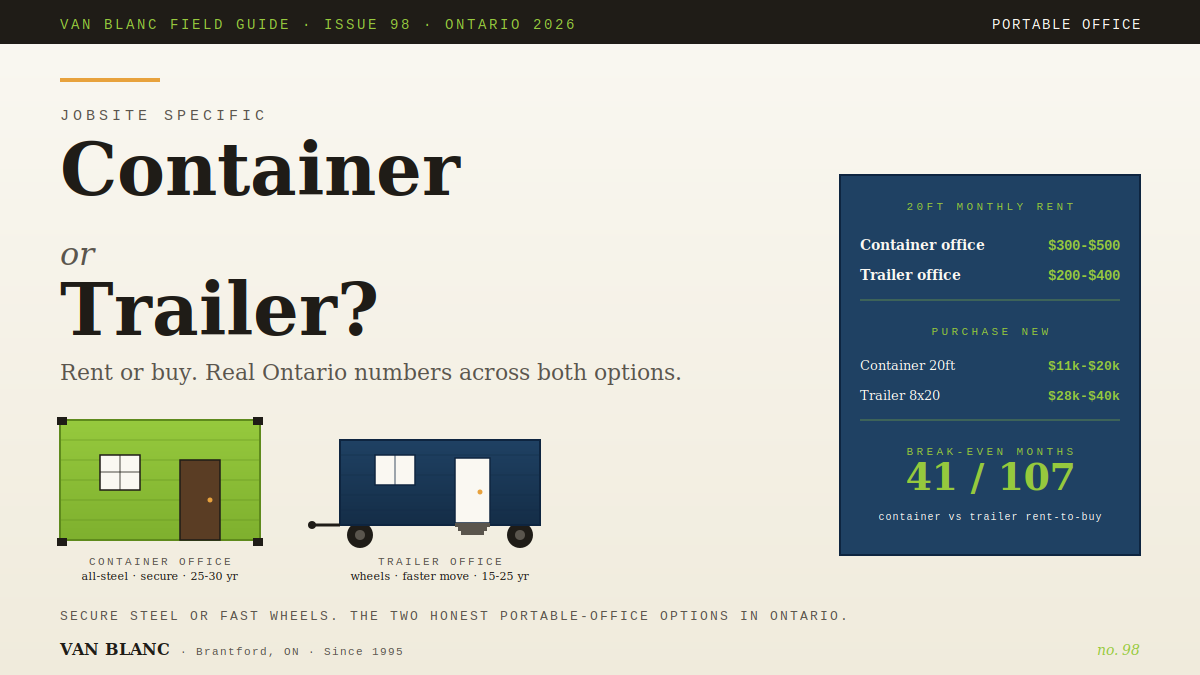
Quick Answer: A portable office in Ontario is a jobsite-ready workspace delivered to your site and moved or removed when the project ends. A shipping container office is more secure and weather-durable than a wheeled trailer; a trailer relocates faster. Choose a container for theft-prone or multi-year sites, a trailer for short move-and-go projects. Occupied units need ESA and CSA inspection.
The office’s smaller sibling guards the entrance: the container gatehouse is the version of this building your gate crew will thank you for in January.
In This Guide
- What counts as a portable office in Ontario
- Container office or trailer office: which should I choose?
- What size portable office do I need?
- Should I rent or buy a portable office?
- What drives the price of a portable office in Ontario?
- Delivery, setup, and tear-down realities
- Power, ESA inspection, and HVAC integration
- Use cases by industry
- Paul on what Brantford jobsite customers actually buy
- FAQs
Reading time: about 13 minutes.
If the container route wins your comparison, our ground-level office program covers sizes, options, and the honest ESA split.
What counts as a portable office in Ontario
A portable office is any pre-built workspace structure designed to be delivered to a site, used for weeks or months or years, and then either moved to the next site or removed entirely. Three main types serve the Ontario construction, industrial, and event markets:
- Container office. A modified shipping container with a finished interior, lights, outlets, climate control, and sometimes a washroom. Delivered by tilt-deck or HIAB truck. Sits on blocks or directly on the ground. Steel construction throughout. We walk through full interior fit-outs on our yard conversion program page.
- Mobile office trailer. A purpose-built wheeled trailer with vinyl or aluminum siding, wood-frame interior, integrated HVAC, and finished cabinetry. Towable behind a pickup or larger truck. Sits on a chassis above ground and needs stairs.
- Modular building. A multi-section pre-fabricated building, larger than a container or trailer (often 1,000 to 5,000 square feet), delivered in pieces and assembled on site. Less truly portable, but listed in the same category by some suppliers.
Van Blanc supplies the first category. The units are on our page of container site offices for sale. Trailers and modular buildings come from companies that specialize in those products. This guide covers the decision framework across all three so Ontario buyers can pick the right tool for the job. If your build leans residential rather than jobsite, our walk-through of backyard work-from-home container builds covers that angle.
Why “portable” matters more than “office”
The portable category exists because permanent construction (a stick-built office, or leased commercial space) is too slow, too expensive, or too inflexible for jobsite work that lasts six months to five years. Once the project ends, the structure moves to the next project or returns to the supplier. Buyers who treat portable offices as permanent buildings end up over-spending. Buyers who treat permanent needs as portable end up replacing furniture quarterly.
Container office or trailer office: which should I choose?
A container office and a trailer office are the two products most Ontario portable-office buyers weigh against each other. They serve overlapping use cases, but with meaningfully different trade-offs. A container office is an all-steel box that locks up tight and stays put; a trailer office rolls in on wheels and rolls out fast.

| Attribute | Shipping container office | Wheeled trailer office |
|---|---|---|
| Construction | 14-gauge Corten weathering steel throughout | Steel chassis with vinyl/aluminum siding, wood-frame interior |
| Weather resistance | Excellent in any Ontario weather (rain, snow, hail, wind) | Good when new, declining as siding ages 5-10 yrs |
| Security | Excellent: steel walls, lockable cargo doors, no easy break-in points | Moderate: vinyl siding can be cut, windows can be broken |
| Relocation | Requires tilt-deck truck or HIAB crane. Slower to move. | Tow with pickup or 1-ton truck. Faster to move. |
| Site access required | Truck access plus 12ft minimum clearance for tilt-deck delivery | Truck plus parking space; less precise siting required |
| Setup time | 2-4 hours for delivery and setup | 1-2 hours for hookup and leveling |
| Insulation R-value (factory) | R-12 to R-25 with closed-cell spray foam | R-11 to R-19 with fiberglass batt |
| Ground level vs raised | Ground level (sits on blocks) | Raised on chassis (requires stairs) |
| Lifespan | 25-30 years structural with maintenance | 15-25 years before major refurb needed |
| Resale value | Holds 50-70% after 5 years | Holds 30-50% after 5 years |
Practical rule: pick a container when security matters, when the site sees harsh weather, when long-term use is planned (3+ years), or when you want a structure you can repurpose later. Pick a trailer when frequent relocation is expected (every 6-12 months), when the project is shorter than two years, or when the supplier offers a strong rental package. Our side-by-side breakdown in the office-trailer-versus-container comparison goes deeper on each trade-off.
Paul LeBlanc, owner: “Twenty years ago every jobsite office in Ontario was a trailer. White siding, hitch, wheels. Then the break-ins got worse, and contractors started calling us for a steel box they could lock and leave overnight. Today it runs about 70 percent container offices to 30 percent trailers in our yard. The ones who still want a trailer are usually on a short job where moving it fast beats locking it down.”
The Ontario jobsite reality
Active construction sites in southern Ontario (the GTA, Hamilton, and the Brantford-Cambridge-Waterloo corridor) report container-office theft and break-in attempts at meaningfully higher rates than trailers. Tools left in a container office at end-of-day are far harder to steal than tools in a trailer, where vinyl siding can be cut open in thirty seconds. Sites with a theft history almost always upgrade to container offices regardless of how often they move.
What size portable office do I need?
The right portable office size comes down to crew size, project duration, and amenity needs. These are the common Ontario sizes:
| Size | Container option | Trailer option | Crew supported | Typical use |
|---|---|---|---|---|
| 10ft / 8×10 | 10ft modified container | 8×10 mini trailer | 1-2 workers | Single foreman, security guard hut, gatehouse |
| 20ft / 8×20 | 20ft modified container (most common) | 8×20 single-wide trailer | 3-6 workers, plus desks | Standard small jobsite office |
| 30-32ft | 30ft custom container | 10×32 single-wide trailer | 6-10 workers | Mid-size construction site, lunchroom split |
| 40ft / 10×40 | 40ft modified container | 10×40 single-wide trailer | 8-15 workers | Large jobsite, conference room option |
| 40HC / 10×40 HC | 40ft high cube container (9.5ft ceiling) | n/a (trailers don’t ship high-cube) | 8-15 workers + storage | Premium build, accessible, conference |
| Double-wide / multi-container | 2-4 connected containers | Double-wide trailer | 15-40 workers | Large projects, full office complex |
The 20-foot container office is by far the most common Ontario size for general-contractor and trades jobsite use. It fits three to six people comfortably with workstations, can take a small kitchen and washroom, and arrives on a single tilt-deck delivery. 40-foot units add more in delivery and site prep but give meaningfully more workspace for larger crews. If your crew runs cold-sensitive equipment alongside the office, our notes on how insulation behaves in an Ontario winter are worth a read before you spec the build.
Should I rent or buy a portable office?
The rent-or-buy decision for a portable office generally splits along project duration and how often you will use it. Here is the way the choice breaks down in practice.
Typical rental situations
- Project duration under two years
- One-time project (no follow-up sites planned)
- Cash-flow-sensitive operations
- You don’t want to handle storage between projects
- You want delivery and tear-down service included
When buying wins
- Project duration over three years
- Multiple sites needed over time (rotate the same office)
- Capital budget available, depreciation can be expensed
- An end-use plan exists (sell at project end, repurpose, or store)
- You want to customize beyond what suppliers offer on rental units
The break-even few customers actually run
A container office crosses over from rent to buy faster than most people expect, usually somewhere between the third and fourth year of continuous use, because its purchase cost is low relative to its monthly rental rate and it holds resale value well. A trailer office takes far longer to reach that crossover, which is why most trailer-office users rent rather than purchase. If you have three or more years of use ahead, ownership is almost always the cheaper path. An equipment loan through your own bank or financer covers businesses that want the monthly shape on an office they own from day one (we sell, we do not rent).
What drives the price of a portable office in Ontario?
The price of a portable office in Ontario is not one number. It is built from several drivers, and a quote that ignores any of them is the quote that grows once the truck is booked. The factors that move the figure most:
- Size and configuration. A 10ft foreman hut, a 20ft standard office, and a 40ft high cube with a conference room sit at very different points. Each added door, window, and partition adds to it.
- Container vs trailer, and grade. A new (one-trip) container office finishes cleaner and lasts longer than a used cargo-worthy unit; the grade you start from sets the floor.
- Rental term vs purchase. A month-to-month rate is higher per month than a 12-month commitment, and purchase removes the recurring cost entirely.
- Modifications. Washroom, kitchenette, extra electrical, insulation level, and HVAC all stack on top of the base unit. Our interior build-out options lay out what each addition involves.
- Delivery distance and access. Distance from our Brantford yards, the type of truck the site needs, and any tilt-deck or crane requirement all factor in.
- Season and the steel market. Container costs track the global steel market, and winter delivery routes in Northern Ontario carry a freight premium.
This is why Van Blanc quotes each office per order, starting from the posted price for the box. A box price alone never reflects your actual site. Tell us the size, the configuration, and your postal code, and Paul or Christian will send back an honest, all-in figure, usually the same day. For a focused look at the rental side, our rundown of what moves a mobile-office rental quote breaks the drivers down further.
Delivery, setup, and tear-down realities
Delivery logistics decide whether a portable office is actually portable on your site. A container office needs a tilt-deck or HIAB-equipped truck with twelve feet of vertical clearance and 60 to 80 feet of approach length. A trailer office can be towed by a heavy-duty pickup with the right hitch class. Different sites suit different products.
Container office delivery requirements
- Truck access. Twelve feet of vertical clearance through gates, under trees, and under wires. 60 to 80 feet of approach length for tilt-deck delivery.
- Ground conditions. A level pad able to support the container weight (roughly 4,000 kg for an empty 20ft, 8,000 kg for an empty 40ft). Concrete blocks or a compacted gravel pad are recommended.
- Setup time. One to three hours from truck arrival to leveled and powered. Add one to two hours if the site needs prep first.
- Delivery logistics. Most of southern Ontario is a 1-3 day delivery from our Brantford yards; Eastern and Northern routes take longer and carry a freight premium. The way the route is priced is covered in our guide to how your container gets delivered across Ontario.
Trailer office delivery requirements
- Truck access. Wide enough to tow a 10-foot-wide trailer plus turning radius (typically a road or access lane at least fourteen feet wide).
- Ground conditions. A level pad with hookup access (power, sometimes water and sewer). Stair access space required.
- Setup time. Thirty minutes to two hours depending on amenities.
- Delivery. Towed in on a single trip for most routes; longer hauls add to the cost.
The single most-overlooked site-access constraint
Container offices need fourteen feet of vertical clearance during the tilt-deck unloading process (the truck arm lifts the container above the trailer bed to slide it onto blocks). A twelve-foot gate or an overhead branch blocks delivery even though the parked container only sits eight to nine feet tall. Check overhead clearance at every gate and turn before booking delivery.
Power, ESA inspection, and HVAC integration
Power and inspection are non-optional for an occupied portable office. Both container and trailer offices need electrical service for occupied use, and Ontario law requires an Electrical Safety Authority (ESA) inspection of any portable office that workers will occupy.
Container offices fall under ESA’s Special Purpose Equipment standard, SPE-1000-13. Our walkthrough of the container electrical and ESA process in Ontario covers it in full. Trailer offices typically ship from the manufacturer with factory CSA certification (the trailer is a single product, certified once) and only require a site-connection inspection.
Heating and cooling on an Ontario portable office is non-negotiable. Winter lows of -20 to -30 Celsius and summer humidity over 30°C make unheated or uncooled offices unworkable. Common HVAC configurations:
- Mini-split heat pump. 12,000 to 24,000 BTU. Best efficiency, requires a 240V circuit.
- Wall-mounted PTAC. A through-wall package unit, plug-and-play. 12,000 to 18,000 BTU.
- Baseboard heat plus window AC. Lowest upfront cost, lowest efficiency.
- Roof-top HVAC. A trailer-specific factory option, premium tier.
Insulation matters as much as HVAC sizing. An uninsulated 20ft container office in Sudbury at -25°C needs roughly 18,000 BTU of heating. The same container with R-15 spray foam needs about 8,000 BTU. Spending on insulation upfront saves multiple times that in HVAC capacity and ongoing energy.
Backyard Office Pod or Container Office: What Are Pod Shoppers Actually Paying For?
The prefab backyard office pod is the polished cousin of everything on this page: architect-styled, glass-fronted, and priced like it. What the brochure price buys is finish, and finish is real value if the pod sits ten feet from a client-facing patio. What it does not buy is steel. A container office conversion starts from a structure rated to cross oceans, takes the same insulation, electrical, glazing, and cladding a pod carries, and leaves budget over, usually enough to cover the interior fit-out entirely. It also stays a movable asset: when the home office era ends, a pod is a permanent landscape feature and a container gets resold or repurposed as something else entirely. If the pod look is the goal, a glazed man door and wood cladding on a one-trip box gets within squinting distance of it.
Use cases by Ontario industry
Portable office use cases vary widely by Ontario industry, and the right size and grade follow the work. The common patterns:
| Industry | Typical size | Why portable office fits |
|---|---|---|
| General construction | 20ft container or 8×20 trailer | Site office, plans review, foreman base, theft-resistant tool storage |
| Heavy civil / utility | 40ft container or 10×40 trailer | Multiple foreman, conference table for plan reviews, storage of survey equipment |
| Mining / forestry (Northern Ontario) | 40ft insulated container | Remote-site office, off-grid solar, insulation for -40°C winter |
| Agriculture / cannabis cultivation | 20ft container office, sometimes paired with reefer | Farm office, crop monitoring, secure document storage on-site |
| Retail / pop-up | 20ft modified container | Brandable, weatherproof, secure at end-of-day |
| Events / festivals | 20ft container or 8×20 trailer | Volunteer registration, security station, vendor coordination |
| Manufacturing / industrial | 40ft container or modular | Plant-floor supervisor office, QC inspection station, on-site break room |
| Government / municipal | 40ft modular or trailer | Field office, document processing, public-facing service point |
Paul on what Brantford jobsite customers actually buy
Van Blanc has supplied portable office containers across Ontario since the early 2000s, and Paul has watched the buying patterns shift across three decades of GTA, Hamilton-Halton, and Brantford-Cambridge-Waterloo construction work.

Christian, his son, adds the modern observation: “We deliver 20-foot container offices to construction sites in Brampton, Mississauga, and across the GTA almost every week. The two questions every customer asks are how fast we can get it there, and whether the electrical will pass ESA. The answers are one to three days, and yes if we route the build through a certified fabricator. The buyers who shop on those two factors come back to us for the next site.”
Three buyer archetypes Paul sees on Brantford yard visits
Three buyer types show up most often at the Brantford yard, and each one lands on a different configuration:
- The mid-size GC. An 8-to-15-person crew. Wants a 20-foot container office, plug-and-play electrical, delivered to the next jobsite within a few business days. Pricing sensitivity is moderate; reliability sensitivity is high. Usually buys outright after the second project, once rental costs have added up.
- The single-trade specialist. A plumbing, electrical, or HVAC sub with a 2-to-5-person crew. Wants a 10ft or 20ft container office, basic spec, with secure tool storage built in. Often rents from a fleet on the first job to test the workflow, then buys from us the second time around, when the math becomes obvious.
- The municipal or industrial buyer. Larger contracts, longer projects. Wants a 40-foot or paired-container office complex with conference space, a washroom, and document storage. Buys outright with a capital allocation, and the office moves to the next contract when this one closes.
Worth the drive to Brantford
Buyers comparing portable office options regularly visit our Brantford yard at 90 Morton Avenue East to walk through container office configurations in person. You can see a finished 20ft office with electrical roughed in, compare 40ft and 40HC layouts, and walk through the modifications that turn a stock container into a jobsite-ready office. We keep 200-plus containers in stock and pair with certified fabricators for the full ESA-rated build. Most Ontario suppliers don’t let you pick the box. We do.
Go Deeper: Detailed Topic Guides
For more depth on specific aspects of this topic, see our spoke articles:
More from this cluster
Deeper reads we’ve added since the original guide:
Sold outright. Delivered in 1 to 3 days.
Van Blanc sells new and used shipping containers outright from our 4 Brantford yards, with delivery in 1 to 3 days and payment on delivery. We do not rent, lease or offer rent-to-own. Request a sale quote or call the yard at 519-754-6844.
Frequently asked questions
Is a container office cheaper than a backyard office pod?
Generally yes for comparable interior spec, because the pod price carries its architectural shell while the container starts from working steel. The gap depends on grade, glazing, and finish level. Describe the office you want at 519-754-6844 and we will price the container version against the pod quote you are holding.
What is a portable office?
A portable office is a pre-built workspace structure designed for delivery to a site, occupancy for weeks to years, and relocation or removal at project end. Three main types serve Ontario: modified shipping containers, wheeled trailer offices, and modular multi-section buildings. Each suits different jobsite needs, durations, and budgets.
How much does it cost to rent a portable office in Ontario?
Rental cost from a fleet operator depends on size, configuration, and lease term. A standard 20ft container office rents for less than a 40ft unit with a washroom and conference space, and a month-to-month rate runs higher than a 12-month commitment. Delivery, ESA inspection, and tear-down are typically additional. Van Blanc sells rather than rents, and every office we deliver is owned outright from day one. Tell us the size and your postal code and we’ll send back an honest, all-in number, usually the same day.
Should I rent or buy a portable office for my construction site?
Renting fits a shorter, one-time project on the monthly math; buying pays once you have three or more years of use ahead, or multiple sites over time. A 20ft container office reaches its rent-versus-buy crossover somewhere between the third and fourth year of continuous use, and the math typically favours purchase for ongoing use because the container holds resale value better than rental costs accumulate.
What is the difference between a container office and a mobile office trailer?
Container office: all-steel construction, better security and weather durability, ground-level access, requires tilt-deck or HIAB delivery, 25-30 year lifespan. Trailer office: chassis with wheels, vinyl/aluminum siding, raised access via stairs, towable behind a pickup, 15-25 year lifespan with maintenance. Pick container for security; pick trailer for fast relocation.
How long does it take to set up a portable office?
Container office: one to three hours from truck arrival to leveled and ready, assuming the site is pre-prepped. Trailer office: thirty minutes to two hours. Add four to eight hours for ESA inspection if it is not already certified. Add one to three days for the power utility connection from the start of installation.
What size portable office do I need for my crew?
10ft for 1-2 workers (foreman station, security hut). 20ft for 3-6 workers with desks (standard small jobsite). 30-32ft for 6-10 workers (mid-size site with split lunchroom). 40ft for 8-15 workers (large project with conference option). Multi-container or double-wide for 15-40 workers (full office complex).
Do I need ESA certification for a portable office in Ontario?
Yes, for any portable office used as occupied workspace. Container offices require an ESA Special Purpose Equipment field evaluation (SPE-1000-13). Trailer offices typically arrive with factory CSA certification but still need a site-connection inspection. We route container builds through a certified fabricator so the electrical passes the first time.
Can I move a portable office between jobsites?
Yes, both types are designed for relocation. Moving a container office to a new site requires a tilt-deck truck or HIAB crane each time, which is a third-party hauling service the customer arranges. Trailer offices tow with a pickup or 1-ton truck. Trailers are faster to relocate, but containers are more durable through repeated moves.
What is the lifespan of a portable office in Ontario?
Container office: a 25-30 year structural lifespan with basic maintenance. Trailer office: 15-25 years before major refurbishment is needed (vinyl siding replacement, roof maintenance, wood-frame inspection). Containers hold resale value better (50-70% after 5 years) than trailers (30-50% after 5 years).
Can a portable office have a washroom?
Yes. Container offices can take a factory-built or field-modified washroom including a toilet, sink, and holding tank or sewer hookup. Trailer offices offer it as a factory option, often standard on 10×32 and larger units. The washroom adds size, weight, and complexity, but is essential for sites without nearby facilities.
What is the most economical portable office option in Ontario?
A basic 8×20 trailer office on a 12-month rental commitment is typically the lowest entry point, and a used 10ft container office is the lowest purchase price. The trade-off: the most economical options have minimal amenities and may not meet ESA certification as occupied space without upgrades. Tell us the use and we’ll point you to the honest fit.
Does Van Blanc deliver portable offices?
Yes, we deliver modified shipping container offices across Ontario in one to three days from our four Brantford yards. We supply the container and standard modifications, and we partner with certified fabricators for the ESA-rated electrical buildout. For wheeled trailer offices we refer customers to trailer-specific suppliers. Most Ontario container suppliers don’t let you pick the specific bin. We do.
Sources
- Canadian Standards Association. (2024). CSA C22.1:24 Canadian Electrical Code, Part I. csagroup.org
- Canadian Standards Association. (2023). SPE-1000-13: Model Code for the Field Evaluation of Electrical Equipment. csagroup.org
- Sunbelt Rentals. (2024). Portable Structures vs Mobile Office Trailers: A Comparison Guide. sunbeltrentals.com
- Boxx Modular Canada. (2024). Portable Office Trailers: A Complete Buying Guide. boxxmodular.ca
- Electrical Safety Authority. (2024). Special Purpose Equipment Field Evaluation. esasafe.com
Reach Van Blanc in Brantford
We have supplied shipping containers across Ontario since 1995. Our warehouse is at 90 Morton Avenue East in Brantford, and we deliver across Ontario in one to three days from our four Brantford yards. No surprise fees, no chase-the-paperwork. Every quote comes with a real lead time, not a hopeful one.
Van Blanc Ent. Inc. 90 Morton Ave E Unit 1B, Brantford, ON N3R 7J7. +1 888-509-6658
Walk our yard before you buy. You can see 20ft container office configurations side by side, compare 40ft layouts, and walk through what the modifications and ESA-certified electrical buildouts look like in real life. With 200-plus containers in stock, you pick the bin and we deliver. Most Ontario container suppliers do not let you choose. We do. When you are ready to commit, you can browse what’s on the lot through our containers available for purchase.
Related Reading
Ready to price your container?
Tell us the size and your postal code and we’ll send back an honest, all-in number, container, delivery, and placement, usually within 1-3 days. No pressure, no mystery fees.
Family-run in Brantford since 1995 · 200+ containers in stock · 4.9★ across 140+ Google reviews · every box graded by a person, walk it before it lands.