
Quick Answer: A backyard sauna and cold plunge setup works when the two stations sit within a few steps of each other, with safe winter footing between them. Plan the transition first, then the equipment. Heat rounds alternate with one-to-three-minute cold immersions, and the layout decides whether February feels glorious or dangerous.
In This Guide
- What a Sauna and Cold Plunge Setup Actually Is
- The Transition Triangle: Layout Before Equipment
- Choosing the Heat Side
- Choosing the Cold Side
- The Power and Water Reality Nobody Itemizes
- What Does February Do to a Backyard Spa?
- The Container Spa Build: One Shell, Both Stations
- Deck Setup or Steel Shell
- Sequence and Safety, Told Straight
- Sauna and Cold Plunge FAQs
Reading Time: 14 minutes
What a Sauna and Cold Plunge Setup Actually Is
Picture the sequence on a January night in Brant County: fifteen minutes in cedar heat, steam rising off your shoulders as you cross four steps of cleared deck, then the gasp of ten-degree water, sixty seconds of it, then back toward the glow of the sauna door. That loop, repeated three or four times and finished cold, is contrast therapy, and the pairing of a heat station with a cold station in one backyard is what people mean when they search for a sauna and cold plunge setup.
The definitional part is simple. A sauna is an insulated hot room, traditionally wood-lined, running roughly 77 to 88 degrees Celsius (170 to 190 Fahrenheit) with a wood-fired or electric heater. A cold plunge is a tub of deliberately cold water, usually held between 7 and 13 degrees Celsius (45 to 55 Fahrenheit), either chilled mechanically or, in a Canadian winter, chilled by the simple fact of being outside. The setup is the third thing, and it is the thing this guide is actually about: the site, the spacing, the power, the water, and the footing that connect the two stations into something you will still be using in year five. One Ontario company sells both halves of that sequence under one warranty desk, and Coldture, reviewed honestly says where that helps and where it does not.
We should say up front what we sell and do not sell. Van Blanc supplies shipping containers and container conversions from our Brantford yard; we do not sell barrel saunas or plunge tubs, so we have no horse in the equipment race. What we have watched, through the custom-features side of our shop, is a steady run of buyers turning sealed steel into exactly this kind of backyard room, and that experience is the honest basis for the container section further down.
The Transition Triangle: Layout Before Equipment
Every guide from the equipment sellers starts with which sauna to buy. Start earlier. The setups that get used four times a week share one geometry, and it costs nothing at planning stage: the sauna door, the plunge, and the towel-and-robe station form a tight triangle, with no leg of it longer than a few steps.
Laying Out the Triangle
- Sauna to plunge: three to six steps. The vascular effect of contrast comes from a fast switch. Thirty metres of icy lawn between stations is not a transition, it is an errand, and errands kill the habit by March.
- Plunge to towels: one reach. Wet hands do not want to open latches. Hooks or a deck box beside the tub, not back at the house.
- Everything to the house: one lit path. The session ends relaxed, barefoot, and in the dark. The walk back should be boring.
- Drainage away from all three. Every exit from the plunge carries litres of water onto whatever is underfoot. In July that is nothing. In February it is a skating rink being poured twice a round.
Deck designers writing about contrast retreats suggest a compact deck of roughly 12 by 16 feet comfortably carries a small sauna plus a plunge tub, and our observation from delivery work agrees: the footprint is rarely the constraint. The constraint is that the triangle usually wants to live near the house for power and water, while the nicest corner of the yard is usually the far one. Power wins that argument almost every time, for reasons the next sections make concrete.
Choosing the Heat Side
The heat station comes in four families, and the honest sorting is by what feeds them rather than by brochure photography. A wood-fired sauna needs no electrical service at all, produces the hottest, most traditional experience, and asks you to be its fireman for forty-five minutes before every session. An electric-heater sauna heats on a timer but typically wants its own dedicated 240-volt circuit, which is a licensed-electrician conversation before it is a shopping conversation. Infrared cabins run cooler on ordinary household power and suit people chasing convenience over ritual. And the barrel sauna, the most popular kit format in Ontario, can carry either heater type inside its distinctive staved shell; we are publishing a separate honest guide to barrel saunas in this same series, so here we will only say that its round profile sheds snow well and its small air volume heats fast.
What matters for the setup is less which family you pick than three placement facts that apply to all of them. Heat wants clearance: every manufacturer specifies distances from combustibles, and a wood-burner adds chimney height and spark separation. Heat wants a level, drained base, the same gravel-or-slab conversation every shed owner knows. And heat wants to face the plunge, door toward tub, so the triangle stays tight and the person exiting at 85 degrees is not navigating around a corner blind with steam.
Paul LeBlanc, Van Blanc: “I spent forty years moving goods out of Asia and nineteen in containers, and the wellness wave is the first time I have watched the same buyers order a sea can for the gym, then call back about a second one for the sauna. The lesson from the yard is always the same: the people still using the setup in year three are the ones who planned the walk between hot and cold, not the ones who bought the biggest heater.”
Choosing the Cold Side
The cold station is simpler and lies about it. The market runs from stock tanks through insulated barrels to purpose-built tubs with integrated chillers and filtration, and the differences reduce to three questions.
First: who holds the temperature? An unpowered tub in an Ontario winter holds cold beautifully and freezes just as beautifully; the same tub in July drifts into the twenties and stops being a plunge. A chiller holds a set point year-round in exchange for its own dedicated outdoor circuit and a place to stand out of the weather. Our sister guide on cold plunge tubs in Canada walks the tub market in detail, so this page will not repeat it.
Second: who cleans the water? Unfiltered water is a dump-and-refill commitment, fine for a stock tank on a farm with a yard hydrant, tedious on a suburban water bill. Filtration plus sanitation stretches water for weeks and adds pump maintenance to your winter.
Third: where does the splash go? A plunge beside a cedar deck stains it; beside a sauna’s electrical disconnect it does worse than stain. The tub belongs on the drained, gritted leg of the triangle, never uphill of the footing people land on barefoot.
The Power and Water Reality Nobody Itemizes
Here is the section the equipment blogs skip, and the reason the far corner of the yard usually loses. A full contrast setup can ask for as many as three separate electrical mouths: the sauna heater’s dedicated 240-volt circuit, the chiller’s dedicated outdoor circuit, and ordinary receptacle power for lighting and pumps. Every metre of trench between the panel and the triangle is money, and every one of those connections is licensed-trades work in Ontario. That is the same split we state plainly on our conversion jobs: our shop preps and roughs in structure, openings, and chases at the yard, and the customer’s licensed electrician completes and certifies the connections on site. Any seller who blurs that line for you, on a sauna or on a container, is telling you something about their other corners too.
Water is the quieter line item. The plunge wants filling, topping, and seasonal draining; a frost-free yard hydrant or an insulated hose run beats hauling buckets by November. And meltwater plus splash-out needs somewhere to go all winter, which is why the gravel apron detail from shed-world shows up under the best spa decks: it drinks the splash and gives boots grit instead of glaze.
One sentence on paperwork, because it is the owner’s side of the project: permits are managed by your municipality, so check with your local building or planning department before you order anything large enough to matter.
What Does February Do to a Backyard Spa?
February is the month the whole setup was for, and the month that audits it. Cold-climate users report the same three failure points, none of which are the equipment.
Footing fails first. Splash-out freezes in sheet layers exactly where hot, barefoot, vasodilated people land at speed. The fixes are unglamorous and total: rubber matting or grit on every leg of the triangle, a stiff broom parked by the tub, and the discipline to clear between rounds.
Textiles fail second. A towel left on a rail at minus fifteen is a board within one sauna round. Winter regulars keep towels and robes inside the sauna’s changing area or in a deck box with a lid, and put the after-session boots there too.
Lighting fails third, by omission. Contrast sessions run at night for most working people, and the triangle needs enough low, warm light to read the ice by. String lights are atmosphere; a fixture over the plunge steps is safety.
None of this is a reason not to build. It is the reason to build the triangle deliberately, and it is also the strongest argument for the option that puts a roof and walls around the cold half of the ritual, which brings us to the part of this guide we know from the inside.
The Container Spa Build: One Shell, Both Stations
Somewhere around this point in the planning, a certain kind of buyer looks at the triangle, the trench, the frozen towels, and asks whether the whole thing could just live indoors without building an addition. That is the container spa build, and it is the conversion our Brantford shop has been asked for more and more since the wellness wave started.
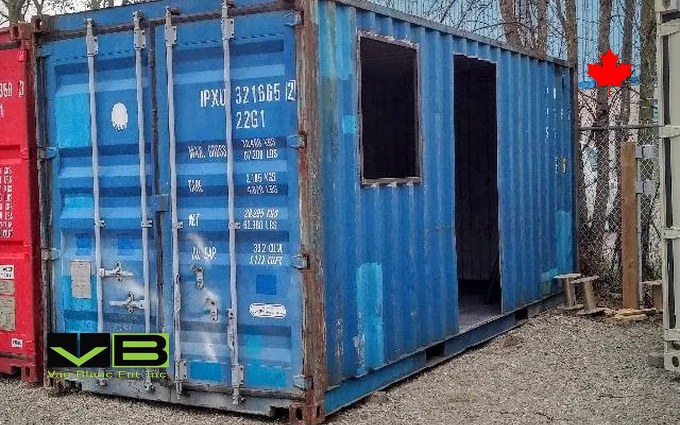
The logic is straightforward. A 20-foot or 40-foot high cube is a sealed, wind and watertight steel room with 2.7 metres of headroom in the high cube format. (Format numbers live in the size and dimension tables.) Our shop cuts and frames the openings, installs insulation and interior structure, and roughs in the chases at the yard, under engineered drawings; your licensed trades finish the wet and electrical work on site. The result holds a sauna cabin at one end, a plunge and changing area at the other, and puts the entire transition triangle under one roof where February cannot reach it. The walk from heat to cold happens on a dry floor, the towels never freeze, and the whole room locks like the shipping asset it started as. (What that lock hardware can actually be is its own short read.)
Standalone pieces suit a buyer who already has a good deck near the house and loves the under-the-stars part of the ritual. If you are trenching services a long way anyway, if security matters on your road, or if you want the spa to survive being ignored for a month, the steel shell starts winning. We wrote up the wet-room side of these builds in our container sauna conversion guide and the tub-in-steel variant in the hot tub conversion piece, and the broader custom program lives on our custom features page.
Thinking in Steel?
Sketch us the room, hot end and cold end, and tell us where it is going. The quote covers the shell and the shop work in one honest, all-in number, with a real lead time, not a hopeful one. Fast 1-3 day delivery across Ontario from our Brantford yards, and you are welcome to walk a high cube before you commit to anything. Those bare shells start life as new one-trip stock.
Van Blanc Ent. Inc. · Family-run since 1995 · 4.9 stars across 140+ Google reviews · Every quote comes with a real lead time
A conversion earns its price when the shell is solving real problems, and only then.
Deck Setup or Steel Shell: The Same Ritual, Two Homes
Because the two paths price and plan so differently, here is the comparison laid flat. Neither column is the winner; the winner is whichever column matches your yard, your road, and your tolerance for February.
| Decision factor | Standalone deck setup | Container spa build |
|---|---|---|
| Time to first session | Fast: kit sauna and tub can run within weeks | Slower: shop conversion under engineered drawings, then site trades |
| Winter transition | Outdoors; footing and textiles need managing every session | Indoors on a dry floor, behind a closed door |
| Under-the-stars factor | The whole point; unbeatable | Gone, unless you add glazing or plunge outside the door |
| Security | Equipment sits in the open | Lockable steel shell, lockbox-ready |
| Trades needed | Electrician for heater and chiller circuits | Same trades, plus the shop work we do at the yard first |
| If you move or sell | Pieces sell separately, deck stays | The room itself can be craned out and sold or relocated |
Three real buyer shapes keep showing up on our quote calls, and they sort themselves cleanly. The shift worker with a small urban yard in Brantford or Toronto wants the deck setup: the triangle fits beside the back door, the power run is short, and the ritual doubles as time outside. The hockey family on a rural half-acre drifts toward the shell, because the same room that recovers a parent’s back on Tuesday absorbs a teenager’s team on Saturday, and nothing walks away while everyone is at work. And the acreage owner already ordering a container for equipment storage asks the question that starts half these projects: if one sea can is coming on the truck anyway, what would a second one cost to arrive as a spa? (New to the vocabulary entirely? The sea can name has a story.) That last call is exactly what the quote line is for.
Sequence and Safety, Told Straight
The protocol itself is short enough to memorize, and consistent across the practitioner guides we reviewed for this piece. Heat for ten to fifteen minutes. Cold for one to three. Rest until breathing settles, then repeat, most people running two to four rounds and finishing on cold. Beginners start with shorter cold and fewer rounds; the practice builds quickly.
The cautions deserve equal billing, and we state them the way the wellness industry sometimes does not. Contrast therapy stresses the cardiovascular system on purpose; that is the mechanism. Anyone on blood pressure medication, anyone with a heart condition, and anyone pregnant should talk to their physician before starting, and nobody should plunge alone at night in winter, because cold-water gasp reflex plus icy footing is a genuinely bad combination. Alcohol and contrast rounds do not mix. The people who get years of good out of these setups treat those rules as part of the ritual, the same way the towel hooks and the broom are.
The whole guide compresses to one planning instruction: design the ninety seconds between hot and cold as carefully as you shop for either machine, because that walk, not the equipment, is what you will actually be living with in February.
Sauna and Cold Plunge FAQs
How far apart should the sauna and cold plunge be?
Within a few steps, ideally three to six. The physiological effect of contrast comes from switching quickly between heat and cold, and the habit survives winter only when the transition is short, lit, and gritted. If the two stations cannot live close together, fix the site plan before buying anything.
What temperatures should each station run?
Practitioner guides converge on sauna air around 77 to 88 degrees Celsius (170 to 190 Fahrenheit) for traditional stoves and plunge water around 7 to 13 degrees Celsius (45 to 55 Fahrenheit). Beginners start at the warm end of the cold range and the short end of each interval, then progress.
Do I need special electrical work for a backyard spa setup?
Usually yes. Electric sauna heaters typically require a dedicated 240-volt circuit and chillers want their own outdoor circuit, and in Ontario those connections are work for a licensed electrician. Wood-fired heat plus an unpowered tub is the one configuration that can run without new service.
Can a sauna and cold plunge run through a Canadian winter?
Yes, and winter is the best season for it, provided the setup was planned for footing, drainage, and frozen textiles. Splash-out ice on the transition path is the real hazard, managed with grit, matting, and clearing between rounds. Equipment handles the cold better than pathways do.
What is a container spa build?
A shipping container converted into a weatherproof spa room, sauna at one end, plunge and change area at the other, with the shop work done under engineered drawings and final electrical and plumbing completed by your licensed trades. It puts the entire hot-to-cold transition indoors, behind a lockable steel door.
Sources
- Sun Home Saunas. (2026). Home Sauna and Cold Plunge Therapy: Contrast Setup Guide. the contrast setup guide
- Backyard Canada. (2026). Sauna and Cold Plunge: How to Build the Ultimate Recovery Setup in Your Canadian Backyard. the Backyard Canada article
- PlungeHQ. (2026). Sauna and Cold Plunge Contrast Therapy: Protocol, Benefits and Science. the protocol and science page
- Nordik Recovery. (2026). Sauna and Cold Plunge Cost Guides. Nordik’s Canadian cost library
Reach Van Blanc in Brantford
We have been supplying shipping containers across Ontario since 1995. The conversion side of the yard at 90 Morton Avenue East is where the spa shells take shape, and walking a bare high cube is the fastest way to feel whether one room for the whole ritual is your answer.
Van Blanc Ent. Inc., 90 Morton Ave E Unit 1B, Brantford, ON N3R 7J7, 519-754-6844
Bring your yard sketch. Ten minutes with a tape measure inside a container answers most layout questions faster than a winter of second-guessing.