
Quick Answer: Outdoor saunas come in four families: barrel, cabin, pod, and cube, heated either by wood fire or by a 240-volt electric stove reaching temperature in thirty to forty-five minutes. Pick the format by bench room and the heater by your property, then site the whole building around the February walk.
In This Guide
- Why the Sauna Moved Outdoors
- The Four Families, Compared Honestly
- Wood or Electric: The Heater Call
- The Ontario-Made Advantage
- Siting for the Winter Walk
- Kit, Pre-Built, or Custom
- Loyly, Whisks, and the Snow Roll
- Sizing the Room
- Accessories That Are Equipment
- Trying First, and the Used Market
- Where Steel Joins the Category
- Running It: Heat-Up, Upkeep, and the Long Game
- Outdoor Sauna FAQs
Reading Time: 13 minutes
Why the Sauna Moved Outdoors
An outdoor sauna is a small, purpose-built hot room standing in the yard rather than carved out of the basement, and the migration outdoors over the past decade is not fashion alone. Outside, the sauna gets what it always wanted: real ventilation instead of a bathroom fan, a cold Ontario night on the other side of the door for the contrast plunge or snow roll, no humidity arguments with the house, and the psychological distance that makes a session feel like leaving somewhere rather than sitting in a closet. The Finnish tradition the whole category descends from was always an outbuilding tradition, a bathhouse standing apart from the dwelling on every farmstead; North America, after a half-century detour through basement cedar closets, is simply circling back to the original arrangement, and doing it with better stoves. For a maker that sells the sauna and the cold plunge together, see the Coldture sauna and plunge review.
Ontario turns out to be superb sauna country. We have the winters that make heat feel earned, a working cedar-milling industry, and manufacturers building for this climate specifically rather than shipping optimism up from the sun belt. What the buyer needs is a map of the category, because the market now sells at least four distinct shapes, two heater philosophies, and three routes to ownership, and the combinations are not interchangeable. Our own stake, disclosed as always: we sell shipping containers and conversions from Brantford, one of the formats on this map is built from our product, and we will place it honestly among its peers rather than at the top of the page.
The Four Families, Compared Honestly
| Format | Shape and size | Honest verdict |
|---|---|---|
| Barrel | Horizontal cylinder, usually 6 to 8 feet long | Fastest heat-up and lowest running cost per session; the curve taxes bench and headroom, and the bands need seasonal snugging |
| Cabin | House-shaped hut with two or three bench tiers | The most room per footprint and the social pick; heats slower than a barrel and costs more per square foot |
| Pod | Teardrop or arc profile between barrel and cabin | Restores headroom the barrel gives up while keeping a small air volume; the compromise format for tight yards |
| Cube | Modern flat-roofed box, often generously glazed | The architectural choice; glass costs heat and privacy, and flat roofs carry Ontario snow that curves shed for free |
The sorting logic is bench-first. Two people who sauna daily want the barrel’s speed, and everything you should know about that format’s staves, bands, and honest cons lives in our barrel sauna deep-dive. A family or a social sauna wants the cabin’s tiered benches, where a full lie-down is actually possible. The pod earns its place in narrow side yards, and the cube earns its place in photographs, which is a real value as long as the buyer prices the glazing honestly in heat-up time and snow duty.
What all four share is the wood question. Western red cedar remains the category favourite for its rot resistance and its smell, Ontario makers do superb work in eastern white cedar, and thermally modified spruce has become the credible modern rival. The species ladder runs exactly as it does for every wood building we have covered: pay for decay resistance where weather lands, and keep interior surfaces bare, because finishes and bare skin at ninety degrees do not mix.
Wood or Electric: The Heater Call
The heater decision shapes the ownership experience more than the shell does, and it usually decides itself once you look at the property honestly.
Electric is the suburban default for good reasons: push a button, and a properly sized stove has the room at operating temperature, up around 88 degrees Celsius, in thirty to forty-five minutes depending on the season. The honest cost is infrastructure, since these stoves typically want a dedicated 240-volt circuit in the 40-amp class, trenched to the sauna and finished by a licensed electrician. That is the same trades split we itemize in the backyard setup guide, and it belongs in the budget on day one, not as a surprise after the shell arrives.
Wood fire is the tradition, and it needs nothing from the grid: stove, chimney kit, dry wood, and forty-five minutes of pleasant firemanship per session. It runs hotter and less precisely than any thermostat, suits lakeside and off-grid properties completely, and asks two things in return: a woodpile managed a season ahead, and clearances taken seriously, because a stove pipe through a cedar wall is exactly as safe as its installation. Hybrid rigs pairing a rock stove with infrared panels exist for buyers who want a fast warm-up option and a traditional loyly in one room, and they are a legitimate answer rather than a gimmick, at a price.
The Ontario-Made Advantage
The category has a genuine local champion story worth telling straight. Dundalk LeisureCraft builds its sauna line in Ontario from eastern white cedar, and its documented range maps the family sizes cleanly: the Luna seats two to four, the Harmony adds a porch and seats four to six, and the Georgian runs six to eight with a proper change room. Beyond patriotism, the local-build case is physical: cedar milled and assembled in the climate where it will live skips the ocean transit, the storage swings, and the humidity whiplash that stress imported wood before its first season, and warranty conversations happen in your own time zone.
The pattern generalizes past any one maker: Ontario’s sauna industry is real, its lead times are honest, and the freight from a provincial shop to your pad is a fraction of a container crossing from overseas. Buy whichever format genuinely fits your yard and your people, but always price the local build of it first; this is one category where the hometown option is frequently also the best one on paper.
Paul LeBlanc, Van Blanc: “Four decades of moving goods taught me to respect anybody who builds close to their buyer. The Ontario sauna shops have the same advantage we lean on with our four Brantford yards: short freight, real inventory you can walk up to, and no story about a ship. When a customer asks me whether to import a sauna kit, I tell them what I would tell myself: go see the one built an hour away first.”
Siting for the Winter Walk
An outdoor sauna is used or abandoned based on thirty metres of February, and siting decides which. The rules are short. Put the sauna close enough that the robe walk is a dash, not an expedition, and light the path, because sessions happen at night. Give the door a cleared, gritted landing, since bare feet and ice are the category’s one real injury story. Set the shell on drained, stable ground, the same pad logic every structure on this site obeys, and leave air around the walls so cedar dries between storms. Wood-fired builds add chimney clearances and a wood stack within arm’s reach of the door; electric builds add the trench line, dug once, properly, before the landscaping goes in. And one sentence covers the paperwork, as ever: permits are managed by your municipality, so check with your local building or planning department before you order.
Kit, Pre-Built, or Custom
Ownership arrives by three roads. The kit is the value road: barrels especially arrive palletized and go up in an afternoon or two with two people, and cabin kits run a weekend or three. The pre-built road delivers a finished sauna on a trailer and lifts or rolls it into place, trading money for weekends and demanding the same access audit as any delivered building: gates, wires, branches, and the turning arc, the identical geometry test we run before any container hits a laneway. And the custom road builds exactly the sauna the property wants, on a deck, into a hillside, or inside an existing structure, at carpenter prices and carpenter quality.
The honest sorting: kits reward capable hands and patience, pre-built rewards clear access and impatience, and custom rewards a specific vision with a specific budget. None of the three is wrong; buying one while wanting another is.
Loyly, Whisks, and the Snow Roll
Because half the pleasure of the category is cultural, the vocabulary deserves a short chapter. Loyly is the Finnish word for the steam that rises when water hits the stones, and it is the whole point of a traditional sauna: dry heat opens the session, and thrown water swings the room humid in waves the bathers control, ladle by ladle. The whisk, a bundle of birch or oak leaves called a vihta, gets dipped and slapped lightly over the skin, part massage and part maple-scented aromatherapy, and Ontario’s birch supply makes it an easy tradition to adopt. The cold half of the ritual is not optional in the tradition either: a roll in the snow, a cold bucket, or the full plunge, which is where the cold plunge conversation joins this one. Sessions run in rounds, heat to cold and back, finishing cold, and the whole cycle is social by design; the sauna was the original Finnish meeting room, and it works exactly the same way at a Grey County farmhouse or a Muskoka shoreline, wherever hot steam finally finds the waiting cold.
Sizing the Room: Benches, Stones, and the Stove Match
Sauna sizing is a three-way match that kit sellers print in tables and buyers routinely ignore. Benches first: a seated adult wants roughly two feet of bench width, and a lie-down wants six, so a family of four sharing sessions needs eight-plus feet of upper bench, which is cabin territory no matter what the barrel brochure implies. Stove second: heaters are rated to a cubic-metre range, and an undersized stove in a generous room runs flat-out forever without ever making proper loyly, while an oversized one short-cycles; match the stove to the room’s actual volume including the vaulted bits. Stones third: more stone mass means steadier heat and better steam, which is why serious stoves hold serious rock, and why the stones themselves, dense, unsplit, arranged loosely for airflow, are equipment rather than decoration. Get the three-way match right and any format on this page performs; get it wrong and no format can.
The Accessories That Are Actually Equipment
Most sauna accessories are gifts; a few are instruments. The thermometer-hygrometer pair is the difference between guessing and running the room, since the same eighty degrees feels entirely different at ten percent humidity and forty. The bucket and ladle are the loyly controls, wood or steel, never plastic near the stove. A sand timer on the wall beats every phone, which should stay in the house anyway, both for the electronics and for the point of the exercise. Headrests turn the upper bench into furniture. And the humble door wedge earns its place the first time a session needs air in a hurry. Everything else, lighting kits, salt walls, sound systems, is taste, and taste is allowed, but the instrument list above is the difference between owning a sauna and operating one.
Trying First, and the Used Market
Two money-saving routes deserve daylight before anyone signs for a new build. The first is renting the experience: mobile sauna operators now tow wood-fired barrels and trailers to driveways and lakefronts across Ontario for a weekend at a time, and one rented February weekend answers the only question that matters, whether your household will actually use the thing, for a fraction of a purchase. Couples who sauna twice in the rental weekend buy with confidence; households whose rental sat cooling by Sunday just saved themselves a very expensive lawn ornament.
The second is the used market, which is genuinely liquid because saunas outlive enthusiasm. A second-hand cedar sauna is inspected the way we inspect used steel: structure first, cosmetics last. Check the base and the lowest course for rot, since ground contact kills cedar buildings the same way it kills sheds. Check the stove: elements and controls on electric units, firebox and chimney condition on wood, and the stones, which should be dense and unsplit rather than crumbling. On barrels, read the bands and the stave joints. A sound used cabin at half price, moved carefully, is one of the category’s best buys; a soft-bottomed bargain is a demolition project with a chimney.
Where Steel Joins the Category
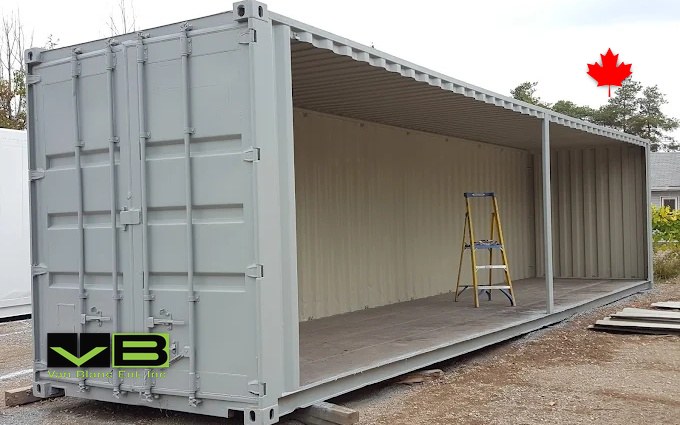
And then there is the fifth format, the one we build. A container sauna puts the hot room inside a steel shell, usually as one end of a larger wellness build with a change area and a plunge, and it belongs on this map with the same honesty we have applied to every other format: it is not the fastest heat-up, not the cheapest entry, and not the prettiest thing beside a flower bed. What it is, is the format for a different brief: security, because the whole build locks like the cargo asset it was; durability, because weathering steel does not care what February does; relocatability, because the finished room craned onto a truck moves house with you; and interior scope, because 320 square feet of shell holds the sauna, the cold side, and the towels in one envelope. The build itself, venting, framing, and closed-cell insulation included, is documented in our conversion walkthrough, and the shop work happens at the Brantford yard under engineered drawings before delivery.
The plain sorting against its peers: one hot room for a family backyard is usually a cedar build, barrel or cabin, often Ontario-made. A weatherproof, lockable spa room that outlives the trend, holds the whole ritual, and could leave with you in a divorce or a move: that is the steel brief, and nothing on the cedar side of the map answers it.
Comparing Formats for a Real Yard?
Describe the yard, the head count, and whether the ritual includes a cold side, and we will size the steel room for it. If steel is the answer, the shell and shop work come back as one honest, all-in number with a real lead time, not a hopeful one. Fast 1-3 day delivery across Ontario from our Brantford yards.
Van Blanc Ent. Inc. · Family-run since 1995 · 4.9 stars across 140+ Google reviews · Every quote comes with a real lead time
Running It: Heat-Up, Upkeep, and the Long Game
The ownership rhythm across every format is gentler than newcomers expect. Sessions cost a heat-up, thirty to forty-five minutes electric or one fire’s worth of wood, plus pennies of stones-and-steam once the room is hot. Upkeep is seasonal rather than weekly: cedar exteriors get inspected and, on non-premium species, refreshed; interiors stay bare and get aired after sessions with the door propped; heater stones get checked yearly and reset as they crack; wood stoves get their chimneys swept on the same calendar as any fireplace; and barrels get their bands snugged, the one format-specific chore on the list. The long game rewards exactly what it rewards in every wood building we cover: species chosen for weather, water kept moving off the structure, and an owner who spends one honest hour per season instead of one panicked weekend per decade.
Four cedar shapes, one steel one, two kinds of fire: the outdoor sauna category is small enough to learn in an afternoon and good enough to use for twenty years. Pick benches before brochures, wire or woodpile before either, and put it close enough to the back door that February votes yes.
Outdoor Sauna FAQs
What is the best type of outdoor sauna?
The one matched to your bench count and yard. Barrels heat fastest and suit couples; cabins carry families and social sessions on tiered benches; pods fit tight yards; glazed cubes trade heat efficiency for looks; and steel-shell conversions serve buyers who need security, relocatability, and room for the whole ritual.
How much electrical service does an outdoor sauna need?
Electric stoves typically want a dedicated 240-volt circuit in the 40-amp class, trenched to the building and finished by a licensed electrician. Reaching temperature takes thirty to forty-five minutes depending on size and season. Wood-fired saunas need no electrical service at all beyond lighting the path.
Are outdoor saunas usable through an Ontario winter?
Winter is their best season, and the design tradition assumed it. The practical requirements are a short, lit, gritted walk from the house, ground that drains, clearances respected around wood stoves, and a shell built from weather-rated species. Cold outside is the feature, not the problem.
Is a barrel sauna better than a cabin sauna?
Better at different jobs. The barrel’s small air volume heats fastest and runs cheapest per session, at the cost of bench and headroom; the cabin’s tiered benches hold more people in more comfort and allow a full lie-down, at the cost of slower heat-up and higher price per square foot.
Should I buy an Ontario-made sauna?
Price it first, at minimum. Ontario makers build in eastern white cedar for this exact climate, skip the supply-chain stress imported kits carry, quote honest freight, and answer warranty calls locally. The format decision is yours; the local build of that format is frequently the best version on paper.
Sources
- Field Mag. (2026). Outdoor Sauna Guide: What to Know and Which Type to Buy. the category editorial
- LeisureCraft (Dundalk). (2026). Your Complete Outdoor Sauna Guide. the Ontario builder’s own guide
- Home and Heat. (2026). Best Outdoor Saunas for Home Use: Barrel, Cabin and Pod Options. the format comparison
- My Sauna World. (2026). Outdoor Sauna Guide: Types, Costs, Installation and Backyard Planning. the planning walkthrough
Reach Van Blanc in Brantford
We have been supplying shipping containers across Ontario since 1995, and the steel corner of the sauna map is built at 90 Morton Avenue East, vents cut and framing in, before the truck ever leaves.
Van Blanc Ent. Inc., 90 Morton Ave E Unit 1B, Brantford, ON N3R 7J7, 519-754-6844
Bring the yard sketch and the head count. Sorting cedar jobs from steel jobs is honest work we do weekly, in both directions.