
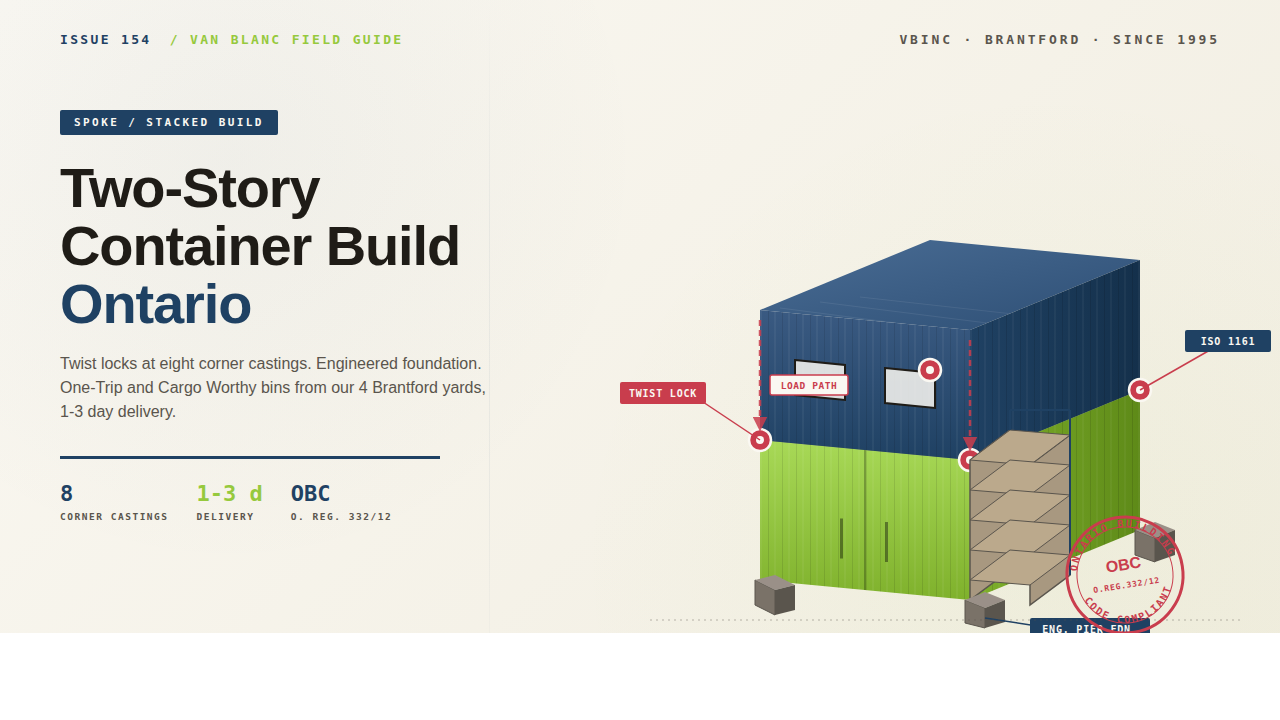
Quick Answer: A two-story shipping container build in Ontario stacks one ISO container on top of another, locked together at the eight corner castings with ISO twist locks so the upper bin transfers its load through the four corner posts of the lower bin. It needs engineered drawings, a poured pier or slab foundation, and the right container grades for the job. Van Blanc supplies One-Trip and Cargo Worthy bins from our 4 Brantford yards, 1-3 day delivery province-wide.
In This Guide
- What is a two-story container build in Ontario?
- Does Van Blanc build the stack or supply the bins?
- Which container grades work best for a stack?
- How do twist locks and corner castings hold a stack?
- What do real Ontario two-story projects look like?
- What drives the cost of a two-story build?
- What happens on delivery day for a stacked build?
- FAQs
Reading Time: 14 minutes
What Is a Two-Story Shipping Container Build in Ontario?
A two-story shipping container build sets one ISO container on top of another and locks them at the eight corner castings with ISO twist locks. The upper container transfers its weight straight down through the four corner posts of the lower container, not through the walls. That corner-post path is the entire load path.
From the road, a two-story container build looks like a stacked structure. From an engineering standpoint it is two steel boxes sharing vertical load through four corner posts each, and that is the only way containers transfer load in a stack. Where one or more ISO containers sit on top of one or more below, the upper bins lock to the lower bins through the corner castings. The walls are not load-bearing in the conventional framing sense, even though the corrugated steel is structural for the box itself.
Ontario buyers ask us about two-story builds for cottages, backyard offices, secondary suites, rental cabins, mining-camp bunkhouses with second-floor sleeping quarters, and small-footprint shop-plus-office combinations on rural lots where the building envelope rewards vertical use of the footprint. The build is feasible. Most buyers also do not picture the scope correctly at the start of the conversation.
What it looks like in practice: the lower container is set on a poured pier foundation or a continuous concrete strip footing, levelled at the corners. The upper container is craned into position. Eight twist locks engage the eight corner castings between the two containers. From there the build proceeds the way any framed-steel structure proceeds, with interior finishing, insulation, electrical, plumbing, stair installation between floors, and any wall cut-outs (windows, doors, openings between joined containers on the same level) reinforced according to engineered drawings.
Paul LeBlanc, owner, Van Blanc Ent. Inc.: “People hear two-story and picture a house with stairs. What they’re really buying from us is two steel boxes that lock together at the corners. I’ve spent 19 years in containers and 40 in Asian trade, and the stack itself is the easy part. Getting the foundation level and the grades right is where I spend the phone call.”
Why the corner posts carry everything
An ISO shipping container is engineered to ocean-shipping standards. When a 40ft container is loaded to its 30,480 kg gross weight and stacked eight or nine high on a container ship, every container below carries the weight of every container above through its four corner posts. The corrugated steel side walls add stiffness and weather protection. They do not carry vertical load. This is why a two-story container build always lands its upper container directly on the corners of the lower container, never offset. Any offset stack requires steel beams transferring load back to the corner-post line.
Does Van Blanc Build the Stack, or Just Supply the Containers?
Van Blanc is the supplier side of a two-story container project, not the builder side. We have been selling containers across Ontario since 1995, 30 years of operational depth, and the answer we give every two-story buyer up front is the same: we supply the steel and deliver it to your site. The engineered drawings, the foundation pour, the crane day, the twist-lock installation, the interior finishing, the stair build between floors, the electrical work, the plumbing rough-in, the wall cut-outs and reinforcement, all of that is the builder’s scope and the structural engineer’s scope. We are honest about that division on the first call.
That honesty matters because the failure pattern on two-story container projects in Ontario is the buyer who treats the container supplier as the general contractor. They buy two bins, set them on gravel, and discover six months in that the upper container is creeping out of plumb because the gravel settled unevenly, the doors no longer close cleanly, and the staircase opening they cut on site weakened the floor frame. None of that is a container problem. It is a project-management gap, and a structural engineer would have caught all of it on paper first. We tell buyers at the yard before they pay.
Christian LeBlanc, second-generation operator: “We deliver into two-story builds across Ontario every season. The projects that work have a structural engineer involved from week one and a builder who has stacked containers before. The projects that struggle skip both of those and then expect the bin to fix it. The bin is steel. It can carry the load. The build is its own job.”
If you walk our Brantford yard at 90 Morton Avenue East before you order, we can show you the corner castings on a stacked pair, explain how the twist locks engage, and point you at builders who do this work properly across Brant, Hamilton, Waterloo, and the GTA. We will not pretend we are the builder. That is part of the family business honesty we have run on since 1995. If you want the load-engineering side of stacking laid out in full, our deeper look at how stacked builds carry weight walks through the corner-post mechanics this article touches on.
Which Container Grades Work Best for a Two-Story Stack?
Container grade matters more on a two-story stack than on a flat ground-level storage container. The upper container is visible from the road, often visible from windows of the neighbouring property, and a permanent part of an occupied structure. It helps to see the bin sizes we keep on the yard before you lock in a combination, because the grade you pick changes how the finished stack reads from the street. Cosmetic wear that does not matter on a back-forty feed store reads as a half-finished build when it is twelve feet up in the air on a residential lot.
Most two-story builds in Ontario use one of these grade combinations:
Grade combinations for a stacked build
- One-Trip upper, One-Trip lower: the premium combination. Both bins arrive in essentially new condition, original factory paint, no rust, doors operating cleanly. Right combination for residential conversions, Airbnb rentals, secondary suites, and any build visible from a public road. It carries the highest bin cost of the four combinations, and a 40ft or 40HC pair runs higher again than a 20ft pair because there is simply more steel and more length to deliver.
- One-Trip upper, Cargo Worthy lower: the value-conscious combination. The upper container takes the visible-from-road position with a clean exterior. The lower container can carry surface rust and minor cosmetic wear because it is closer to the ground and often partly screened by landscaping, decking, or cladding. Cargo Worthy is structurally inspected for international shipping, so the lower bin is still carrying the upper bin’s load through corner castings that have been re-inspected.
- Cargo Worthy upper, Cargo Worthy lower: the working-build combination. Right for unfinished workshop-plus-storage stacks, mining-camp bunkhouses where appearance is less important than function, and any build that will be clad in wood, metal panel, or composite siding after the stack is in place. Cladding hides the cosmetic wear entirely.
- Wind & Watertight upper, Wind & Watertight lower: rarely recommended for a two-story occupied build because the upper bin’s visible cosmetic wear lands at eye level for a second-story window. Acceptable only when the entire structure will be clad on all four sides post-install.
We carry all four grades at our 4 Brantford yards and walk every buyer through the trade-offs on the first call. The phrase we use is unbeatable quality for the budget the buyer brings. The industry calls the premium grade one-trip because the bin made exactly one loaded voyage from the factory, and when the upper level will face a public road, that factory-finish bin we bring in fresh for visible builds is the one most buyers settle on. One-Trip on top of Cargo Worthy is the most common combination across our two-story deliveries in Ontario because it puts the visible bin where the visible bin matters and the working bin where cladding or grade-level landscaping carries the visual load.
How Do Twist Locks and Corner Castings Hold a Stack Together?
Every shipping container has eight corner castings, one at each corner of the box, top and bottom. The corner castings are heavy steel forgings welded into the frame at the factory. They have three machined slots, one on each exposed face, designed to receive ISO twist locks, lifting hooks, and crane spreader bars. Every container in service worldwide carries the same standardised corner casting per ISO 1161.
A twist lock is the mechanical fastener that joins two containers stacked corner-to-corner. The lock body inserts into the corner casting slot. A handle rotates the lock head 90 degrees. The locked head cannot be withdrawn through the slot until the handle is rotated back. ISO-rated twist locks for permanent installation have published shear, tension, and compression capacities measured in tens of tonnes per lock. The full eight-lock connection on a stacked pair of containers is engineered to ocean-shipping tolerances, which means it carries vertical and lateral loads vastly in excess of what an Ontario residential or commercial two-story build will ever impose.
The numbers most buyers do not know
A modern ISO twist lock is rated to roughly 210 kN of shear capacity, 250 kN of tension capacity, and 1,000 kN of compression capacity per lock. Eight locks per stacked-pair connection. That is the engineering reason container stacks on cargo ships go eight and nine containers high in heavy seas. On land, with no wave motion, a two-story stack imposes a tiny fraction of the load the lock system is rated for. The constraint on an Ontario two-story build is never the twist locks. They go into the lower container’s top corner castings first. The crane then lowers the upper container onto the protruding lock bodies. As the upper container settles down, its bottom corner castings receive the lock heads. The crane operator rotates the lock handles to engage. If you set the upper container first and then try to install the locks, the locks have no way in. We have watched this happen on a customer site where the build crew did not plan the sequence. The bin came back off the lower container. Half a day lost. Cost the buyer crane time twice.
What Do Real Ontario Two-Story Container Projects Look Like?
Real Ontario two-story container projects fall into four recurring patterns across 30 years of our deliveries. Each pattern brings a different buyer, a different builder team, and a different finished use.
The cottage-country second-floor sleeping cabin
A buyer in Muskoka or Haliburton builds a two-story 20ft + 20ft stack as a secondary sleeping cabin to a main cottage. Ground floor is winterised storage for kayaks, snowmobiles, and the off-season cottage furniture. Upper floor is a single bedroom with a small writing nook, accessed by an exterior staircase to a small landing. Total interior space about 320 sq ft. One-Trip upper, Cargo Worthy lower, the lower bin cedar-clad to match the main cottage. We have delivered into half a dozen of these across the Kawarthas and Muskoka.
The backyard secondary suite (urban lot)
A homeowner in Hamilton or Kitchener-Waterloo with a deep lot builds a two-story 20ft + 20ft container suite at the back of the property as a rental unit or extended-family suite. Ground floor is living room, kitchenette, and bathroom. Upper floor is bedroom plus closet. Engineered drawings and a structural engineer involved from week one. The most paperwork-heavy of the four patterns but also the highest-return, because the suite either generates rental income or houses an aging parent. One-Trip both levels.
The workshop-plus-office stack (rural lot, agricultural or light industrial)
A contractor or small fabricator with a Norfolk, Brant, or Wellington County lot builds a two-story 40ft + 40ft stack. Ground floor is a full workshop with the side wall opened up and reinforced for a roll-up door. Upper floor is a project office, drafting space, and a small kitchenette for the crew. Cargo Worthy both levels, the whole stack metal-panel clad in the same colour scheme as the rest of the buyer’s operation. Functional, durable, and the cheapest of the four patterns per square foot.
The mining or remote-camp bunkhouse
A Northern Ontario operation in Sudbury, Timmins, or further north orders multi-bin two-story stacks for site-camp accommodation. Ground floor is kitchen, mess hall, ablution block. Upper floor is sleeping quarters in 5-to-10-bunk configurations. These stacks are usually 40HC bins for the extra foot of headroom on the upper floor. Insulated to R-25 with spray foam, ESA-certified electrical, full freight quoted per route from our Brantford yards into the camp location.
Each pattern has its own buyer character, its own paperwork load, and its own combination of grades. The common thread is that the supplier side (us) and the builder side (their team) stay clearly separated. We supply, deliver, and walk the buyer through grade selection. Their builder and engineer take it from the foundation forward.
Ready to price your container?
Tell us the size and your postal code and we’ll send back an honest, all-in number, container, delivery, and placement, usually within 1-3 days. No pressure, no mystery fees.
Family-run in Brantford since 1995 · 200+ containers in stock · 4.9★ across 140+ Google reviews · every box graded by a person, walk it before it lands.
What Drives the Cost of a Two-Story Container Build?
The cost of a two-story container build is driven by the same handful of factors every time: container size, grade combination, how far the bins travel from our Brantford yards, the season and steel market on the day you order, and the crane and foundation work the builder coordinates. Two-story builds get advertised across the internet as turnkey package prices that bundle bins, build, and finishing together, which is why a posted number rarely matches what your project actually needs. We supply bins, and we quote the steel honestly per order. Here is how the common two-story configurations compare on grade, footprint, and relative bin cost from our 4 Brantford yards.
| Configuration | Grade | Approx. footprint | Relative bin cost |
|---|---|---|---|
| 2 x 20ft One-Trip stack | One-Trip both | ~320 sq ft over two floors | High (both bins premium grade) |
| 1 x 20ft One-Trip upper + 1 x 20ft CW lower | Mixed | ~320 sq ft over two floors | Moderate (clean bin only where it shows) |
| 2 x 40ft One-Trip stack | One-Trip both | ~640 sq ft over two floors | Highest (most steel, premium grade) |
| 2 x 40HC One-Trip stack | One-Trip both, extra headroom upper | ~640 sq ft, extra foot of headroom | Highest (HC adds height and cost) |
| 2 x 40ft CW stack (workshop pattern) | Cargo Worthy both | ~640 sq ft over two floors | Lowest (working grade, often clad) |
Those configurations cover the bins delivered to a southern Ontario site from our 4 Brantford yards. Northern Ontario freight is quoted per route. Delivery into a stacked build typically requires a tilt-deck or flatbed truck for each bin and a crane onsite for the upper-container lift, which the builder coordinates. Crane day is usually a separate line item the builder books with a local crane operator. The foundation is its own major cost, and getting the ground ready for a stacked load is where the engineer earns the fee. Engineered drawings, build-out finishing, and the interior electrical and plumbing scope are all separate from the bin price and add up to several times the bin cost on a typical residential two-story project.
The Facebook trap on stacked builds
Two-story container projects are a magnet for the Facebook Marketplace scam pattern. Buyer sees a listing for two 40ft containers at below the going rate, sends a deposit, and then sees the listing disappear. Two weeks later they call us, asking if we can rush a replacement set into the project schedule. We see this pattern recur across our 30 years. The bin that is cheaper on Facebook is the bin that never arrives. Call us before you wire anything. Our quotes come with a real lead time, not a hopeful one, and we are honest about the COD payment structure that has kept our reputation clean since 1995.
What Happens on Delivery Day for a Stacked Build?
Delivery day for a stacked build usually runs across two scheduled windows. The first window lands the lower container on the prepared foundation. The builder levels and anchors the corners. The second window, often a few days or a week later once the foundation cure is complete and the lower bin is plumb, lands the upper container with the crane already onsite. Twist locks are pre-installed on the lower bin’s top corner castings before the upper bin lifts. The crane lowers the upper container straight down onto the lock bodies. The crew rotates the lock handles to engage.
The whole upper-lift sequence takes about thirty to forty-five minutes if the foundation is level, the lower bin is plumb, and the lock sequence was planned. It takes most of a day if any of those three are off. We deliver into the schedule the builder sets, and we recommend buyers stay onsite for the lift so they can see the steel they paid for go into position. Our 1-3 day delivery window applies to the bin delivery itself. The build schedule is the builder’s domain.
For buyers across Ontario who want to see a stacked pair before they commit to a two-story project, we walk our Brantford yard with you. Worth the drive from anywhere in Ontario to put your hand on the corner casting and see how a twist lock engages. Christian or another operator on the yard will walk through it with you. For ground-level multi-bin yards and storage stacks, the load-engineering guide for stacked containers covers a different mechanical question from an occupied two-story build and is worth reading if you are stacking for storage rather than living space.
Frequently Asked Questions
What drives the cost of a two-story shipping container build in Ontario?
The bin cost from our 4 Brantford yards covers the steel itself and varies with size, grade combination, and delivery distance, since a 40ft or 40HC pair carries more steel than a 20ft pair and One-Trip grade costs more than Cargo Worthy. The full turnkey build adds engineered drawings, foundation, crane day, interior finishing, and electrical and plumbing scope, and those line items together run several times the bin cost on a typical residential two-story suite. The bins are only a small slice of the project total, so call your builder for the full project budget and call us for an honest, all-in number on the steel.
How are two shipping containers stacked safely?
Eight ISO twist locks engage the eight corner castings between the upper and lower container. The lower container’s top corner castings receive the lock bodies first. The crane then lowers the upper container straight down onto the protruding lock heads. The handles rotate 90 degrees to lock. Twist locks are rated to tens of tonnes per lock, vastly more than any two-story residential or commercial build will impose.
What grade of container should I use for a two-story build?
One-Trip on the upper level if it will be visible from a road, with One-Trip or Cargo Worthy on the lower level depending on whether the lower bin will be clad. Cargo Worthy on both levels for unfinished workshop or industrial stacks. Wind & Watertight on a two-story build is only acceptable if the entire structure will be clad on all four sides post-install.
Can Van Blanc build the two-story structure for me?
No. Van Blanc supplies and delivers shipping containers from our 4 Brantford yards across Ontario in 1-3 days. We do not build the foundation, do the crane day, install twist locks, finish the interior, or coordinate the engineered drawings. Those are the structural engineer’s and the builder’s scope. We can point you toward builders in your region who have stacked containers before.
What foundation does a two-story container build need in Ontario?
An engineered foundation designed by a structural engineer for the stacked load. Typical configurations include poured concrete piers under each of the four corner castings, a continuous concrete strip footing along the long axis of the container, or a full poured slab. Gravel pads, railway ties, and wood blocking are not engineered foundations and will let an occupied two-story stack settle out of plumb over time, which is the most common reason a stacked build goes wrong.
How fast can Van Blanc deliver bins for a two-story project?
1-3 days to every region across Ontario from our 4 Brantford yards. Most southern Ontario projects get both bins within a week of order confirmation, scheduled to land on the dates the builder needs them. Northern Ontario freight is quoted per route. Every quote comes with a real lead time, not a hopeful one.
Sources
- International Organization for Standardization. (2022). ISO 6346:2022 – Freight containers, Coding, identification and marking. iso.org
- International Organization for Standardization. (2013). ISO 1496-1 – Series 1 freight containers, specification and testing, general cargo containers. iso.org
- International Convention for Safe Containers (CSC), 1972, International Maritime Organization. Structural safety and stacking strength requirements for freight containers. imo.org
- International Organization for Standardization. (1984, current). ISO 1161 – Series 1 freight containers, corner and intermediate fittings, specifications. iso.org
- Falcon Structures. (2024). Engineering a Staircase for Stacked Shipping Container Offices. falconstructures.com
Permits are managed by your municipality. Check with your local building or planning department before you order.
Reach Van Blanc in Brantford
We have been supplying shipping containers across Ontario since 1995. Our warehouse is at 90 Morton Avenue E in Brantford, and we deliver right across the province on a cash-on-delivery basis. No surprise fees, no chase-the-paperwork.
Van Blanc Ent. Inc. 90 Morton Ave E Unit 1B, Brantford, ON N3R 7J7 +1 888-509-6658
Two-story builds reward a yard visit before you order. Come walk a stacked pair with Christian or another operator, see how the twist locks engage at the corner castings, and pick the grades that match your build budget honestly. Worth the drive for unbeatable quality and 30 years of operational experience.