
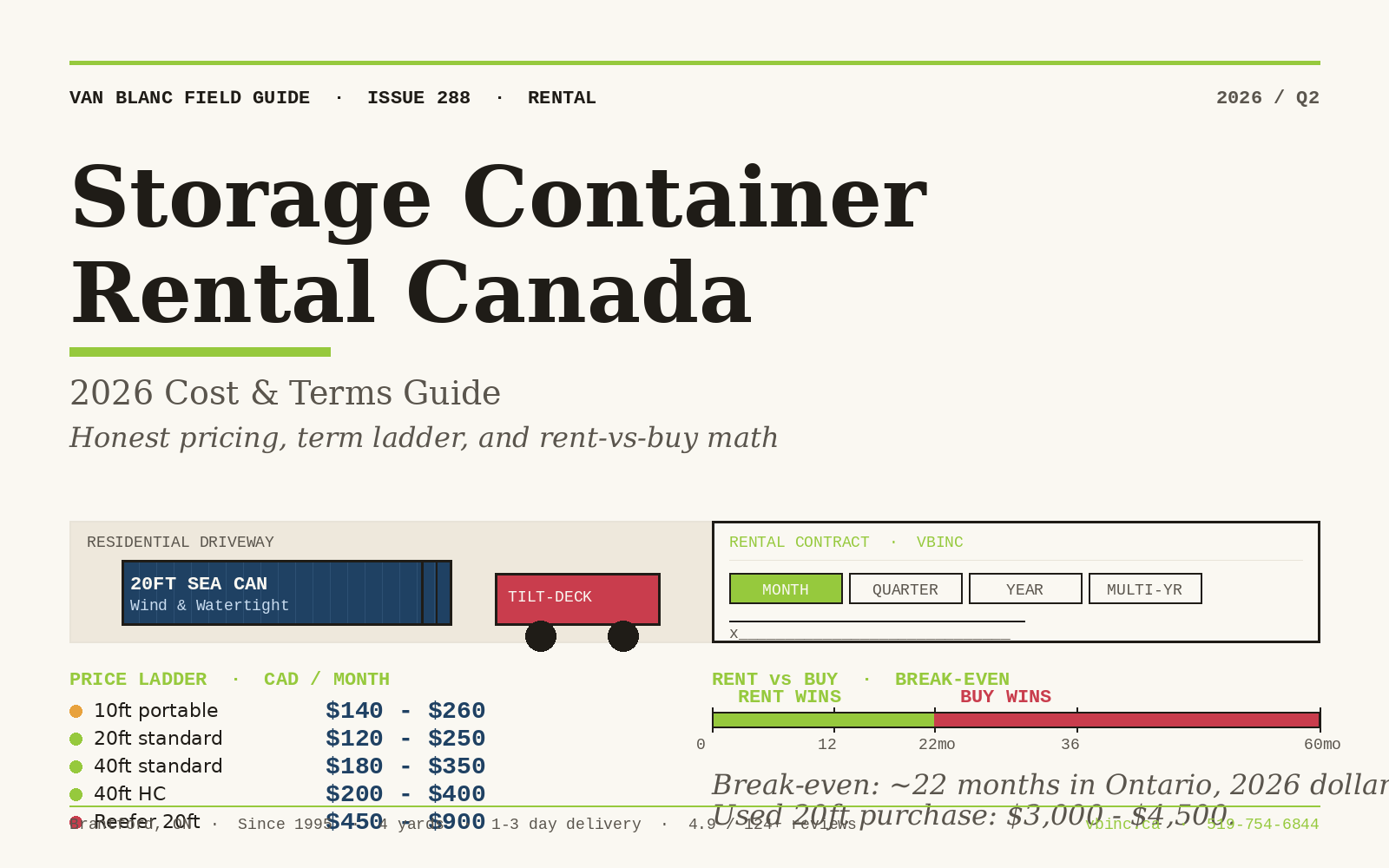
We sell containers. We do not rent.
Van Blanc sells shipping containers outright. We do not rent, we do not lease, and we do not offer rent-to-own. Renting comes up on this page because buyers compare it against owning, and that comparison is worth reading, but purchase is the only arrangement we offer. Stocked units deliver from our Brantford yards in 1 to 3 days. Request a sale quote or call the yard at 519-754-6844.
Quick Answer: Storage container rental in Canada means renting a steel ISO sea can, usually a 20ft unit or a 40ft unit, on a monthly term plus a separate delivery charge. Buying pays back against rent somewhere between 18 and 24 months and wins every month past 24. Van Blanc does not rent; we sell across Ontario from four Brantford yards with 1 to 3 day delivery, and this guide is written by a seller who watches renters run the numbers.
One vocabulary note before renting anything: in Ontario the phrase bin rental covers two opposite products, untangled in the two bins that share one name.
In This Guide
- What does “storage container rental” mean in Canada?
- How much does a storage container rental cost by size?
- Rental Term Structures: Month-to-Month, Quarterly, Annual
- When to Book: The Canadian Rental Calendar
- Delivery, Pickup, and the Hidden Logistics Fees
- Insurance, Damage Policy, and the Lock Box Question
- Is it cheaper to rent or buy a shipping container in Ontario?
- Residential vs Commercial: Different Buyers, Different Terms
- Best-Fit Applications: Moves, Job Sites, Reno, Seasonal, Retail
- Should you rent from a national chain or a local Ontario yard?
- Where Van Blanc Fits: Yards, Radius, Purchase Terms
- Detailed Topic Guides
- Reading a Rental Agreement in Five Lines
- Frequently Asked Questions
- Sources
- Reach Van Blanc in Brantford
Reading time: about 22 minutes.
What does “storage container rental” mean in Canada?
Storage container rental in Canada means paying a monthly fee to keep a steel shipping container on your site for as long as you need it, with the container, delivery, and pickup arranged by the supplier and the unit returned at the end of the term. Most renters take a 20ft or 40ft sea can on a month-to-month term with a one-month minimum.
The phrase covers more ground than most buyers realise on the first call. In Canada, “storage container rental” can mean a 20ft sea can dropped on your driveway during a renovation, a 40ft high-cube parked on a job site for a year, a fleet of insulated bins on a mining camp in Sudbury, or a tiny 8ft portable storage box you load yourself for a cross-province move. The steel is similar. The contracts, the delivery model, the price logic, and the people behind the truck are not.
Canadian buyers run into four product families when they search for storage container rental, and the family you actually need decides almost everything else about cost and term.
The first family is the full ISO shipping container rental: a 20ft or 40ft Corten steel intermodal box, the same kind that crosses oceans, dropped on your site for as long as you need it. Most Canadians call these sea cans, c-cans, or just bins. This is the heart of the rental market, and the same steel we sell outright from our Brantford yards. Monthly rates vary depending on size and grade. Term is typically month-to-month with a minimum first month.
The second family is portable storage, sometimes called moving and storage containers: 8ft, 10ft, and 16ft purpose-built boxes from the national pod and portable-storage operators. They get dropped at your door, you load them, and the operator either keeps them at their warehouse or trucks them to a new address. Convenient for residential moves; usually pricier per cubic foot than a 20ft sea can; almost never used by farms, contractors, or industrial buyers.
The third family is modified container rental: containers with doors, windows, electrical, insulation, or a refrigeration unit. Job-site office containers, reefer containers, container guard shacks. Rates climb because the modification cost gets amortised across the rental period.
The fourth family is self-storage units, which are not really containers at all. They are climate-controlled storage rooms inside a warehouse. The container word gets attached because some self-storage providers also offer outdoor steel storage as a parallel product, which is closer to how renting works province-wide here in Ontario. They are a different category entirely.
Most of this guide focuses on the first family: the 20ft and 40ft sea can rental that the majority of Canadian commercial, industrial, and serious residential buyers actually want. We touch the others where the comparison matters.
How much does a storage container rental cost by size?
Storage container rental cost in Canada is driven by size and grade, not by a single headline number, and the same forces show up when you look at what moves the price of buying one outright. Headline rates do not tell the truth about storage container rental cost in Canada. The number on a competitor’s website is the rental fee in isolation. The amount that lands on your invoice is the rental fee plus delivery, pickup, deposit, fuel surcharge, and HST. Buyers who only compare the headline number get caught when the first month’s bill is forty percent higher than they expected.

Paul LeBlanc, owner: “The first question on every call is what does it cost a month, and the honest answer is that the monthly rate is the small part. The number that surprises people is the delivery and pickup. I have been selling bins across Ontario since I started Van Blanc in 1995, and I have watched renters get a single bundled number and feel misled when the truck bill shows up. We split the container and the delivery on every quote so a buyer in Brantford and a buyer in Burlington both see exactly what their address costs, and we do not rent, so there is no pickup leg waiting at the end. That honesty is why people drive to our four Brantford yards to see a bin before they pay a dollar.”
Here are the 2026 monthly rental ranges across Ontario, with the surrounding costs that show up on most contracts. Rates vary by size, grade, and delivery distance, and reflect what mainstream rental suppliers charge for a standard Wind & Watertight or Cargo Worthy used container.
| Container size | Relative monthly rate | Typical use | One-way delivery |
|---|---|---|---|
| 8ft / 10ft portable storage | Lowest base rent, higher per cubic foot | Residential moves, tight driveways | Quoted per address |
| 20ft standard dry | Lowest sea-can rate | Renos, job sites, farm, retail | Quoted per address (GTA and beyond) |
| 20ft high cube | Small premium over 20ft standard | Stacked goods needing headroom | Quoted per address |
| 40ft standard dry | Higher than 20ft | Large reno, warehouse overflow | Quoted per address |
| 40ft high cube, a foot taller | Small premium over 40ft standard | Construction sites, manufacturing buffer | Quoted per address |
| 20ft reefer (refrigerated) | Several times a dry rate, plus power | Cold chain, food service, brewery | Quoted per address |
| 40ft HC reefer | Highest, plus power | Pharma, greenhouse, beverage | Quoted per address |
A few things to read out of that table before you call a supplier.
The 20ft is the workhorse and the cheapest entry point. It is also the bin most people picture when they go looking to rent a sea can somewhere in Ontario. Measure what you are storing, then pick the length that holds it with room to reach the back. Eight feet wide by twenty feet long by eight-and-a-half feet tall gives you 1,360 cubic feet, which is roughly the contents of a three-bedroom Ontario house if you stack carefully or a respectable construction yard’s worth of materials.
High cube versions add a foot of internal headroom (9’6″ external versus 8’6″) for a small premium over a standard unit. Worth it if you are stacking pallets, hanging shelving, or running ductwork along the ceiling for a converted office.
Reefer rentals are a different planet. The refrigeration unit pulls power, needs servicing, and ages faster than the steel. Brewers, greenhouses, food service, and pharma routinely rent them seasonally. Expect to pay three to four times a dry container rate and to budget for electricity on top.
The portable storage family (8ft, 10ft, 16ft pods) costs more per cubic foot than a 20ft sea can. You are paying for the door-to-door white-glove logistics, not the steel. If you have your own driveway, your own loading time, and your own move logistics, a 20ft sea can almost always wins on cost.
Five inputs set the monthly number: size, term length, condition tier, delivery and pickup distance, and the season you order in. Short terms carry the highest effective rate; long terms bend the math toward owning, and the break-even the national programs themselves publish sits around 20 to 27 months, past which buying wins and you keep the box. That is the whole answer without a stale rate card. Van Blanc does not rent, but tell us the size and your postal code and the real purchase figure comes back the same day at 519-754-6844, or start with the short page on why we sell instead of rent.
Rental Term Structures: Month-to-Month, Quarterly, Annual, Multi-Year
Every Canadian storage container rental contract sits somewhere on a term ladder that runs from a single month with no commitment to a five-year lease with locked-in pricing. The term you pick shapes the monthly rate, the cancellation flexibility, the delivery cost amortisation, and whether the rental becomes an operating lease or a capital lease on your books.
Here is how the ladder typically looks in practice across Ontario suppliers.
| Term structure | Typical rate adjustment | Typical renter | Watch-outs |
|---|---|---|---|
| Month-to-month | Headline rate, no discount | Renos, short projects, uncertain timeline | Delivery and pickup hit harder relative to total spend |
| 3-month minimum | 5 to 10 percent off month-to-month | Seasonal storage, mid-length renos | Most common minimum on Ontario contracts |
| 6-month commit | 10 to 15 percent off | Long renos, multi-phase jobs, seasonal retail | Early cancellation usually means paying out the remainder |
| 12-month commit | 15 to 25 percent off | Year-round storage, ongoing job sites | Best operating-lease tax treatment for small businesses |
| Multi-year lease (24 to 60 months) | 25 to 40 percent off headline | Large operations, mining camps, industrial yards | May trigger capital lease accounting; talk to your accountant first |
| Rent-to-own (some fleets offer it; we do not) | Higher monthly with credit toward purchase | Buyers who want the container but cannot capitalise it upfront | Read the credit schedule carefully; some suppliers apply only a fraction |
The read across these tiers: past 24 months, the rent paid has passed the price of the container, so buying is the cheaper move, and on shorter terms a bought box still keeps its resale value. We work that math out below, and our Ontario-specific rent-or-buy breakdown runs the same numbers for buyers closer to home.
A note on the operating versus capital lease distinction. For small Ontario businesses renting one bin for a job, this never comes up. For a contractor renting eight bins on a multi-year project, it matters. Operating leases stay off your balance sheet and the rent shows as an operating expense. Capital leases land on your balance sheet as an asset and a liability, which changes your debt ratios and your tax depreciation. Suppliers do not decide which is which; your accountant does, based on the lease terms (length, bargain purchase option, transfer of risk and reward). If the lease is over 75 percent of the container’s useful life or the present value of payments exceeds 90 percent of the fair value, it is usually a capital lease. Most month-to-month and 6-month residential or small-commercial rentals are operating leases, full stop.
The “minimum first month” tactic
Almost every Ontario supplier writes a one-month minimum into their contract even on “month-to-month” deals. If you cancel after two weeks, you pay the full month. This is not a scam; it covers their delivery cost amortisation. But it does mean if you order on the 28th and finish on the 7th, you pay for the full month. Time your delivery to the start of your rental window, not the start of the calendar month.
When to Book: The Canadian Container Rental Calendar
Container rental demand in Canada runs on a calendar that surprises first-time renters, and knowing it is worth more than any discount. Spring opens with renovation season: March through May, fleets across the country tighten as driveways fill with 20-footers. June and July belong to the movers, closing-date bridges and military posting season both peak. August through October is the heaviest stretch of the year: harvest cold storage, retail stocking for Q4, and construction sites racing frost all draw on the same fleets at once, and refrigerated units in particular book out weeks ahead. Our seasonal walkthrough of that crunch, timed for Ontario growers, lives in the harvest cold-storage booking guide. November through February is the quiet season, which makes it the smart season: winter renters get the fastest trucks, the deepest unit selection, and the least schedule pressure of the year.
The practical rule from thirty years of watching that calendar: book two to three weeks ahead in the busy half of the year, and the calendar works for you instead of against you.
Delivery, Pickup, and the Hidden Logistics Fees
Delivery is the line item that breaks more storage container rental quotes than any other. The headline rate is per month; you sign; the truck shows up; the invoice says rent plus one-way delivery plus pickup plus deposit plus HST. The first-month all-in figure always lands well above the headline rent.
This is industry-standard practice across Canada, not a Van Blanc quirk. The reason is straightforward. A tilt-deck truck with a sea can on board is expensive to operate when you factor in driver, fuel, insurance, depot loading time, and the truck’s own depreciation. A delivery from Brantford to Burlington takes about three hours round trip. A delivery from Brantford to Sudbury takes about ten hours. Suppliers either charge a flat zone-based delivery fee, or they meter the distance, or they bundle delivery into a higher headline monthly rate (which means short-term renters subsidise long-term renters).
Here is what Ontario buyers should actually expect to see on a quote.
| Line item | What to expect | What it covers |
|---|---|---|
| One-way delivery (within 100km of Brantford) | Quoted per address | Truck, driver, fuel, loading at yard, tilt-deck placement on site |
| Long-haul delivery (100-300km) | Higher, scales with distance | Same as above plus distance fuel and driver hours |
| Pickup at end of rental | Similar to delivery | Same logistics in reverse; sometimes bundled with delivery as round trip |
| Damage deposit | Refundable | Held against floor damage or door damage; refunded if container returns clean |
| Fuel surcharge (when posted) | 5 to 10 percent of delivery | Some suppliers carry a posted fuel-cost adjustment on quotes |
| HST | 13 percent on all charges | Standard on Ontario container rentals |
| Lockbox upgrade | One-time add-on | Welded steel collar that protects the padlock from bolt cutters |
| Site re-spot (moving the container after placement) | Quoted per visit | If you need it shifted six feet after the truck leaves |
Two practical implications of how delivery cost stacks against rental fee. First, the shorter your rental, the more punishing delivery is as a percentage of total spend. On a one-month rental of a 20ft, delivery, pickup, deposit, and HST make the all-in figure far higher than the headline rent. That same container rented for six months earns the multi-month discount, so the all-in cost rises by only a fraction even though you have it six times as long. Second, suppliers further from your site charge more in delivery, full stop. A Mississauga buyer renting from a Brantford yard pays more on each leg than a Brantford buyer would. This is why national chains often charge the same headline rate everywhere: they bake the average delivery cost into the monthly, and the customer near their depot subsidises the customer far away.
Van Blanc’s approach is to quote delivery separately. You see the truck cost on the line. Christian LeBlanc, the second-generation operator who runs the day-to-day at the yard, puts it this way:
Christian LeBlanc, second-generation operator: “Our quotes split the container and the delivery on purpose. When a Burlington contractor calls and asks why his quote is more than the Brantford one, I want to tell him the truth: it is one more hour of truck time each way. He can decide if that is worth it. The suppliers who bury delivery in a single headline monthly rate are not doing him a favour. They are gambling that he will not notice he is paying for someone else’s longer haul. I would rather give him a real number for his actual address. That is the same family customer service my dad has been running since 1995, and that is why buyers from across Ontario still drive to our four Brantford yards to see a bin before they pay a dollar.”
Insurance, Damage Policy, and the Lock Box Question
Storage container rentals come with three layers of risk that most buyers do not think about until something goes wrong: physical damage to the container, damage to the customer’s site (driveway, pavement, lawn), and theft from inside the container.
On container damage, most Ontario suppliers carry their own commercial property insurance on the rented fleet. That covers the container itself against fire, vandalism, and major incidents. It does not cover normal cosmetic wear (paint scuffs, light dents) or floor damage from misuse. Floor damage from forklift tine punctures or chemical spills typically lands on the renter, drawn from the damage deposit and then billed beyond if it exceeds. Cargo Worthy and Wind & Watertight grades come with visible cosmetic wear at delivery; suppliers document the condition before drop-off so the post-rental inspection has a baseline.
On site damage, the renter is on the hook. A tilt-deck truck placing a 4,000kg container exerts real point loads. Asphalt driveways can crack. Interlock can shift. Soft soil after spring thaw can deform. Reputable suppliers ask about your site surface before delivery and recommend wood blocking (railway ties or 4×6 lumber) under the container’s four corners to spread the load. Van Blanc’s drivers carry blocking on the truck and will use it if the site needs it; some suppliers charge for blocking, some include it. Always ask.
On theft, the renter is responsible for the contents. The container’s standard cargo door handles take a padlock; a lock box upgrade (a welded steel collar around the lock) makes bolt cutters dramatically harder. A lock box is a modest one-time add-on and is worth it on any rental where you are storing valuable contents. For job sites and rural deliveries, the lock box is borderline mandatory.
What good site prep looks like before delivery day
The container needs a level, firm surface roughly twelve feet wide and twenty-five feet long (for a 20ft) or twelve by forty-five (for a 40ft). Concrete pad is ideal but not required. Compacted gravel works. Grass works if it is dry and the soil is not soft. The truck will need a straight approach of at least sixty feet to tilt and slide the container into position. If your driveway has a sharp turn, the driver will tell you whether to expect tilt-deck or roll-off delivery; both work but the staging differs. Block the four corners with railway ties or pressure-treated 4×6 lumber if you are renting for more than a month, especially on soft ground. The wood spreads the load and protects against frost heave. ISO 6346 stipulates the container’s corner castings as the load-bearing points; the rest of the steel rests on those four corners only.
Is it cheaper to rent or buy a shipping container in Ontario?
Buying a shipping container in Ontario pays for itself against rent in roughly 22 months; after that the rental keeps billing and the owned box costs nothing more, with resale value still in it. This is the question every container conversation eventually reaches. If you are going to need the storage for two years, are you better off renting or buying? The arithmetic is unforgiving once you write it down, and almost every supplier in Canada agrees on the cross-over point even though they have different reasons to nudge you in either direction.
The break-even point in Ontario lands at roughly 22 months for a used container, and roughly 28 to 32 months if you compare rental against a new one-trip container from our rows. After that, every month of rental is money you would not have spent. Where a buyer cannot capitalise upfront, an equipment loan through their own bank or financer, arranged before the truck rolls gives the monthly shape against a box they own from day one, and the effective price still lands below a multi-year rental.
The freight-balance test
The single fastest way to decide rent versus buy: estimate your project length, multiply your monthly rental rate by that number of months, add the delivery and pickup, and compare to the purchase price plus one delivery. If the rental column is more than 80 percent of the purchase column, buy. Below that, add what the box brings back on resale to the buy side, plus the soft factors (capitalisation, mobility, modification needs), before you decide.
Residential vs Commercial: Different Buyers, Different Terms
Storage container rental contracts read differently for a homeowner doing a kitchen reno than for a general contractor running a five-bin job site. The steel is identical; the paperwork is not.
Residential rentals are usually month-to-month with a one-month minimum. The renter is a private individual; the supplier carries the rental on their own books; the contract is short and reads like a self-storage agreement. Damage deposit is held against floor or door damage. Most residential renters use a 20ft and keep it for two to six months while their renovation, move, or seasonal use plays out.
Commercial rentals look quite different. The renter is a business; contracts are typically 6, 12, or 24 months; volume discounts kick in for multiple units; lockbox upgrades and shelving and lighting and ESA-certified electrical packages are bookable add-ons; and the supplier often invoices monthly rather than collecting upfront. Construction firms and contractors are the largest commercial customer category, followed by retailers (seasonal storage), agricultural operations (year-round equipment shelter), and manufacturers (production buffer and finished-goods storage).
The pricing inside the contract is nominally the same. The container does not know who is renting it. What changes is the duration, the discount, the financial treatment, and the add-on options. A homeowner renting one 20ft for three months has no leverage for a volume discount. A contractor renting eight 40ft HC bins across two job sites for eighteen months has significant leverage and will often negotiate twenty to thirty percent off the headline rate.
The other meaningful difference is insurance posture. Residential renters rely on their home insurance to cover contents inside the container; most Ontario homeowner policies do cover off-premises personal property up to a percentage cap (typically ten percent of the dwelling coverage). Commercial renters usually need their own commercial property insurance to extend to the contents and may need to add the container to a builders-risk policy on active job sites. Suppliers do not provide this; the renter has to arrange it.
Best-Fit Applications: Moves, Job Sites, Reno, Seasonal, Retail
The most common storage container rental in Canada falls into one of seven applications. Knowing which one you are matters because the size, term, and accessory choices differ significantly.
1. Residential moves. The dominant use case for portable storage operators. Container drops at your house, you load over two to four days, the operator either parks it at your new house or warehouses it between addresses. Best fit: 8ft, 10ft, or 16ft purpose-built portable storage. Term: one to three months. Cost: a monthly rate plus delivery legs.
2. Renovation storage. Homeowner is gutting a kitchen, a basement, or a whole-house. They need to clear the furniture and appliances out for two to six months. A 20ft sea can on the driveway holds the contents of a three-bedroom house if you stack carefully. Best fit: 20ft standard dry, month-to-month with three-month minimum. Cost: a monthly rate plus delivery and pickup on each leg in the GTA.
3. Construction job site storage. General contractor needs secure tool storage and finished-materials storage on-site for a multi-month build. Often paired with a separate container office or modified ground-level office. Best fit: 20ft or 40ft Cargo Worthy, 6 to 18 month term, lockbox upgrade essential. Cost: a monthly rate plus delivery. Volume discount kicks in at three or more units.
4. Seasonal retail. Garden centre, ski-rental shop, pumpkin patch, Christmas tree lot. The business needs storage for off-season inventory or as a pop-up retail point. Best fit: 20ft standard dry; 40ft if they are running a retail conversion. Term: 4 to 8 months seasonally. Cost: a monthly rate, often bundled into a multi-year recurring seasonal agreement.
5. Agricultural storage. Farms storing feed, hay, equipment, fertilizer, or seasonal supplies. Often year-round. Best fit: 40ft Wind & Watertight (cheapest grade) or 20ft for smaller operations. Most farms buy rather than rent because the use case is permanent, and a bought box covers a one-off emergency too (a fire, a barn collapse, a transition year) and stays on as storage after. Cost: a monthly rate if rented from a fleet operator; from us, a one-time purchase, with an equipment loan through the farm’s own lender where the cash needs spreading.
6. Industrial buffer storage. Manufacturing operation needs extra space for finished goods waiting to ship, raw materials buffer, or seasonal production overflow. Best fit: 40ft or 45ft HC, often multi-unit, 12 to 60 month terms with capital-lease accounting consideration. Cost: a monthly rate per unit; volume and term discounts significant.
7. Cold storage. Brewery, distillery, greenhouse, food service, pharma, lab. Refrigerated container rental serves seasonal cold-chain needs (a brewery launching a beer garden, a greenhouse needing extra cold storage during harvest, a food-service operator buffering during a kitchen reno). Best fit: 20ft or 40ft HC reefer. Term: 1 to 12 months. Cost: a monthly rate plus electricity.
Real example: the 22-month Cambridge job site
A general contractor in Cambridge ran a multi-phase commercial fit-out across 2024 and 2025. Two 40ft HC dry containers on-site for tool and material storage, one 20ft dry as a temporary office before the modular trailer arrived, lockboxes on all three. Twenty-two months total. The contractor had been quoted on a multi-year lease but did the rent-versus-buy math at month four and called Van Blanc to buy the two 40ft outright; we delivered fresh units and the rented 40s went back to the fleet operator. The 20ft stayed on the operator’s rental because they would not need it past month eight. Total spend was about 14 percent lower than the original full-rental quote, and the two purchased bins now serve a different job site eighteen months later. The lesson: pick the bin you will keep using.
Should you rent from a national chain or a local Ontario yard?
Whether to rent from a national chain or a local Ontario yard comes down to what you value: brand polish and sight-unseen convenience, or line-item pricing and a bin you can inspect first. The Canadian storage container rental market splits into two business models with very different customer experiences.
National chains and pod operators, several of them with dozens of Canadian locations and one US-based, alongside smaller national or multi-regional players. The model: standardised pricing across the country, online booking, large fleet, branded white-glove logistics, focus on residential moves and short-to-medium commercial rentals. The customer never sees the depot; the truck shows up, drops a clean-painted branded container, and the franchise handles the rest. Pricing is consistent because the network averages out regional costs.
Local independent yards, which is what Van Blanc is and has been since 1995. The model: a real Ontario yard you can drive to, an inventory of containers you can walk and inspect before paying, and a family making delivery and pricing decisions based on the specific buyer in front of them. Pricing is broken out (container plus delivery plus options), and reflects the actual cost of serving your specific address rather than a regional average.
The two models treat the buyer very differently, and the table shows where.
| Factor | National chain | Local yard (Van Blanc) |
|---|---|---|
| Pricing transparency | Headline rate sometimes bundles delivery cost regionally; flat-rate convenience | Container and delivery split on every quote; what you see is what you pay |
| Can you see the bin first? | Rarely; sight-unseen booking is the norm | Yes; the four Brantford yards are open for in-person inspection |
| Container grade options | Usually one mid-grade option for rental | Wind & Watertight, Cargo Worthy, or one-trip on request |
| Volume discounting | Standardised; less flexibility | Direct negotiation with the operator |
| Delivery speed | Often 1-3 business days in Ontario | 1 to 3 days from the Brantford yards across most of Ontario |
| Custom modifications | Limited; standardised fleet | Doors, windows, electrical, insulation, paint available on every purchase |
| Personal contact | Call centre or franchise operator | Paul or Christian on the phone; same family since 1995 |
| Brand polish | Strong; consistent branded paint and logos | Used-container condition as it is; the steel is for storage, not for advertising |
The takeaway: a national chain sells convenience on a box it takes back at the end. The local yard lets you inspect the bin before you pay, settle the grade and the price directly with the operator, get delivery in 1 to 3 days, have the modifications done at the yard, and keep the box when the job is over. Most Ontario commercial buyers (contractors, farms, manufacturers, retailers) end up at the local yard.
We do not disparage the national operators. We are just different. A real yard, a real family, real Ontario inventory, and prices that are not averaged across the country at your expense.
Ready to price your container?
Tell us the size and your postal code and we’ll send back an honest, all-in number, container, delivery, and placement, usually within 1-3 days. No pressure, no mystery fees.
Family-run in Brantford since 1995 · 200+ containers in stock · 4.9★ across 140+ Google reviews · every box graded by a person, walk it before it lands.
Where Van Blanc Fits: Yards, Radius, Purchase Terms
Van Blanc Ent. Inc. sells shipping containers and sea cans across Ontario from four Brantford yards, and does not rent them. The company was founded in 1995. Paul LeBlanc owns it; his son Christian, the second-generation operator, runs day-to-day yard operations and handles most quotes. The combined family operating tenure is now thirty years on company tenure; Paul has thirty years in containers; Christian has four years of direct yard experience plus a childhood of trips to Asia with his father starting at age fifteen.
The program in one paragraph: 20ft, 40ft, 40ft high cube, 45ft HC, and reefer units, in Wind and Watertight, Cargo Worthy, or one-trip grade, sold outright, with volume pricing on three or more units; a business that wants a monthly payment arranges an equipment loan through its own bank or financer, and we supply the invoice and serial number. Delivery runs 1 to 3 days across most of Ontario from the four Brantford yards, with Northern routes quoted per trip, and every quote splits the container and delivery as separate line items. The straight answer on rentals lives on the page every rental searcher eventually lands on, and inventory is held across the yards so a buyer can walk the row and read the CSC plate before paying anything. Payment runs draft cheque, cash, wire, or credit card via authorisation form, on delivery.
The “far cheaper on Facebook” warning. Many buyers call us saying they can get a bin far cheaper on Facebook. Two weeks later they call back saying they got scammed. Paul has been operating Van Blanc since 1995, and that pattern repeats every week. If a Facebook listing is cheaper than the going Ontario rate, that is not a discount. That is the trap. We see the call-back two weeks later every time.
Worth the drive. Buyers from across Ontario regularly drive to the Brantford yards to see a bin before they pay. It is worth the drive for better quality, family customer service, thirty years of operational experience, and a real lead time on every quote, not a hopeful one. The four Brantford yards are at 90 Morton Avenue East and the surrounding network. Walk-ins welcome during business hours.
Why the Brantford location matters for Ontario buyers
Brantford sits at the intersection of Highway 403 and the QEW-401 corridor. From the four Van Blanc yards on Morton Avenue East, a delivery truck can reach Hamilton in 35 minutes, Burlington in 50 minutes, Mississauga in 70 minutes, Cambridge in 30 minutes, Niagara in 75 minutes, and London in 80 minutes. That logistics geometry is why 1-3 day delivery is achievable across most of Ontario from a single hub. National chains with depots scattered across the country average regional cost; Van Blanc’s single-hub model lets the customer near Brantford pay less while still serving customers across Ontario fairly. The buyer in Burlington pays exactly the marginal hour of truck time, not a hidden subsidy for a Sudbury delivery.
Detailed Topic Guides
Detailed Topic Guides
This hub covers the landscape. For deeper coverage of specific topics, see our spoke articles:

- Office Trailer vs Shipping Container: Ontario Comparison
- Mobile Office Container Rental Cost in Ontario
- Non-Operating Reefer Containers for Dry Storage in Ontario
- Winter Construction Storage and Frost Protection in Ontario
- Short-Term vs Long-Term Container Lease in Canada
- Operating Lease vs Capital Lease for Containers in Canada
- Mobile Classroom Containers and Portable Schools in Ontario
- Portable Office Internet and Cellular Setup in Ontario
Reading a Rental Agreement in Five Lines
Every container rental agreement in Canada answers five questions, and so does a rent-to-own agreement. Read for them in order and nothing important hides:
The Five Lines That Matter
- Term and renewal: month-to-month, fixed term, or auto-renewing? What notice does ending it require?
- Delivery and pickup charges: stated separately from the monthly rate, or bundled? Both legs, not just the first one.
- Condition and damage: what grade arrives, how is existing wear documented, and what counts as damage versus normal use when it leaves?
- Contents and liability: whose insurance covers what is inside? (Almost always yours; confirm your policy rider rather than assuming.)
- Access and relocation: can the unit be moved mid-term, and by whom? Placed containers are relocated by third-party haulers, and the agreement should say so plainly.
A supplier who answers all five before you ask is showing you how the rest of the relationship will run. A supplier who cannot answer the second one is showing you the same thing.
Frequently Asked Questions
How much does a storage container rental cost in Canada per month?
Storage container rental in Canada is quoted as a monthly rate that varies by size and grade, with 40ft units running higher than 20ft. Delivery is charged per leg within the GTA, more for long-haul. The all-in figure for the first three months lands well above the headline rent once delivery, pickup, deposit, and HST stack up. Always ask for the all-in number, not just the headline rent.
What is the minimum rental period for a storage container?
Most Ontario suppliers write a one-month minimum into month-to-month contracts. Even on flexible rentals, the first month is non-negotiable because it amortises the delivery cost. Discounted tiers start at 3 months, then 6, 12, and multi-year. Suppliers typically offer 5 to 25 percent off the headline rate as the term lengthens.
Is it cheaper to rent or buy a shipping container in Ontario?
The break-even hits at roughly 22 months for a used container in 2026 Ontario dollars. Over 24 months: buying wins. In the 18 to 24 month grey zone, the answer depends on your cost of capital, your need to modify the container, and whether you would resell it later. We walk through the full math under the rent-versus-buy section above.
What sizes of storage containers can I rent in Canada?
The Canadian market offers 8ft, 10ft, and 16ft purpose-built portable storage; 20ft and 40ft standard dry sea cans; 20ft and 40ft high cube; 45ft high cube; and refrigerated reefer containers in 20ft and 40ft HC. Van Blanc sells the full range from four Brantford yards, outright; we do not rent. The 20ft standard dry is the workhorse and the most common unit; the 40ft and 40ft high cube suit larger renovations, job sites, and warehouse overflow. Tell us what you are storing and your postal code and we will match the size to the job.
How fast can Van Blanc deliver a container in Ontario?
Standard delivery is 1 to 3 days across most of Ontario from the four Brantford yards. Eastern Ontario (Kingston, Brockville, Ottawa) lands in the same 1 to 3 days. Northern Ontario is quoted per route with premium freight, typically 5 to 10 days. Every quote comes with a real lead time, not a hopeful one. We do not promise same-day; 1 to 3 days is the floor across our standard service zone.
What is the difference between renting from a national chain and buying from a local Ontario yard like Van Blanc?
National chains run dozens of Canadian locations with standardised pricing. Van Blanc is a family-run Brantford yard with four locations, direct operator contact, and pricing broken out by line item. National chains offer brand polish and convenient online booking; local yards like ours sell rather than rent, and offer faster Ontario delivery, in-person container inspection, modification options, and direct negotiation with the operator.
Can I modify a rented storage container with windows, doors, or electrical?
No. Van Blanc sells containers outright and does not rent, lease, or offer rent-to-own. Past a few months, buying a used wind-and-watertight box normally costs less than renting one, and you can sell it on or ask us about buyback when you are done.
What does the delivery fee include on a storage container rental?
One-way delivery covers the truck, driver, fuel, loading at the yard, and tilt-deck placement on the customer’s site. Pickup at end-of-rental is a separate (or bundled round-trip) charge. Damage deposit is held separately and refunded after the post-rental inspection. Fuel surcharge and HST apply on top. Some suppliers bundle delivery into a higher headline monthly rate; Van Blanc, which sells rather than rents, quotes delivery as a separate line so you can see what you are paying for.
Are storage container rentals insured against damage or theft?
The supplier insures the container itself against fire, vandalism, and major incidents. The renter is responsible for contents inside the container, for site damage (driveway, lawn), and for floor damage from misuse. Most residential renters rely on a homeowner policy off-premises personal property clause. Commercial renters typically extend their commercial property or builders-risk policy to cover the contents. A lockbox upgrade (a modest one-time add-on) is recommended for any rental where the contents are valuable or the site is unmonitored.
What does rent-to-own mean for a shipping container?
A rent-to-own program puts a container on a fixed monthly payment that builds toward ownership. Some fleets credit only 40 to 60 percent of each month’s rent; Van Blanc does not run a rent-to-own program at all, so the cleaner route to a monthly shape is a purchase loan through your own lender, where every payment is against a box you already own. An equipment loan does the same job for businesses that cannot capitalise the purchase upfront but know they want the container in the end, and the effective cost still lands below a multi-year straight rental.
Why do storage container rental quotes come back higher than the advertised headline rate?
The headline rate is the rental fee in isolation. The all-in cost adds delivery, pickup, damage deposit, fuel surcharge, lockbox upgrade if needed, and HST. A low headline monthly rate can land much higher per month for the first three months once everything stacks. The right move is to ask the supplier to break out every line on the quote before you sign. If they will not, that is your signal to call somewhere that will.
Sources
- International Organization for Standardization. (2022). ISO 6346:2022, Freight containers, Coding, identification and marking. iso.org/standard/82754.html
- International Maritime Organization. (1972, amended through 2024). International Convention for Safe Containers (CSC). imo.org
- Government of Ontario. (2024). Building Code (O. Reg. 332/12), Section 3, Use and Occupancy Classification. ontario.ca/laws/regulation/120332
- Toronto Trailers. (2026). How Much Does It Cost to Rent a Storage Container in 2026. torontotrailers.com
- Ontario Construction News. (2026). Shipping container pricing in Canada: A 2026 guide for construction professionals. ontarioconstructionnews.com
- Transport Canada. (2025). Cargo Securement Standard 10, Containerized Cargo. tc.canada.ca
- Institute of International Container Lessors. (2024). Container Inspection Criteria, Grade Standards for Used Containers. iicl.org
- BigSteelBox. (2026). Portable Storage Container Rentals: Compare Storage Options. bigsteelbox.com
Permits are managed by your municipality. Check with your local building or planning department before you order, then tell us your delivery address and we will handle the container.
Reach Van Blanc in Brantford
We have been supplying shipping containers across Ontario since 1995. Our four Brantford yards are anchored at 90 Morton Avenue East, and we deliver right across the province in 1 to 3 days with line-item pricing and a real lead time on every quote.
Van Blanc Ent. Inc. · 90 Morton Ave E Unit 1B, Brantford, ON N3R 7J7 · +1 888-509-6658
If you want to walk the row and read the CSC plates before paying anything, the Brantford yards are open during business hours. Worth the drive for unbeatable quality, family customer service, and 30 years of experience.