
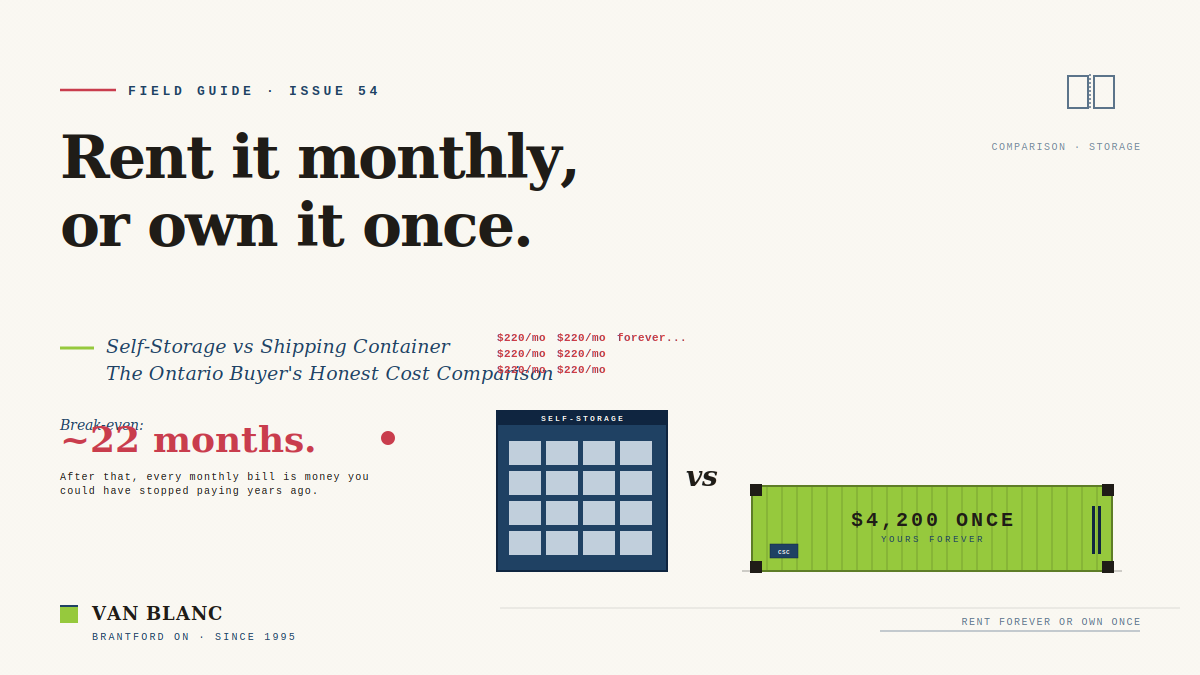
Quick answer. Standard reference: Bank of Canada, Business Outlook. A 10×10 self-storage stall in Mississauga keeps billing you month after month. After roughly 22 months, the cumulative rent matches the price of a Cargo Worthy 20 ft container bought outright. The break-even is not theoretical. It is a date on the calendar somewhere in the middle of year two. After that, every monthly bill is money you could have stopped paying. The container would already be yours, sitting in your driveway, with no shared corridor and no fluorescent hallway lights. Family-run since 1995 with COD-honest pricing: call for a same-day quote tailored to your site.
Businesses whose storage problem is specifically paper should see the container archive versus per-box records billing, including how to set a container up for files.
Why this comparison usually misses the point
The way most articles frame this is “containers are bigger and self-storage is climate-controlled and which one is right for you?” That framing is fine for a search ranking and useless for an actual buying decision. The real question is not which product is better. It is which one costs less by the time you actually stop needing it, and which one leaves you with something at the end.
Self-storage is a rental product. You sign a month-to-month lease on a 10×10 stall inside someone else’s warehouse, you pay every month, and on the day you move out, you have paid hundreds or thousands of dollars to a company that still owns the building. A shipping container is a capital purchase. You pay once, the container is delivered to your property, and on the day you no longer need it, you either keep it, sell it, or give it to one of your kids when they buy their first house. The math is not close once you are past the break-even.
The Canadian self-storage industry pulls in billions of dollars a year (IBISWorld 2026, Storage and Warehouse Leasing in Canada). That figure is the amount Canadians are paying every year for storage they do not own. Most of them have no idea that for roughly a year of those payments, they could have bought the container outright.
The monthly math, with real Ontario numbers
Public Storage Canada publishes its own pricing on its Ontario pages, which gives us a clean third-party baseline to work from. Rather than chase a single number, it helps to see how the unit sizes stack up by footprint and what each one realistically holds:
| Unit size | Approximate floor area | Common use |
|---|---|---|
| 5 × 5 to 5 × 10 | 25 to 50 sq ft | Boxes, seasonal stuff, a couple of bikes |
| 10 × 10 to 10 × 15 | 100 to 150 sq ft | 1-bedroom apartment, a small workshop’s worth of tools |
| 10 × 20 to 10 × 30 | 200 to 300 sq ft | Whole house, business inventory, RV-size |
The monthly rate spread is mostly geography. Toronto carries the highest rates even on small units. Hamilton sits lower. Mississauga and Ottawa land in the upper middle. Climate control and ground-floor drive-up access add a premium on top of the city rate.
For most of the buyers we talk to in Brantford, the relevant comparison is a 10×10 stall rented month after month against a 20 ft Cargo Worthy container bought once and delivered on a short haul. That is the apples-to-apples decision. Here is what it looks like cumulatively, expressed as a share of the one-time container purchase:
| Months in | Cumulative self-storage spend (as % of one-time container cost) | Container, paid once | Money still going out |
|---|---|---|---|
| 6 | ~27% | Paid in full up front | Storage stall: keep paying |
| 12 | ~55% | Container is yours | Storage stall: still billing monthly |
| 18 | ~82% | Container is yours | Storage stall: still billing monthly |
| 22 | ~100% (break-even point) | Container is yours | Storage: now overpaying |
| 36 | ~164% | Container is yours | Container has paid for itself and then some |
| 60 | ~273% | Container is yours, ~70% resale value | Container saved you well over its own cost |
Five years in, the self-storage path has spent close to three times the cost of a container and walks away with nothing. The container path paid once, owned a 20 ft steel structure the whole time, and could still sell it for most of what it cost. That is the difference between renting and owning, applied to a problem that does not have to be a rental problem in the first place.
What you actually get for each dollar
A 10×10 self-storage unit is 100 square feet of floor space inside a warehouse. The walls are drywall or sometimes plywood. The hallway is shared with everyone else in the building. You drive to the facility, badge in through a gate, walk down a corridor, unlock a door, and use the space during the facility’s open hours. When you leave, you lock the door and drive home.
A 20 ft shipping container is roughly 8 ft wide by 20 ft long, which works out to about 160 square feet of floor space, with another 80-some cubic metres of vertical room because the ceiling is around 8 ft 6 in. You access it on your own property, on your own schedule, no badge, no driving, no facility hours. The walls are 14-gauge Corten weathering steel, not drywall. The doors are double cargo doors with eight-point locking gear that came off the ocean.
Per square foot of usable floor, a Cargo Worthy 20 ft from our yard is a one-time cost spread across about 160 square feet you own outright. A 10×10 self-storage stall bills you every month for 100 square feet you never own. Within roughly 14 months of rental you have paid more per square foot than the container cost. The container has another 25 to 35 years of useful life ahead of it after that.
The pick-your-box differentiator (and why it matters more here than people realise)
Here is something most people learn the hard way. When you order a container online from a national reseller, you do not pick the container. You pick a grade. They ship you whichever unit in that grade is in their pool when your order comes up. You see it for the first time when the truck rolls in, and at that point it is yours.
Some of those national resellers are brokers. They take your money, then drive to a yard somewhere and pick whatever is next in line. You get the container that came up in the queue, not the container you would have chosen if you had been standing in the yard.
Van Blanc lets you walk our 200+ container inventory and pick your own unit before you pay. You read the CSC plate yourself. You look at the floor and the door gaskets and the corner castings. You point at the one you want and say “that one.” Then we deliver that one, not whichever one was next.
For storage, that matters because you are committing capital to a piece of steel. You should be allowed to inspect the piece of steel before you commit. Self-storage skips this question by never giving you anything to own. The container path makes ownership the point.
Climate honesty: what containers do and do not do
This is the place where self-storage advertising tries to win the argument, and where we have to be honest in return. A standard shipping container is not climate-controlled. It is sealed steel. In an Ontario winter the interior will hold around the ambient outdoor temperature, maybe a few degrees warmer because of the air mass, but it will go below freezing in February. In an Ontario summer it can get warm inside if the sun bakes the roof all day.
For most stored items, this is fine. Power tools, lawn equipment, bicycles, sporting gear, lumber, business inventory, paperwork in plastic totes, household furniture, holiday decorations, motorcycles, kayaks. None of that cares about a 25°C July afternoon or a -10°C January morning. The container keeps water out and mice out and thieves out, and that covers almost every storage need.
The categories that genuinely benefit from climate-controlled self-storage are narrow. Original artwork. Paper documents that absolutely must stay dry without a backup plan. Vintage electronics with capacitors that sulk in the cold. Wine cellars. Musical instruments with hide glue. Those items need real climate control, and the next paragraph covers how an insulated box with a small heater gets there.
For everything else, a container insulated with a few inches of spray foam from a Canadian supplier we know, plus a small electric heater, turns it into a near-climate-controlled space for far less than the cumulative cost of a climate-controlled stall.
Self-Storage or a Container: Short Stays, No Driveway, Climate
Buyers usually raise three situations when they weigh a stall against a box:
1. Short-term, under six months
If you are between leases or staging a house for sale and only need storage for a few months, a container bought for the stretch sits at your door instead of across town, and it sells on once you are settled, so you only carry the gap between purchase and resale.
2. No driveway, no yard, no landlord approval
Apartment renters in downtown Toronto cannot park a 20 ft container anywhere. If a relative, a farm or a work yard has the room, a box placed there still gives you steel storage you own.
3. Items that genuinely need climate control
Artwork, archival paper, certain instruments. A modified container, insulated at the yard with a small heater added, can match this for less over the long term.
If you are storing for more than 18 to 24 months, on a property where you can place a container, with normal storage contents, a container is the better economic choice.
Ontario city quick reference
For buyers across Ontario, here is how the math plays out by region. The container price is roughly stable province-wide because they all ship from our Brantford yards. Self-storage rates vary mostly by city density.
| City | Self-storage rate level | Delivery distance from Brantford yard | Where break-even lands |
|---|---|---|---|
| Toronto | Highest in the province | Longer haul | A few months later in year two |
| Mississauga | Upper middle | Medium haul | Mid year two |
| Hamilton | Lower | Short haul | Earliest, early year two |
| Ottawa | Upper middle | Longer haul | A few months later in year two |
| Kitchener-Waterloo | Lower | Short haul | Earliest, early year two |
| London | Lower | Short haul | Earliest, early year two |
| Barrie | Middle | Medium haul | Mid year two |
| Brantford | Lower | Home turf, shortest haul | Earliest, early year two |
| Cambridge | Lower | Short haul | Earliest, early year two |
| Sudbury | Middle | Longest haul | Later in year two |
Hamilton, London, Brantford and Kitchener-Waterloo are the cities where the break-even hits earliest. Toronto and Ottawa take a few extra months because of higher container delivery cost into the city, but the break-even still lands inside year two everywhere.
What about renting a container instead of buying?
This is the question we get most often after the cumulative-cost math sinks in. If buying a container beats self-storage, why not rent a container and beat both?
Van Blanc does not rent; we sell. Container rental is billed monthly for a 20 ft on your property, depending on contract length, and the break-even versus buying lands at roughly 24 to 30 months. Past that point the rented box keeps billing while an owned one costs nothing more, and a box bought for a shorter stretch still holds its resale value when you are done. Our buying-vs-renting article walks through the math in more detail.
The broker problem nobody warns about
One more thing worth knowing if you are shopping for a container online and comparing options. A meaningful share of the websites selling “shipping containers for sale Ontario” on Google are brokers, not yards. They take your money, find a unit somewhere, arrange a delivery, and that is it. You never meet the container before it lands on your property. If there is a problem with the floor, the doors, the corner castings, or the seals, your only recourse is whatever the broker’s policy says.
This is part of why we recommend buying from a yard with actual on-the-ground inventory you can walk. We have around 200 containers in our Brantford yards at any given time. Buyers regularly drive in from Toronto, KW, London, Hamilton, Niagara, even Ottawa, to walk the row before paying. The drive is worth it, partly because you save a few hundred dollars by skipping the broker margin, but mostly because you know exactly which container you bought.
If you would rather not drive, that is fine too. We will FaceTime the unit for you, walk the row on camera, and ship the container you picked. The point is that you got to pick.
The bigger framing
Containers exist in the first place because they are the structural backbone of global shipping. Rose George, in her 2013 book Ninety Percent of Everything, documents that around 90% of all goods on earth move by sea, almost all of it inside ISO shipping containers. The container you would buy from our yard has lived its first decade or two as a component of that system. It is engineered to survive Atlantic storms with eight other containers stacked on top of it. A backyard storage application is the easiest job that container will ever do.
Self-storage is built as a rental product, billed for as long as you stay. When the problem is “I need to store stuff for a long time and I have a place to put a container,” the container wins on math every time after roughly 22 months.
“The people who push back on this comparison usually do it because they have not done the cumulative math. We sit down with the calculator at the yard and walk through the months. By the time they get to month 22, they get it. The container goes home with them the same day.”
Christian LeBlanc, Van Blanc Ent. Inc., Brantford
What Is On-Site Storage, and Is It the Same Thing?
On-site storage means storage that lives at your own property instead of a facility across town, and in Ontario it almost always means a steel shipping container delivered to your driveway, yard, or job site. The term is the mirror image of self storage: same need, opposite location. With on-site storage the loading happens at your door on your schedule, nothing rides in a car across the city, and the monthly bill covers steel you control with your own lock. Every comparison in this article applies to it directly, because the container IS the on-site storage model; the phrase is just one more entry in the vocabulary, alongside sea can and storage bin, for the box this page has been weighing all along.
Sold outright. Delivered in 1 to 3 days.
Van Blanc sells new and used shipping containers outright from our 4 Brantford yards, with delivery in 1 to 3 days and payment on delivery. We do not rent, lease or offer rent-to-own. Request a sale quote or call the yard at 519-754-6844.
Frequently asked questions
How much does a shipping container cost compared to a storage unit?
A 20 ft Cargo Worthy container in Ontario is a one-time purchase plus a short-haul delivery within our normal radius. A 10×10 self-storage unit bills you every month, so the cumulative rental cost matches the container purchase price around month 21 to 22. After that, every additional month of self-storage payment is money you would not have spent if you had bought. Container pricing tracks size, grade, delivery distance, and the steel market, so a same-day quote for your postal code is the only honest number.
Are shipping containers cheaper than self-storage in Canada?
Yes, for any storage need longer than about 22 months. That is the month the container pays itself back, and from then on the gap widens in the container’s favour every month.
What is the difference between a portable storage container and a shipping container?
Portable storage containers from the pod brands are smaller (usually 8 to 16 ft) and built specifically for the moving-and-storage rental market. Shipping containers are 20 ft, 40 ft, 45 ft or 53 ft ISO units originally built for ocean cargo. ISO containers are larger, more durable, made of heavier steel, and meaningfully cheaper per cubic foot of storage.
Can I put a shipping container in my driveway in Ontario?
Placement requirements vary by municipality, so a quick call to your local planning office before delivery is the easiest way to confirm what works on your property. In most residential settings in Ontario, a 20 ft container fits comfortably on a standard driveway. We deliver with tilt-deck trucks that lift containers off the trailer without needing a crane.
Are containers weatherproof for Ontario winters?
Yes. ISO shipping containers are built from Corten weathering steel with marine-grade coatings rated for decades of UV and saltwater. Ontario winters are gentler on a container than a Pacific crossing. Inside humidity can build up in unventilated containers, so we recommend adding a couple of universal vents if you are storing items long-term. We can install the vents at the yard before delivery.
Is it cheaper to buy or rent a container for storage?
Buying pays itself back in about 24 months, and from then on the owned box costs nothing while a rental keeps billing. Rental is billed monthly for a 20 ft on your property, while buying outright is a single up-front purchase. The break-even between renting and buying lands around 24 to 30 months depending on rate and contract.
How long do shipping containers last as backyard storage?
Properly placed on level ground with the original drainage paths kept clear, a Cargo Worthy container will hold up for 25 to 35 years as backyard storage. The original marine coating was designed for ocean service. A static residential setting is far easier on the steel than the Atlantic was. See our lifespan guide for the full picture.
Why buy from a yard instead of online?
Online listings for “shipping containers for sale Ontario” are often brokers, not yards. They take your order, find a container somewhere, arrange a delivery. You never see the container before it arrives. A real yard like ours lets you walk the inventory, inspect the floor and seals, and pick the unit you want. The price is usually similar or lower because there is no broker margin in the middle. See our C-Can buyer guide for the inspection checklist we use.
Come walk the yard
If you are weighing self-storage against a container, the best next step is to see the containers in person. The Brantford yards hold around 200 units at any given time. You can walk the row, read the CSC plates, open the doors, climb inside, and pick the exact unit you want before paying a dollar. We can have it delivered to most Ontario addresses in one to three days from confirmation. Drop us a line if you want to set up a yard visit.
Call Van Blanc, Brantford, Ontario, 519-754-6844
Van Blanc Ent. Inc. has been delivering containers across Ontario since 1995. 4.9-star rating across 140+ Google reviews. Brantford yards with 200+ containers in stock, and you pick your unit before you pay.
Ready to price your container?
Tell us the size and your postal code and we’ll send back an honest, all-in number, container, delivery, and placement, usually within 1-3 days. No pressure, no mystery fees.
Family-run in Brantford since 1995 · 200+ containers in stock · 4.9★ across 140+ Google reviews · every box graded by a person, walk it before it lands.
Sources & References
Authoritative external sources cited or referenced in this guide: